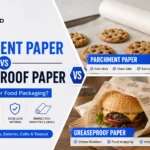
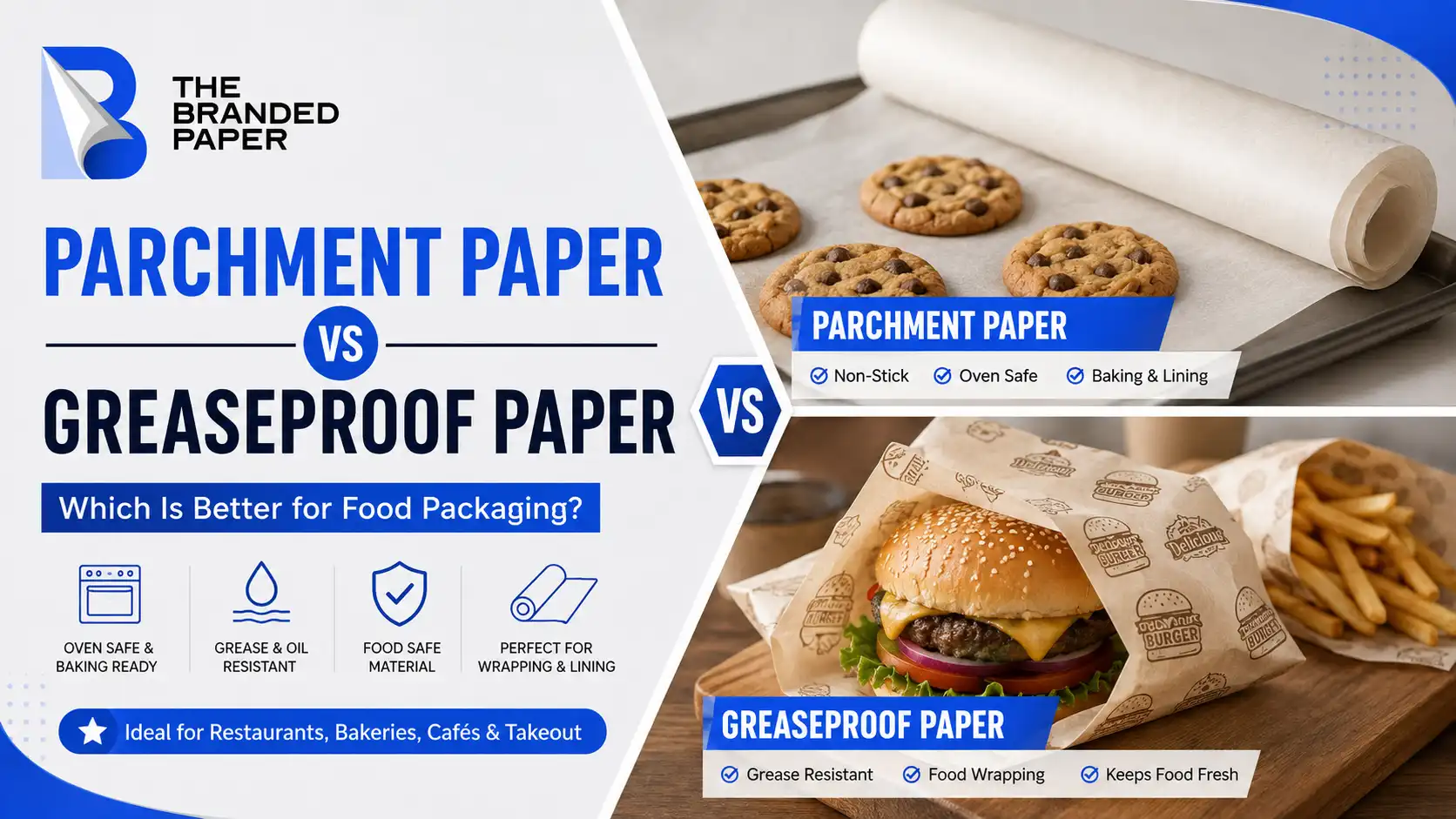
Parchment Paper vs Greaseproof Paper is a common question for restaurants, bakeries, cafés, food trucks, and food brands choosing paper for wrapping, lining, baking, and takeout. The two papers can look similar, but they are designed for different jobs.
Parchment paper is widely used for baking, tray lining, food preparation, and selected food-packaging applications. Greaseproof paper is designed mainly to resist oil and grease, making it useful for wraps, liners, sandwiches, burgers, pastries, and other foods that can leave oily marks. The better choice depends on the food, temperature, packaging method, and the paper specification.
Parchment Paper vs Greaseproof Paper: What Is the Difference?
Parchment paper is generally chosen for baking and heat-related food preparation, while greaseproof paper is mainly chosen for resistance to grease and oil. Both can be suitable for food contact, but their construction, coatings, and intended uses can differ.
Parchment paper is commonly made from paper that has been processed to create a smooth, release-friendly surface. Many commercial parchment products also use a silicone coating to improve non-stick performance.
Greaseproof paper focuses more on keeping oils and fats from passing through the sheet. It is often used for food wrapping, serving, bakery packaging, and liners.
| Feature | Parchment Paper | Greaseproof Paper |
| Main purpose | Baking, lining, food preparation | Wrapping and protecting against grease |
| Grease resistance | High on suitable products | High |
| Non-stick performance | Usually strong | Depends on construction |
| Oven use | Common on products rated for oven use | Not automatically oven safe |
| Food wrapping | Suitable for some applications | Common application |
| Baking | Common | Depends on product specification |
| Burger and sandwich wrapping | Possible for suitable grades | Common choice |
| Tray lining | Common | Possible for suitable products |
| Heat resistance | Product-specific but commonly designed for baking | Product-specific |
| Custom printing | Available on selected products | Available on selected products |
| Best fit | Baking, liners, preparation, selected packaging | Greasy foods, wraps, liners, food service |
The key point is simple: “greaseproof” describes resistance to grease, while “parchment” usually describes a particular paper type and performance profile. The name alone does not tell you every property.
Is Greaseproof Paper the Same as Parchment Paper?
No. Greaseproof paper and parchment paper are not automatically the same product. They can overlap in performance, but they are manufactured and specified for different applications.
A paper can be grease-resistant without being intended for high-temperature baking. At the same time, parchment paper can resist grease very well and may work as a food wrap or liner when the specific product is designed for that use.
This distinction matters for food businesses. A restaurant may need paper that keeps oil from soaking through a burger wrap. A bakery may need paper that releases baked goods cleanly from a tray. Those are different performance requirements, even though both involve food and grease.
Before ordering, look beyond the product name. Check:
- Intended food-contact use
- Temperature range
- Grease and oil resistance
- Coating or treatment
- Printing suitability
- Sheet or roll format
- Food type
- Supplier documentation
The FDA evaluates food-contact substances according to their intended use and conditions of use rather than treating every paper product as interchangeable.
Parchment Paper vs Greaseproof Paper for Baking
Parchment paper is usually the better choice for baking because it is commonly designed for oven use, food release, and lining baking surfaces. Greaseproof paper can work for certain baking-related applications, but it should not be placed in an oven unless the manufacturer specifically rates it for that use.
Parchment paper is popular for cookies, pastries, bread, roasted foods, and other baked products because the surface helps reduce sticking and makes cleanup easier.
For bakeries and commercial kitchens, the practical benefits include:
- Easier food release
- Cleaner baking trays
- Less sticking
- Faster cleanup
- Easier handling of baked goods
- Consistent preparation workflows
Greaseproof paper has a different strength. It helps manage oil and fat during serving and wrapping. That makes it useful for finished food rather than automatically making it suitable for baking.
For example, a bakery may use parchment paper to line a tray for cookies and then use greaseproof wrapping paper to package finished pastries for customers.
Can You Use Greaseproof Paper for Baking?
You can use greaseproof paper for baking only when the specific product is rated for the required oven conditions. “Greaseproof” describes grease resistance; it does not by itself guarantee oven safety.
This is one of the most common purchasing mistakes. A food business sees that a paper resists oil and assumes it can also handle oven temperatures. Those are separate properties.
Before putting greaseproof paper in an oven, confirm:
- The manufacturer’s stated temperature limit.
- Whether the paper is intended for direct oven use.
- Whether the coating or treatment is suitable for the temperature.
- Whether the intended food-contact conditions match the product specification.
The same rule applies to custom-printed paper. Printing does not make an otherwise unsuitable paper oven safe. The paper construction, coating, ink system, and intended use all need to be considered together.
Is Greaseproof Paper Oven Safe?
Greaseproof paper is not automatically oven safe. Some specialty grease-resistant papers may be designed for heat, while others are intended mainly for wrapping, serving, or packaging at lower temperatures.
This is why “oven-safe paper” and “greaseproof paper” should not be treated as synonyms.
For a restaurant or bakery, the safest approach is to match the paper to the actual workflow. If the paper will touch food inside an oven, ask the supplier for the product’s documented temperature range and intended application.
For prepared food packaging, the requirements can be different. A sandwich wrap may never enter an oven, so grease resistance and flexibility may matter more than high-temperature performance.
Is Parchment Paper Greaseproof?
Parchment paper can provide strong grease resistance, but parchment paper and greaseproof paper are still not interchangeable terms. The actual grease resistance depends on the paper construction and surface treatment.
Many parchment products are designed to prevent food from sticking while also handling oils and fats released during cooking. That makes parchment useful for buttery pastries, roasted foods, cookies, and other products with higher fat content.
For food packaging, however, the question should be more specific:
Does this particular parchment paper provide the grease resistance needed for my food and packaging method?
A dry bakery product, a butter-rich pastry, and a greasy burger can place very different demands on the paper.
What Is Greaseproof Paper Used For?
Greaseproof paper is commonly used for wrapping, lining, serving, and packaging foods that contain oil or fat. It is especially useful when a business wants to reduce grease seep-through and keep the outer packaging cleaner.
Common applications include:
- Burger and sandwich wraps
- Bakery and pastry packaging
- Food basket liners
- Tray liners
- Deli packaging
- Takeout presentation
- Fried-food wrapping
- Food-service counters
- Retail food packaging
For restaurants, the paper needs to do more than resist grease. It also needs to fold cleanly, fit the food, withstand normal handling, and work efficiently during busy service.
That is why greaseproof food wrapping paper can be a practical option for foods with sauces, oils, butter, or warm fillings.
The Branded Paper also offers Custom food wrapping paper for restaurants, cafés, delis, bakeries, food trucks, and other food businesses.
Parchment Paper for Wrapping Food: Does It Work?
Parchment paper can be used for food wrapping when the specific paper is suitable for that purpose. It can work well for bakery items, prepared foods, presentation, liners, and selected takeout applications.
Parchment can offer a cleaner, more premium feel, especially for products where appearance matters. It can also work well in preparation and serving workflows.
For example, a bakery may use parchment for:
- Cookies
- Cakes and desserts
- Pastries
- Bread
- Bakery box liners
- Serving sheets
- Counter presentation
Restaurants may also use parchment for tray liners, basket liners, food presentation, and suitable wrapping applications. The correct size and format matter just as much as the paper type.
See Custom Parchment Paper for Restaurants for practical considerations around sheet sizes, applications, and ordering.
Greaseproof Paper vs Parchment Paper for Food Packaging
For food packaging, greaseproof paper is often the more direct choice when the main concern is oil and grease resistance. Parchment paper can be a better fit when the business also needs baking, lining, food release, or a more specialized surface.
Consider the type of food first.
A burger restaurant may prioritize grease resistance and easy wrapping. A bakery may need both baking performance and attractive finished packaging. A café serving pastries and sandwiches may use different paper types across different parts of the operation.
The right decision often looks like this:
| Food or application | Usually the stronger starting point |
| Cookies baked on trays | Parchment paper |
| Pastry baking | Parchment paper |
| Baking tray lining | Parchment paper |
| Burger wrapping | Greaseproof food wrap |
| Sandwich wrapping | Greaseproof or suitable food wrapping paper |
| Fried foods | Grease-resistant food paper |
| Bakery box liner | Parchment or suitable grease-resistant paper |
| Takeout presentation | Parchment or food wrapping paper |
| High-oil foods | Greaseproof paper designed for the application |
| Oven preparation | Parchment rated for the required temperature |
These are starting points rather than universal rules. Food type, temperature, coating, and manufacturer specifications should always decide the final application.
Greaseproof Paper vs Baking Paper: Are They Different?
Greaseproof paper and baking paper can overlap, but they should not be assumed to have identical properties. In the United States, “parchment paper” is commonly used for baking products, while “greaseproof” usually describes a paper’s resistance to grease and oil.
The terminology can become confusing because suppliers in different markets use the words differently.
For buying decisions, focus less on the label and more on the specification:
- Is it rated for oven use?
- Is it non-stick?
- What temperature can it handle?
- Is it intended for direct food contact?
- How does it perform with oily foods?
- Is it designed for wrapping, lining, or baking?
That gives a more reliable answer than comparing names alone.
How to Choose the Right Paper for a Restaurant or Bakery
Choose food packaging paper based on the food, operating conditions, and packaging workflow—not simply on whether the product is called parchment or greaseproof.
Start with the food. A dry pastry has different needs from a greasy burger or a hot baked product.
Then consider the following:
1. Food type
Identify how much oil, grease, moisture, sauce, or butter the food contains. Greasy foods usually need stronger grease-resistant performance.
2. Temperature
Determine whether the paper will remain at room temperature, contact hot food, or enter an oven. Never assume oven suitability from grease resistance alone.
3. Packaging method
Think about whether the paper will be used for wrapping, basket lining, tray lining, serving, preparation, or baking.
4. Sheet size
Correct sizing makes daily work easier. A sheet that is too small can slow staff down, while oversized sheets can create unnecessary waste.
5. Format
Pre-cut sheets can be faster for repeatable restaurant service. Rolls offer more flexibility when different food sizes require different lengths.
6. Printing
For branded packaging, choose paper and inks that are suitable for the intended food-contact application. A good design still needs to perform well during actual service.
7. Storage
Bulk paper should be stored in a clean, dry area where sheets or rolls remain protected until use.
The Branded Paper’s Custom parchment paper options are designed around applications such as bakery preparation, liners, serving, presentation, and suitable food packaging.
Custom Parchment Paper vs Greaseproof Paper for Branding
Once the material is right, branding becomes much easier.
Custom printed packaging works best when the paper’s performance and the visual design are chosen together. A restaurant should not select a paper only because it prints well. It should also fit the food, packaging method, and daily workflow.
A branded parchment sheet can add identity to bakery boxes, dessert presentation, trays, and takeout orders. Greaseproof food wrapping paper can put the brand directly in front of customers on burgers, sandwiches, and other wrapped foods.
Useful branding options include:
- Repeating logo patterns
- Simple single-logo layouts
- Brand colors
- Custom graphics
- Seasonal artwork
- Coordinated packaging designs
The result can be a more consistent look across different customer touchpoints.
What About PFAS in Greaseproof Food Packaging?
PFAS should be part of the material conversation when selecting grease-resistant food packaging in the United States. The FDA states that PFAS-containing grease-proofing substances are no longer being sold by manufacturers for food-contact use on paper food packaging in the U.S. market, following the agency’s market phase-out actions.
For commercial buyers, that makes supplier documentation especially useful. Ask about the paper construction, coatings or treatments, printing components, intended food-contact use, and any applicable product documentation.
Avoid treating “greaseproof,” “food grade,” or “PFAS-free” as terms that explain every aspect of a product by themselves. The full specification matters.
Common Mistakes When Choosing Between Parchment and Greaseproof Paper
The biggest mistake is choosing paper based on the name alone.
Other common problems include:
- Assuming all greaseproof paper is oven safe
- Assuming all parchment paper works for every food-wrapping application
- Ignoring temperature requirements
- Choosing a sheet size without testing the actual food
- Using one paper for every product on the menu
- Overlooking coating and treatment information
- Ordering bulk quantities before testing the paper in normal service
A short real-world test can reveal problems that are difficult to see from a product description. Check folding, grease penetration, tearing, food release, handling, storage, and overall appearance before committing to a large order.
Which Is Better: Parchment Paper or Greaseproof Paper?
Neither paper is universally better. Parchment paper is usually the stronger choice for baking, non-stick preparation, and oven-related applications. In contrast, greaseproof paper is often the better starting point for wrapping and serving foods with significant oil or grease.
For food businesses, the decision is application-specific:
Choose parchment paper when baking, lining trays, food release, or heat performance is central to the job.
Choose greaseproof paper when grease resistance, food wrapping, and clean presentation are the main priorities.
Some businesses may use both. That can be more practical than forcing one material to handle completely different tasks.
Choosing the Right Paper for Food Packaging
Parchment paper and greaseproof paper solve related but different packaging problems. Parchment paper is strongly associated with baking, non-stick preparation, and heat-related applications. Greaseproof paper is strongly associated with protecting wraps, liners, and food packaging from oil and grease.
For restaurants, bakeries, cafés, and food brands, the best choice starts with the actual job: What food is touching the paper? Will it be heated? How greasy is the food? Is the paper being used for baking, wrapping, lining, or presentation?
Once those questions are clear, selecting the right paper becomes much easier. For businesses that also want a consistent branded presentation, the material can then be matched with the right sheet size, format, printing, and order volume.
Frequently Asked Questions
1. Is greaseproof paper better than parchment paper?
Not in every situation. Greaseproof paper is often better for wrapping greasy foods, while parchment paper is usually better for baking and non-stick preparation.
2. Can greaseproof paper replace parchment paper?
Only for applications where its specifications match the job. Greaseproof paper should not replace oven-rated parchment paper unless the manufacturer confirms that it is suitable for the required temperature and use.
3. Can parchment paper be used to wrap burgers?
It can be suitable for burger wrapping when the specific parchment product is designed for food packaging and provides the needed grease resistance. For very greasy foods, a dedicated greaseproof food wrap may be a better fit.
4. Is parchment paper completely greaseproof?
Parchment can have strong grease resistance, but performance varies by product construction. Check the supplier’s specification for the intended food application.
5. Is greaseproof paper safe for hot food?
A food-contact paper may be suitable for hot food when its construction is designed and documented for that use. Check temperature limits and intended conditions before purchase.
6. What paper is best for greasy foods?
A properly specified grease-resistant food packaging paper is usually the best starting point for greasy foods. The required level of oil resistance depends on the food, contact time, temperature, and packaging method.
7. Is baking paper the same as parchment paper?
In many U.S. baking contexts, “baking paper” and “parchment paper” may refer to similar products. However, terminology varies, so the product specification is more reliable than the name alone.