
A food wrapper can cause problems when it is too small, too weak for the job, or poorly matched to the food. Grease can transfer through the paper, sauces can make wrapping messy, and oversized sheets can create unnecessary waste. For restaurants, bakeries, cafés, delis, food trucks, and other food businesses, choosing the right packaging paper means balancing food protection, ease of use, sheet size, and presentation.
Custom wax paper sheets are designed to serve that practical role while also giving businesses a way to add a logo, pattern, or brand design to everyday food packaging. The right sheet can be used for wrapping sandwiches and burgers, lining baskets and trays, separating food items, and presenting bakery or deli products.
The important part is choosing the format and specifications around the way your business actually uses the paper.
What Are Custom Wax Paper Sheets Used For?
Custom wax paper sheets are wax-coated food packaging sheets that can be printed with a business logo or design. They are commonly used for wrapping, lining, and serving food where a grease- and moisture-resistant paper layer is useful.
Common applications include:
- Sandwich and burger wrapping
- Basket and tray liners
- Bakery and pastry packaging
- Deli food wrapping
- Grab-and-go meals
- Takeout presentation
- Food boxes and packaging inserts
- Retail food presentation
The Branded Paper offers custom wax paper in sheets or rolls, with food-grade bleached or natural base paper, single- or double-sided wax coating, a listed 30–60 GSM range, and standard sizes including 10″ × 10″, 12″ × 12″, and 15″ × 15″. Custom sizes are also available upon request, along with 1–4 color CMYK printing.
For more background on selecting food wrapping materials, see our guide to Food-safe wrapping paper for restaurants.
Where Can You Use Wax Paper Sheets for Food?
The best application depends on the food, the way it is served, and how the paper needs to perform during preparation and handling.
Wax Paper for Sandwiches
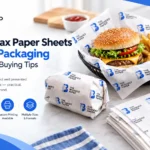
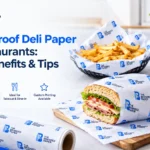
Sandwich shops and cafés can use wax paper sheets as wraps, liners, or layers between food and packaging. A sheet needs enough surface area to cover the sandwich and allow the intended folding method without forcing the food into an awkward package.
Printed wax paper also gives the outside of the wrap a more consistent branded appearance.
For more ideas about sandwich packaging, see What Paper Is Best for Wrapping Sandwiches?.
Wax Paper for Burgers
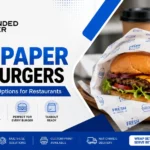
Burger businesses commonly use wax paper to wrap burgers or line baskets and trays. The paper can create a cleaner layer between food and the serving surface while helping reduce direct grease transfer.
The sheet size should match the burger size and wrapping style rather than being chosen by the product name alone.
You can also compare this application with the examples in our Custom burger wrapping paper guide.
Wax Paper Basket Liners
Wax paper basket liners can cover the base of a serving basket while adding a branded layer underneath the food. This is particularly useful for burgers, sandwiches, fries, snacks, and similar food-service applications.
For basket liners, consider both the size of the basket and how much of the liner you want visible. A sheet that is too small may fail to cover the surface; one that is much larger may fold or extend beyond the intended presentation.
Wax Paper for Bakery Packaging
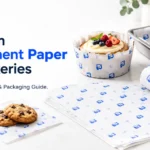
Wax paper sheets can also be useful for wrapping or lining bakery products such as cookies, pastries, and other ready-to-serve items. The right application depends on the food and the packaging environment.
One important distinction: wax paper should not automatically be treated as oven baking paper. Wax-coated paper is different from parchment paper, and direct oven exposure is not appropriate for ordinary wax paper. Reynolds, for example, advises against directly exposing its consumer wax paper to oven heat.
For bakery businesses that need paper specifically for baking, compare the requirements with Custom parchment paper for bakeries.
How to Choose the Right Wax Paper Sheet Size
Sheet size is one of the most practical decisions when ordering custom food packaging paper.
A useful starting point is to look at the actual dimensions of the food and the wrapping or lining method.
Common size considerations
| Application | What to Consider |
| Small bakery items | Enough surface area to wrap or separate the product |
| Cookies and pastries | Compact size with minimal excess paper |
| Sandwiches | Enough paper for the sandwich plus the desired fold |
| Burgers | Enough area for a secure wrap or basket lining |
| Food baskets | Coverage of the basket base and desired paper overhang |
| Trays and boxes | Surface coverage without excessive material |
| Multiple menu items | Whether one standard size can serve several products |
The Branded Paper currently lists 10″ × 10″, 12″ × 12″, and 15″ × 15″ as standard sizes and allows custom sizes upon request.
Is 12 × 12 wax paper a good choice?
A 12″ × 12″ sheet can be a useful starting point for many general food-wrapping and lining applications, but it should not be treated as a universal size.
Before choosing 12 × 12 sheets, test the actual food and folding method. Check whether you have enough paper to wrap the item cleanly without leaving large unused sections.
If one menu item needs much more coverage while another needs much less, ordering more than one sheet size may make more sense.
Wax Paper Sheets vs. Rolls: Which Format Fits Your Business?
Both sheets and rolls can work well, but the better format depends on how your staff prepares and serves food.
Choose pre-cut wax paper sheets when:
- Staff need ready-to-use pieces
- Consistent sheet dimensions are important
- You use several stations during service
- You want simple basket or tray liners
- You want to reduce the need for staff to measure and cut paper
Consider rolls when:
- Your operation uses continuous paper
- Staff cut paper to different lengths
- You need variable wrap sizes
- The packaging workflow is built around a roll dispenser
Pre-cut wax paper sheets are often easier to standardize, while rolls offer more flexibility in how much material is dispensed.
For high-volume operations, it is worth comparing the entire workflow—not only the price of the paper. Consider storage, handling, cutting, speed of service, and material waste.
The Branded Paper offers both sheet and roll formats, so the appropriate choice can be based on the actual packaging application.
What Is Dry Wax Paper?
Dry wax paper is a type of wax-coated paper used in food packaging. The exact construction and performance can vary by product, so businesses should look at the supplier’s specifications instead of assuming that every wax-coated paper behaves the same way.
Suppliers may offer different wax constructions, paper weights, and coating configurations for applications ranging from bakery packaging to sandwiches and food-service liners. Current commercial packaging offerings show distinctions between dry wax, wet wax, flat sheets, interfolded sheets, and rolls.
The practical question is not simply “Is it dry wax?” but:
Does the paper’s construction match the food, moisture level, grease exposure, and handling conditions in your operation?
What Does GSM Mean in Wax Paper?
GSM means grams per square meter and is used to describe the weight of paper.
For buyers, GSM is useful because paper weight is one part of the overall packaging specification. However, it should not be used alone to decide whether a sheet is right for a particular food.
Other factors include:
- Base paper
- Wax coating
- Single- or double-sided coating
- Sheet size
- Food type
- Grease and moisture exposure
- Wrapping method
- Intended handling conditions
The Branded Paper lists its custom wax paper in a 30–60 GSM range.
When comparing suppliers, ask for the complete specification rather than comparing GSM by itself.
How Grease and Moisture Resistance Matter
Food packaging often has to deal with oil, sauces, condensation, or food moisture.
Wax-coated paper can provide resistance that helps make wrapping and serving cleaner. The Branded Paper describes its custom wax paper as grease- and moisture-resistant and positions it for applications such as sandwiches, burgers, bakery products, deli items, trays, baskets, and boxes.
However, grease resistance does not mean that every wax paper is suitable for every wet or oily food under every condition.
A better buying process is to consider:
- How oily is the food?
- Does it contain sauces or liquids?
- How long will it remain wrapped?
- Will the paper be used as a liner or a full wrap?
- Does the food release moisture while hot?
- Does the supplier provide application-specific information?
For a broader comparison of food wrapping choices, see The best paper for greasy food.
Custom Wax Paper Printing: Turning Packaging Into Branding
One of the biggest differences between standard and custom wax paper is the ability to print the packaging with your brand.
A custom sheet can feature:
- Company logo
- Repeating logo pattern
- Brand colors
- Simple graphic elements
- Tagline or other approved artwork
The Branded Paper offers 1–4 color CMYK printing and accepts uploaded logo artwork for custom orders.
How should you design a printed wax paper sheet?
Keep the packaging readable and useful rather than filling every part of the sheet with artwork.
Consider:
Logo size: Large enough to be recognizable without overwhelming the food presentation.
Repeat pattern: Useful when the paper may be folded in different directions.
Spacing: Leave enough room around the logo so the design does not look crowded.
Print coverage: Think about where the artwork will appear after the sheet is folded or placed inside a basket.
Color selection: Use brand colors that remain recognizable against the chosen paper.
Before approving a production run, review the artwork proof and make sure the logo, colors, proportions, and repeat pattern match your expectations.
For more design guidance, see our Custom printed food paper design guide.
What About Food-Safe Printing Ink?
Printing is part of the food-packaging specification, so it should not be treated as a purely visual decision.
The FDA explains that substances used in food-contact packaging can include components applied to packaging surfaces, including certain colorants, and that food-contact substances are subject to specific regulatory requirements and intended-use conditions.
For that reason, businesses ordering custom printed wax paper sheets should ask suppliers about the paper, coating, inks, and intended food-contact application rather than relying only on the phrase “food-safe.”
The Branded Paper states that its custom wax paper uses food-safe, eco-friendly inks.
For a commercial order, documentation and suitability should always be confirmed for the intended use.
Flat, Pre-Cut, or Interfolded Wax Paper Sheets?
There is more than one way to supply wax paper in sheet form.
Flat sheets
These are individual sheets stacked together. They work well when staff can quickly pick up one sheet at a time.
Pre-cut sheets
Pre-cut sheets provide a consistent finished dimension and remove the need to measure or cut paper during service.
Interfolded sheets
Interfolded sheets are designed to dispense one sheet at a time from a stack or dispenser-style package. This can be useful when speed and controlled dispensing matter.
Commercial packaging suppliers currently offer flat-packed and interfolded custom wax paper formats in addition to rolls.
The right option depends on how your team works. A restaurant with high-volume counter service may have different requirements from a bakery wrapping a smaller number of products throughout the day.
What Should You Check Before Ordering Custom Wax Paper Sheets?
A good order starts with the application, not the printing.
Use this checklist before requesting a quote:
1. Identify the food
Tell the supplier what you plan to wrap or line. A sandwich, pastry, burger, deli item, and basket of fries can place different demands on the packaging.
2. Measure the packaging area
Measure the food, basket, tray, or box where the paper will be used.
3. Choose a sheet format
Decide whether flat sheets, pre-cut sheets, interfolded sheets, or rolls fit your workflow.
4. Select the paper specification
Discuss the available base paper, coating, GSM, and whether single- or double-sided coating is appropriate.
5. Decide how you want to print
Choose between a simple logo layout and a broader repeating pattern based on the way the sheet will be used.
6. Prepare your artwork
Use the supplier’s preferred file format and request a proof before production.
7. Consider quantity
Estimate typical daily or weekly consumption before ordering. A larger order may make operational sense for a business that uses the same packaging regularly, but quantity should be based on actual usage rather than buying more simply because it is available in bulk.
For more information about pricing considerations, see Custom Wax Paper Cost for Restaurants.
Common Mistakes to Avoid
Choosing the sheet before measuring the food
A standard size may sound convenient, but the correct size depends on the actual product and packaging method.
Treating wax paper like parchment paper
Wax paper and parchment paper serve different roles. Wax paper should not be assumed to be suitable for direct oven use.
Choosing paper only by GSM
GSM is useful, but coating, food type, size, and handling conditions matter too.
Using too much artwork
A dense print can make packaging harder to read and may not work well after folding.
Ordering without testing the application
A sample or proof can reveal problems with size, folding, print placement, or handling before a larger production run.
Assuming every “food-safe” claim means the same thing
Ask what the claim covers and whether the material and printing system are suitable for your intended food-contact application. FDA guidance makes clear that food-contact substances are evaluated and regulated according to their intended uses.
How The Branded Paper’s Custom Wax Paper Fits Food Businesses
The Branded Paper offers custom wax paper for restaurants, bakeries, cafés, food trucks, delis, and other food businesses across the United States.
Its listed product specifications include food-grade bleached or natural base paper, single- or double-sided wax coating, a 30–60 GSM range, 10″ × 10″, 12″ × 12″, and 15″ × 15″ standard sizes, custom sizing upon request, 1–4 color CMYK printing, food-safe eco-friendly inks, and sheet or roll formats.
That makes the product suitable for businesses that need to balance food packaging function with custom branding.
You can View the Custom Wax Paper product to review the available options and request a quote.
What to Consider Before Ordering Custom Wax Paper
The right custom wax paper sheet is not simply the one with the biggest size range or the most printing options. It is the one that fits your food, wrapping method, service workflow, branding needs, and packaging requirements.
Start with the application. Measure the food or serving area, choose the sheet format, review the paper and coating specifications, then finalize the artwork and print details. Testing the actual packaging setup before a larger order can also help you catch problems before they become a recurring operational issue.
For restaurants, bakeries, cafés, food trucks, and food brands that want packaging to serve both a practical and branding purpose, Custom Wax Paper Sheets from The Branded Paper can be considered as part of that packaging decision.
Frequently Asked Questions
1. Are custom wax paper sheets safe for food packaging?
Food-contact suitability depends on the specific paper, coating, inks, and intended conditions of use. The FDA regulates food-contact substances and components used with food packaging, so businesses should confirm the supplier’s documentation and suitability for their intended application.
The Branded Paper lists its custom wax paper as food-safe and states that it uses food-safe, eco-friendly inks.
2. What size wax paper sheet should I use for burgers and sandwiches?
There is no single size that works for every burger or sandwich. The right dimensions depend on the food size and how you wrap or line it. Measure the finished food and allow enough paper for the intended folds or coverage. The Branded Paper lists 10″ × 10″, 12″ × 12″, and 15″ × 15″ among its standard sizes.
3. Can I get custom wax paper sheets with my logo?
Yes. Custom wax paper can be printed with a business logo, repeating pattern, or other approved artwork. The Branded Paper offers 1–4 color CMYK printing and accepts logo artwork for custom orders.
4. Are wax paper sheets the same as parchment paper?
No. Wax paper has a wax coating, while parchment paper is a different type of non-stick paper designed for different applications. Wax paper should not be assumed to be suitable for direct oven exposure.
5. Should a restaurant choose wax paper sheets or rolls?
Pre-cut sheets can be useful for standardized wrapping and lining, while rolls can provide flexibility when staff needs different lengths. The better choice depends on the restaurant’s preparation process, storage, dispensing, and volume.
6. What does GSM mean on wax paper?
GSM means grams per square meter and describes the weight of the paper. It is one specification to compare, but it should be considered together with the coating, food application, sheet size, and handling requirements.
7. Can custom wax paper be made in a custom size?
The Branded Paper states that custom sizes are available upon request.
8. What should I ask a supplier before ordering?
Ask about the paper and coating construction, available sheet sizes, GSM, print options, food-contact suitability, artwork requirements, proofing process, format options, and quantity requirements. Most importantly, explain what food you are packaging so the supplier can evaluate the application appropriately.