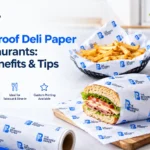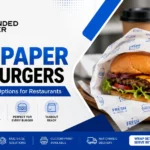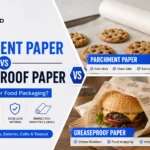
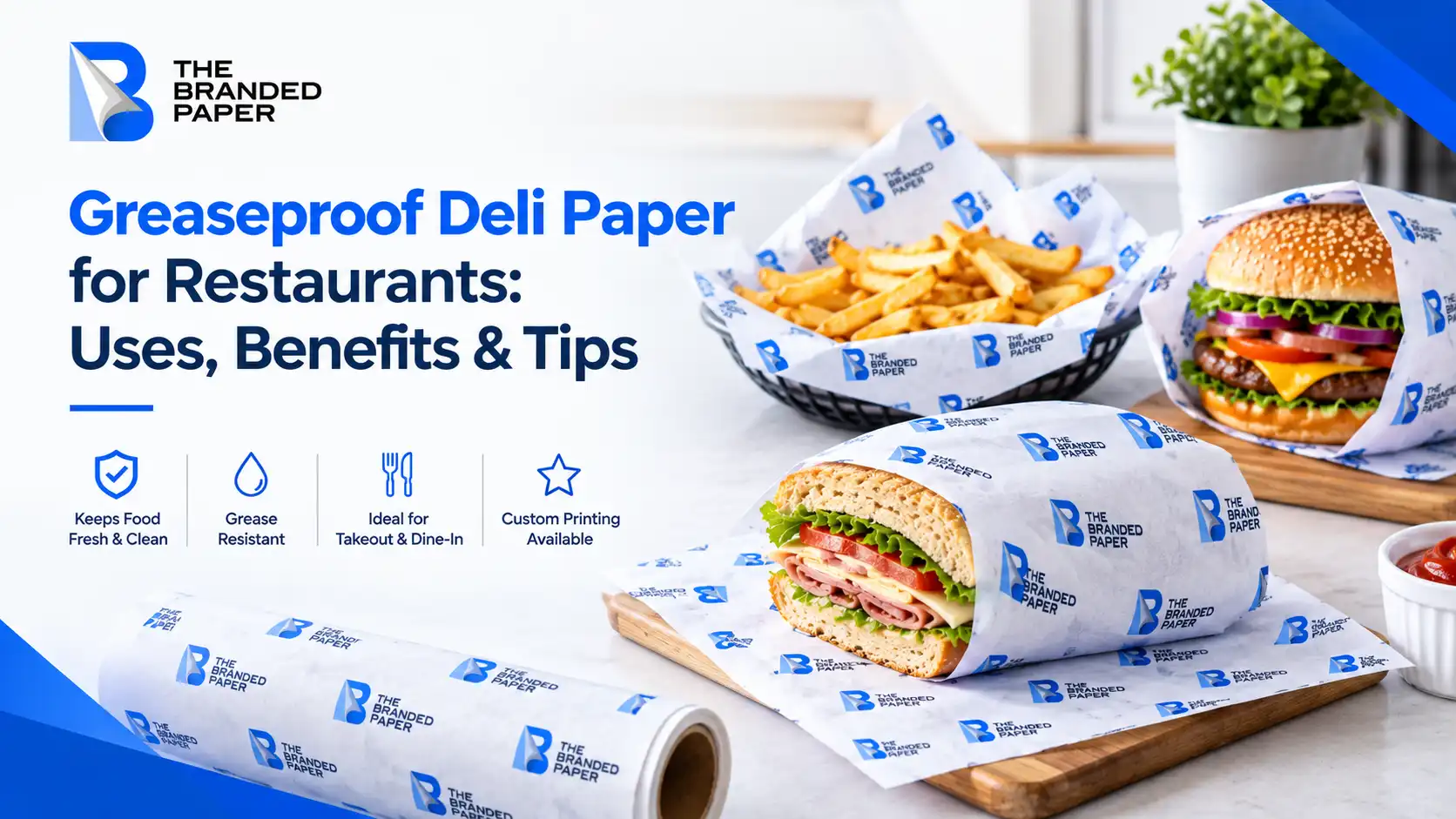
Restaurants do not need paper that simply looks clean on the serving line—they need packaging that works with the food being served. Greaseproof deli paper can help restaurants wrap sandwiches, line baskets and trays, handle oily foods, and improve food presentation, but the right choice depends on the food, portion size, format, and intended use.
The term “greaseproof deli paper” combines two ideas. Deli paper generally refers to the type of foodservice paper used for wrapping and lining, while greaseproof describes the paper’s ability to resist grease and oil. That makes it a practical option for many restaurant applications where ordinary paper can become saturated quickly.
For restaurants evaluating food packaging, the important questions are straightforward: What is deli paper used for? Is it suitable for direct food contact? Which size should you choose? Are sheets or rolls better? And what should you check before ordering custom printed paper?
What Is Greaseproof Deli Paper?
Greaseproof deli paper is foodservice paper designed for uses where food can transfer oil or grease to the packaging. Restaurants commonly use this type of paper as a wrapper, liner, or presentation layer for foods such as sandwiches, burgers, fried foods, bakery items, and deli-style meals.
The important point is that not all paper performs the same way. Paper intended for direct food contact should be selected for its specific intended use, including the type of food and conditions of contact.
The FDA treats food packaging and substances applied to packaging surfaces as food contact substances and regulates relevant materials and components according to their intended use. FDA regulations include provisions covering components of paper and paperboard used with aqueous and fatty foods, as well as dry foods.
For restaurant buyers, that means the label “greaseproof” alone should not be the only deciding factor. The paper should be appropriate for the intended food-contact application.
Greaseproof Paper vs. Deli Paper: Are They the Same?
These terms are closely related, but they are not necessarily identical.
Deli paper describes a foodservice paper commonly used for wrapping, lining, serving, or separating food.
Greaseproof paper describes a performance characteristic: resistance to grease and oil.
A product can therefore be both deli paper and greaseproof paper.
This distinction is useful when comparing packaging options. A restaurant might be looking for deli paper because of how it will be used, while grease resistance is one of the performance requirements that determines whether the paper is suitable for that job.
A simple way to think about it is:
| Term | What it tells you |
| Deli paper | How the paper is commonly used in foodservice |
| Greaseproof paper | A resistance characteristic of the paper |
| Greaseproof deli paper | Deli-style foodservice paper with grease-resistant performance |
The exact construction, treatment, and performance can vary by product, so restaurants should always review the supplier’s specifications and intended-use information.
What Is Deli Paper Used For?
One of the main advantages of greaseproof deli paper is flexibility. A single paper format can serve several functions in a restaurant, which can simplify packaging operations.
1. Wrapping sandwiches
Deli paper is commonly used to wrap sandwiches for dine-in service, takeaway, and delivery. It can help contain crumbs, sauces, and surface grease while keeping the food presentation neat.
For sandwiches with heavier fillings or sauces, the paper’s grease resistance becomes especially important.
2. Wrapping burgers
Burgers produce a combination of heat, oil, moisture, and sauces that can challenge ordinary paper.
A suitable grease-resistant sheet can be used as a burger wrap, partial wrap, or presentation layer. The best format depends on the burger size and the way the restaurant serves it.
3. Lining food baskets
Deli paper basket liners can separate food from the serving basket and provide a clean presentation surface.
This is especially useful in casual restaurants, burger shops, diners, cafés, and food trucks where baskets are part of the serving experience.
4. Lining trays
Deli paper tray liners provide a simple way to improve presentation while creating a paper layer between the food and the tray.
This can be useful for sandwiches, fries, fried foods, appetizers, and combination meals.
5. Wrapping fried food
Fried foods release oil as they sit, making grease resistance particularly important. Deli paper can be considered for fried chicken, fries, fried sandwiches, onion rings, and similar menu items, provided the particular paper is intended for the food and conditions involved.
6. Takeout and food delivery
Restaurants can use deli paper for takeaway presentation and as part of a larger food packaging setup.
However, packaging decisions should consider hold time, food temperature, moisture, sauce content, and transport conditions. Paper that works well for a short serving period may not perform the same way after a longer delivery period.
Why Restaurants Use Greaseproof Deli Paper
The value of greaseproof deli paper is not simply that it resists oil. Its usefulness comes from several restaurant-level benefits working together.
Better handling of greasy foods
Grease-resistant food paper is designed to slow the transfer of grease and oil through the paper. That can help reduce messy handling and maintain a cleaner presentation.
The FDA describes grease-proofing agents as substances used on paper and paperboard packaging to prevent leaking of grease, oil, or water.
Cleaner food presentation
A clean sheet can make a meal look more organized, especially when the paper is used as a basket liner or visible wrapping layer.
More flexible foodservice applications
A paper format that can wrap, line, and present food can be useful across different service styles.
Branding opportunity
For businesses that want packaging to do more than protect food, custom printed deli paper can turn an otherwise plain wrapping surface into a branded customer touchpoint.
The Branded Paper offers custom deli paper for branded food presentation and packaging, allowing businesses to incorporate their logo or design into their packaging.
How to Choose Deli Paper for Restaurants
The right paper depends more on the restaurant’s actual workflow than on the word “greaseproof” printed on a product description.
Use these criteria before placing an order.
1. Start with the food
Consider what you are wrapping or lining.
A dry pastry has very different packaging needs from a hot burger covered in sauce. Fried foods, oily proteins, sandwiches, bakery items, and cold deli products can all behave differently.
Ask:
- Is the food greasy or oily?
- Is there a lot of sauce?
- Is it hot, warm, or cold?
- Will condensation form?
- How long will the food remain wrapped?
2. Consider the application
Decide whether the paper will be used as:
- A full wrapper
- A partial wrapper
- A basket liner
- A tray liner
- A separator
- A presentation sheet
- A takeout packaging layer
The application affects the size and format you need.
3. Choose the right size
The correct deli paper size should give employees enough paper to perform the intended task without creating unnecessary waste.
For example, a sheet used as a basket liner may need different dimensions from a sheet used to fully wrap a large sandwich.
A practical approach is to measure the largest food item and then test the wrapping method your staff actually use.
4. Think about sheets vs. rolls
Both formats have a place in foodservice.
| Deli paper sheets | Deli paper rolls |
| Ready to use | Cut to length as needed |
| Easy to stack at prep stations | Flexible for different food sizes |
| Consistent dimensions | Useful for variable wrapping needs |
| Convenient for basket and tray lining | Can work well where custom lengths are useful |
For a high-volume operation using one or two standard applications, deli paper sheets may be simpler.
For operations that need different lengths or wrapping styles, rolls can offer more flexibility.
5. Verify food-contact suitability
Do not assume that any printed or grease-resistant paper is automatically appropriate for direct food contact.
Ask the supplier about the paper’s intended food-contact use and any relevant technical documentation.
The FDA’s food-contact framework covers packaging and components according to their intended use, including paper and paperboard applications involving fatty, aqueous, and dry foods.
6. Consider printing separately from performance
A visually attractive paper is not automatically the best paper for your food.
First determine the functional requirements. Then decide whether printing, branding, colors, or other visual elements should be added.
For restaurants, the strongest choice is usually the paper that performs well and fits the brand—not the other way around.
Is Deli Paper Food Safe?
It can be, but “deli paper” is not by itself a guarantee of food-contact safety.
Food-contact suitability depends on the specific paper and any materials associated with it, including coatings, additives, adhesives, and printing components where applicable.
The FDA explains that substances used in food packaging can be subject to food-contact requirements and that paper and paperboard components have specific regulatory provisions depending on the type of food contact.
Restaurants should therefore verify:
- Whether the paper is intended for direct food contact.
- What types of food it is designed to contact.
- Whether the intended temperature and contact conditions are supported.
- Whether the printing system is suitable for the intended application.
- Whether the supplier can provide relevant compliance or technical documentation.
What about PFAS and greaseproof paper?
This is an important consideration in U.S. food packaging.
The FDA announced in February 2024 that PFAS-containing grease-proofing substances were no longer being sold by manufacturers for food-contact use in the U.S. market. The agency later stated that 35 related food-contact notifications had been determined no longer effective after manufacturers ceased production, supply, or use of those substances for the intended use.
That does not mean every product described as greaseproof is interchangeable. Restaurants should still ask suppliers what materials are used and request documentation relevant to the specific product.
Deli Paper Sizes: What Size Do Restaurants Need?
There is no single best deli paper size for every restaurant.
The correct size depends on how the paper will be used and the food it needs to cover.
A useful decision process is:
For basket or tray lining:
Choose a sheet large enough to cover the serving surface without excessive overhang.
For sandwiches:
Choose enough paper to wrap or fold around the sandwich securely.
For burgers:
Consider the burger diameter, height, toppings, and whether you want a full wrap or a partial wrap.
For takeaway:
Consider the food container, folding method, and how the paper interacts with other packaging.
Before ordering in bulk, test a few sizes on the actual food and serving equipment. A small amount of testing can prevent a much larger quantity from being ordered in a size that does not fit your workflow.
Deli Paper for Hot Food: What Should Restaurants Consider?
Hot food deserves extra attention because heat, grease, moisture, and time interact.
A paper that works well for a quick dine-in presentation may behave differently during a longer takeaway or delivery period.
Instead of asking only, “Can this paper handle hot food?” consider the complete use case:
Food temperature → grease level → moisture → contact time → wrapping method → secondary packaging
For example, a dry hot sandwich may create a different challenge from a heavily sauced fried chicken sandwich held in a closed container for 30 minutes.
Restaurants should follow the supplier’s stated temperature and use limitations rather than assuming that all greaseproof paper performs identically.
Greaseproof Paper for Takeout Food
Takeout packaging creates a different set of requirements because the food may remain enclosed after leaving the restaurant.
The paper may encounter:
- Heat
- Steam
- Condensation
- Oil
- Sauces
- Longer holding times
- Movement during transportation
This is why greaseproof paper for takeout food should be evaluated with the complete packaging system in mind.
A useful test is to package the actual menu item the way a customer receives it. Check the paper after the restaurant’s typical holding and transport period.
Look for:
- Grease breakthrough
- Excess moisture
- Tearing
- Food sticking
- Loss of presentation quality
- Paper becoming difficult to handle
Real-world testing is more useful than choosing a paper based on a generic description alone.
Greaseproof Paper for Fried Food
Fried foods are one of the clearest use cases for grease-resistant paper because oil can migrate quickly from the food into the packaging.
For these applications, consider both grease resistance and moisture management.
Foods such as:
- Fried chicken
- French fries
- Onion rings
- Fried sandwiches
- Chicken tenders
- Fried appetizers
can release different levels of oil and moisture.
A suitable sheet may work well as a basket liner or serving layer, but restaurants should still test the actual menu item and service time.
The goal is not simply to stop every trace of grease. The goal is to use paper that is appropriate for the food and maintains acceptable handling and presentation throughout the expected service period.
What Makes Greaseproof Deli Paper a Good Restaurant Choice?
For many restaurants, the strongest benefit is flexibility.
One paper product can potentially support multiple parts of the foodservice workflow:
Prep → wrap → serve → line → present → take out
That flexibility can be especially useful for restaurants with menus built around sandwiches, burgers, fried foods, deli items, and casual food presentation.
But flexibility should not replace proper application testing. A paper that works well for one menu item may not be the right choice for another.
Custom Printed Deli Paper for Restaurant Branding
Once the functional requirements are established, restaurants can consider custom printed deli paper.
Instead of using plain paper, a restaurant can incorporate:
- Logo
- Brand pattern
- Business name
- Visual identity
- Promotional messaging
- Simple decorative elements
This can make the packaging part of the customer experience without requiring a separate piece of branded packaging for every order.
For a restaurant, deli, food truck, café, or food brand, the most useful approach is to treat printing as an extension of the existing packaging workflow. The paper still needs to perform its primary job; the branding adds value on top of that.
Explore Custom Deli Paper from The Branded Paper
Common Mistakes When Choosing Restaurant Deli Paper
Choosing based only on price
The least expensive paper may not be the best value if it creates messy wraps, poor presentation, or higher waste.
Choosing the wrong size
Oversized sheets can create unnecessary waste, while undersized sheets may fail to wrap or line the food properly.
Ignoring hold time
A paper can perform well for immediate service but struggle after sitting with hot, oily food.
Assuming “greaseproof” means universally food safe
Food-contact suitability is product-specific. Verify the intended application and supplier documentation.
Ordering custom printing before testing the paper
Test the paper with your actual food first. Branding should come after you know the paper works for your operation.
A Simple Restaurant Deli Paper Selection Checklist
Before ordering, confirm:
| Question | What to check |
| What food will touch the paper? | Sandwiches, burgers, fried food, bakery items, etc. |
| Is the food greasy or oily? | Select appropriate grease resistance |
| Is the food hot? | Check the manufacturer’s intended temperature/use |
| How long will it stay wrapped? | Test the real holding period |
| Will you wrap or line? | Choose the appropriate format |
| What size do you need? | Measure the food and serving equipment |
| Sheets or rolls? | Match the format to staff workflow |
| Direct food contact? | Verify intended food-contact suitability |
| Custom printing? | Confirm the paper and printing system are appropriate |
| Takeout or delivery? | Test the complete packaging setup |
How to Choose the Right Greaseproof Deli Paper
Greaseproof deli paper can be a practical option for restaurants that need paper for wrapping, lining, serving, and takeout presentation. The best choice is not simply the paper with the strongest marketing claim. It is the paper that matches the restaurant’s food, temperature, grease level, holding time, size requirements, and service workflow.
For restaurants considering branded packaging, custom printed deli paper adds another layer of value by turning a functional foodservice material into part of the brand presentation.
The Branded Paper provides custom deli paper for businesses looking to combine food packaging with branded presentation. Before choosing a product, define your food application, test the paper in real service conditions, and verify the supplier’s intended-use information.
Frequently Asked Questions
1. Is greaseproof deli paper the same as parchment paper?
No. They can overlap in some foodservice applications, but they are different paper types with different characteristics and intended uses. The right option depends on the food, temperature, moisture, and packaging application.
For a deeper comparison, see Parchment Paper vs. Greaseproof Paper.
2. Can deli paper be used for greasy food?
Suitable grease-resistant deli paper can be used for many greasy or oily food applications, but performance depends on the specific paper and use conditions. Test the product with the actual food, temperature, and holding time involved.
3. Are deli paper sheets better than rolls?
Neither format is universally better. Sheets are convenient for standardized applications such as basket and tray lining, while rolls can provide more flexibility where different lengths are needed.
4. Can restaurants print their logo on deli paper?
Yes, custom printed deli paper is available as a branded packaging option. The printing approach and suitable paper should be confirmed with the supplier for the intended food-contact application.