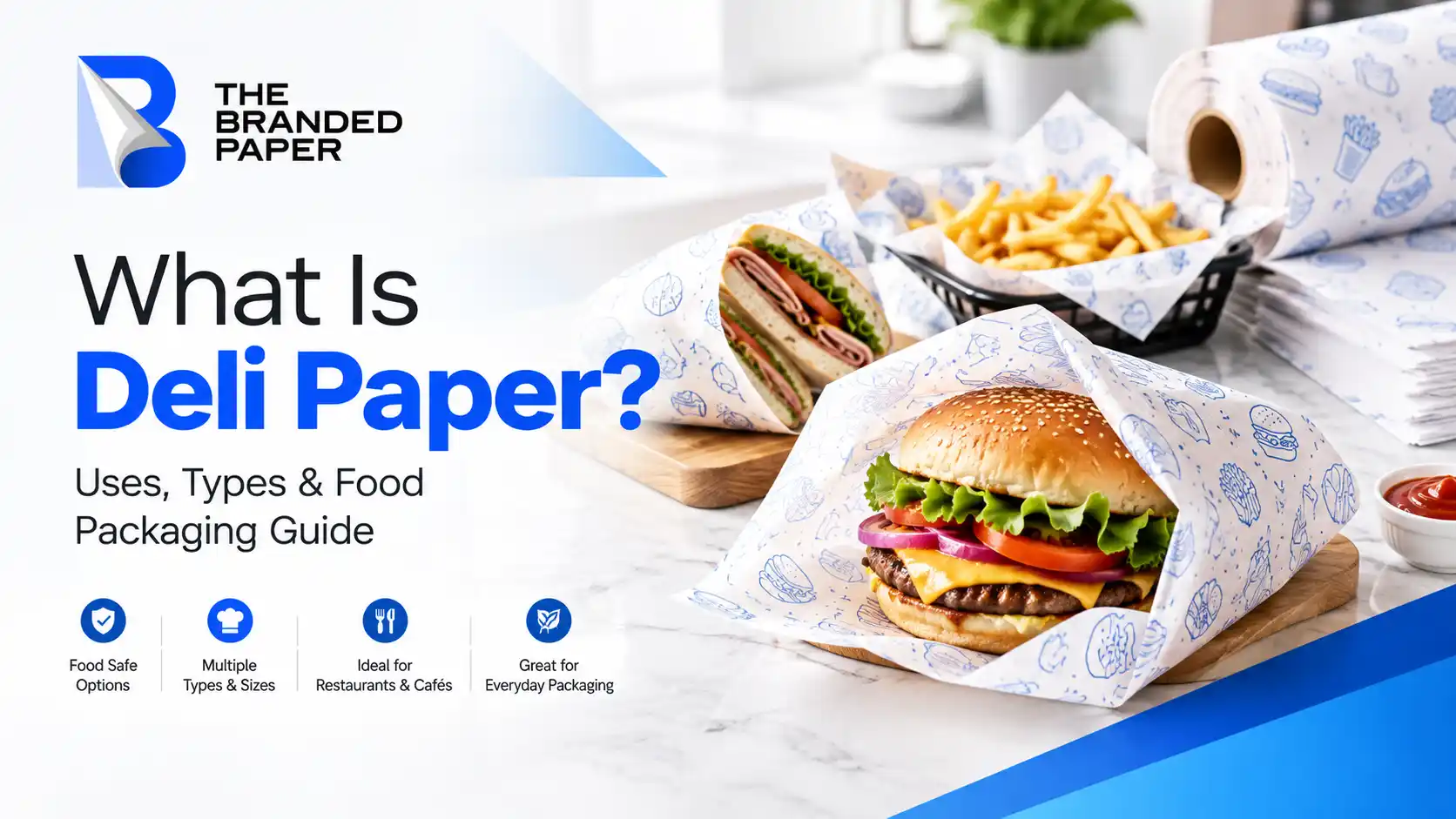
When restaurants, delis, cafés, bakeries, and food trucks need a simple way to wrap, line, separate, or present food, deli paper is one of the most versatile paper packaging options available.
But deli paper isn’t a single material with one fixed specification. Depending on the product, it may be plain or treated for greater grease and moisture resistance, and it can come as pre-cut sheets or other formats. The right choice depends on what you are wrapping, how greasy or moist the food is, how long it will stay wrapped, and how your team uses the paper during service.
For food businesses, understanding those differences can help prevent common problems such as leaking grease, undersized sheets, difficult wrapping, or choosing a paper that is not intended for the way it will be used.
What Is Deli Paper?
Deli paper is lightweight food-service paper used to wrap, line, separate, and present food. It is commonly found in restaurants, delis, sandwich shops, cafés, bakeries, food trucks, and other food-service settings.
Typical uses include:
- Wrapping sandwiches, burgers, and other handheld foods
- Lining food baskets and trays
- Separating sliced meats and cheeses
- Handling bakery items at the counter
- Creating a clean presentation layer for takeout food
- Supporting branded food presentation when custom printed
The term describes a food-service use and paper format, rather than one universal coating or construction. Some deli papers are designed primarily for presentation and handling, while others have treatments intended to improve grease or moisture resistance.
That distinction matters when choosing paper for a commercial food operation.
What Is Deli Paper Made Of?
There is no single recipe for every deli paper product.
Deli paper generally starts with a paper substrate and may receive an additional treatment or coating depending on its intended use. Products can vary in weight, surface treatment, grease resistance, moisture performance, and format.
For example, food businesses may encounter:
- Plain or untreated paper for lighter-duty wrapping and presentation
- Dry wax or grease-resistant paper for foods that release more oil or moisture
- Interfolded sheets designed for quick dispensing
- Printed deli paper customized with a logo, pattern, or brand design
This is why the phrase “deli paper” alone is not enough when ordering packaging. The paper should match the actual food and service conditions.
For direct food contact, the important question is whether the specific material and any substances applied to it are suitable for the intended use. The FDA explains that food packaging components and other food-contact substances are evaluated and regulated based on their intended conditions of use.
What Is Deli Paper Used For?
Deli paper can serve several jobs in a food-service operation. That flexibility is one reason it remains useful across restaurants, cafés, delis, and other food businesses.
1. Sandwich wrapping
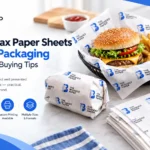
Deli paper is widely used to wrap sandwiches, subs, wraps, and other handheld foods.
The paper creates a practical layer around the food while helping keep sauces, crumbs, and surface grease contained. It can also make sandwiches easier for customers to handle.
For restaurants that specialize in sandwiches, choosing the right size and grease resistance is especially important.
You can also see our guide to Paper for wrapping sandwiches for a more focused look at sandwich packaging.
2. Burger wrapping
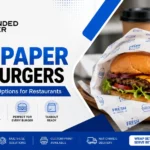
Burgers can place greater demands on food paper because they may combine hot fillings, melted cheese, sauces, meat juices, and oil.
A properly selected deli paper can be used for burger wrapping, partial wrapping, or as a basket liner. The right paper depends on the burger, grease level, holding time, and service method.
For a deeper look at the decision, see Deli paper for burgers.
3. Basket liners
Deli paper basket liners create a clean surface between food and the serving basket.
They are common in burger restaurants, casual restaurants, cafés, diners, and food trucks. The paper can help collect crumbs and surface grease while also improving the appearance of the finished order.
When branding is important, the visible liner can become part of the customer’s overall food presentation.
4. Tray liners
Deli paper can also serve as a tray liner for sandwiches, fries, appetizers, burgers, and combination meals.
The application is simple, but sheet dimensions still matter. A liner that is too small may leave much of the tray exposed, while a sheet that is too large can create unnecessary handling or paper waste.
5. Cheese and meat separation
Deli paper is also used around deli-counter products such as sliced meats and cheeses.
A sheet can provide separation between individual portions and create a cleaner way to handle products during service. The exact paper construction should match the food and intended contact conditions.
6. Bakery products
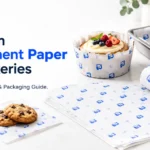
Cafés and bakeries may use deli-style sheets for pastries, cookies, bread items, and other counter-service products.
The paper can act as a pickup sheet or presentation layer, making it easier for employees to handle food without adding a bulky package for every individual item.
For food businesses where baking itself is involved, however, deli paper should not automatically be treated as an oven paper. The intended application matters.
7. Fry baskets and other presentation uses
Deli paper can also be used as a liner for fries and other served foods. Some food businesses fold or form food paper into simple presentation formats such as fry cones.
For fried foods, grease resistance becomes more important because oil can quickly affect paper performance.
Our guide to The best paper for greasy food covers this issue in more detail.
Types of Deli Paper
The term “deli paper” covers several practical variations.
Plain Deli Paper
Plain deli paper is useful when the main job is handling, wrapping, separating, or presenting food without requiring a heavy grease barrier.
It can work well for lighter applications where excessive oil or moisture is not expected.
Dry Wax Deli Paper
Dry wax deli paper is designed with a treatment that improves resistance to grease and moisture.
It can be useful for foods such as sandwiches, burgers, cheese, and other items where ordinary paper may become saturated more quickly.
The important point is that dry wax should be selected because of the performance required by the food—not simply because the product name includes “wax.”
Grease-Resistant or Greaseproof Deli Paper
Some deli papers are designed specifically for food with higher grease loads.
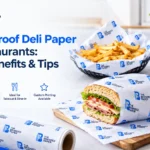
Greaseproof describes a performance characteristic related to resisting grease or oil, while deli paper describes the food-service application. A paper can therefore be both deli paper and grease-resistant paper.
Our article on Greaseproof deli paper for restaurants explains this distinction in more detail.
Interfolded Deli Paper
Interfolded deli paper is pre-folded so that individual sheets can be pulled from a dispenser or stack during service.
That format can be useful in busy food-service environments where employees need to grab one sheet quickly and consistently.
U.S. foodservice listings commonly position interfolded deli sheets for sandwich wrapping, bakery pickup, display-tray lining, food preparation, and basket lining.
Deli Paper Sheets and Rolls
Pre-cut sheets are convenient when the same paper dimensions are used repeatedly across a menu.
Rolls can make sense for operations built around continuous wrapping or dispensing, depending on the supplier and equipment.
The best format is therefore a workflow decision:
| Format | Often useful for |
| Pre-cut sheets | Sandwiches, burgers, bakery items, basket and tray lining |
| Interfolded sheets | Fast counter service and one-at-a-time dispensing |
| Rolls | Continuous wrapping or operations designed around roll-fed handling |
Before ordering, consider how employees actually use the paper during the busiest part of the day.
How to Choose Deli Paper for Your Food Business
The right deli paper is not necessarily the thickest, strongest, or most heavily treated option.
Start with the food itself.
1. Look at grease and moisture
Ask:
- Is the food oily?
- Does it contain sauces?
- Will condensation form?
- Is it served hot or cold?
- How long will it remain wrapped?
A dry pastry and a sauce-heavy burger create very different demands on paper.
2. Match the paper to the job
Decide whether you need the paper for:
- Full wrapping
- Partial wrapping
- Basket lining
- Tray lining
- Food separation
- Bakery pickup
- Takeout presentation
The application affects both the paper construction and sheet size.
3. Choose a practical size
Deli paper sizes should be based on the food and the wrapping method your staff actually use.
A sheet that works for a small sandwich may not be large enough for a loaded burger or large sub.
Instead of selecting a size simply because it is common, test the paper with your largest or most difficult-to-wrap menu item.
4. Consider service speed
In a busy restaurant, packaging is part of the workflow.
If employees have to unfold, tear, resize, or fight with the paper during every order, even a good paper product can become inefficient.
Interfolded sheets can be helpful where one-at-a-time dispensing is important. Pre-cut sheets can work well where staff already use a repeatable wrapping process.
5. Check food-contact suitability
Never assume that any paper is appropriate for direct food contact.
FDA guidance explains that food-contact substances include food packaging and components applied to packaging surfaces, and that safety is evaluated according to the intended use and conditions of contact.
For commercial purchasing, ask the supplier for the relevant material and food-contact information for the application you need.
Is Deli Paper Food Safe?
Deli paper can be suitable for direct food contact when the specific product is designed and authorized for that intended use.
That does not mean every paper labeled “deli paper” is automatically suitable for every food, temperature, or contact condition.
For example, a paper may be intended for room-temperature wrapping but not for cooking. Another may be designed to handle oily food but have different limitations for heat or extended holding.
The FDA’s food-contact framework specifically considers the type of food and the conditions under which the material will contact it, including temperature and other conditions of use.
For a commercial food business, the safer purchasing approach is to ask:
- What is the paper intended to contact?
- Is it suitable for direct food contact?
- What coating or treatment is used?
- What temperature conditions are supported?
- Is documentation available for the intended use?
Can Deli Paper Go in the Oven?
Do not assume deli paper is oven-safe.
Deli paper is primarily used for wrapping, lining, handling, and presentation. Unless the exact product is specifically rated by its manufacturer for the temperature and cooking conditions involved, it should not be treated as an oven paper.
FDA food-contact guidance distinguishes different conditions of use, including refrigerated storage, room-temperature use, hot-fill applications, and cooking at elevated temperatures.
For baking or other oven applications, use a paper that is specifically designed and rated for that purpose. That’s where Custom parchment paper is a more relevant product category to investigate.
Deli Paper vs Wax Paper
Deli paper and wax paper are not automatically the same thing.
The term deli paper generally describes a food-service paper used for wrapping, serving, lining, or separating food. Wax paper describes paper with a wax-based surface treatment.
There can be overlap: some deli sheets are wax-treated or dry-wax, so a deli paper product may also be a type of wax-coated food paper.
The difference is best understood by looking at the actual construction and intended use rather than the name alone.
See Deli paper vs wax paper vs parchment paper for a more detailed comparison.
Deli Paper vs Parchment Paper
Deli paper and parchment paper solve different problems.
Deli paper is primarily associated with foodservice wrapping, lining, handling, and presentation.
Parchment paper is commonly used for baking and other applications where a heat-resistant, non-stick surface is required.
That distinction matters for bakeries and restaurants. A bakery may use deli paper to present a finished pastry while using parchment during the baking process.
Do not substitute one for the other simply because both are sold as food paper.
Deli Paper vs Greaseproof Paper
These terms describe different aspects of the product.
Deli paper tells you more about the food-service use.
Greaseproof paper tells you about resistance to grease and oil.
So a food business can have grease-resistant deli paper.
The precise level of grease resistance depends on the paper’s construction and treatment. This is why restaurant buyers should look at the supplier’s specifications rather than assuming that every deli paper behaves the same way.
What About PFAS-Free Deli Paper?
PFAS has become an important consideration for businesses evaluating modern food packaging.
The FDA states that PFAS-containing grease-proofing substances are no longer being sold by manufacturers for food-contact use in the U.S. market, following a market phase-out, and the FDA later determined that related food-contact notifications for those grease-proofing applications were no longer effective.
That does not mean a buyer should simply assume a product is PFAS-free because it is described as “food safe.”
If PFAS status matters to your business, ask the supplier for current documentation supporting the specific product and coating you are considering.
You can also read our guide to PFAS-free food packaging for additional background.
Custom Printed Deli Paper for Branding
Deli paper does more than protect food. When it is printed with a logo, repeating pattern, or other brand design, it becomes part of the visual presentation of the meal.
This can be useful for:
- Restaurants
- Sandwich shops
- Burger businesses
- Cafés
- Food trucks
- Delis
- Bakeries
- Takeout-focused brands
- Catering businesses
The Branded Paper currently offers Custom deli paper with logo printing and options for standard or custom sizing through its quote process.
For businesses developing branded food packaging, it is also useful to consider the artwork alongside the paper choice. Our Custom printed food paper design guide covers practical design considerations for food packaging.
Quick Guide: Which Paper Should You Consider?
| Food or application | Paper to consider | Main reason |
| Sandwich wrapping | Deli paper | Fast handling and presentation |
| Burger wrapping | Deli or grease-resistant food paper | Grease and moisture control |
| Basket lining | Deli paper | Presentation and food separation |
| Bakery pickup | Deli sheets | Convenient counter handling |
| Greasy fried foods | Grease-resistant paper | Better resistance to oil |
| Oven baking | Parchment paper | Designed for baking applications |
| Cold-food wrapping | Deli or wax paper | Depends on moisture and intended use |
| Branded food presentation | Custom printed deli paper | Adds visible brand identity |
There is no single paper that is ideal for every food-service application. The better approach is to start with the food, service conditions, and workflow, then choose the paper construction and format that fits those requirements.
Deli Paper: What to Know Before Choosing It
So, what is deli paper?
Deli paper is lightweight food-service paper used for wrapping, lining, separating, handling, and presenting food. It can be plain, grease-resistant, dry-wax treated, interfolded, or custom printed depending on the intended application.
For restaurants and food businesses, the most important decision is not simply choosing “deli paper.” It is choosing a paper that fits the food, grease and moisture level, temperature, service method, sheet size, and food-contact requirements.
If you are looking for branded packaging, The Branded Paper’s custom deli paper is the logical next step to review available options and request a quote.
Frequently Asked Questions
1. Is deli paper the same as wax paper?
No. Deli paper refers broadly to food-service paper used for wrapping, lining, separating, or presentation, while wax paper refers to paper with a wax-based surface treatment. Some deli papers can be wax-treated, so the categories can overlap.
2. What is deli paper used for?
Common uses include wrapping sandwiches and burgers, lining baskets and trays, separating deli meats and cheeses, handling bakery products, and presenting food for dine-in or takeout service.
3. Is deli paper food safe?
A specific deli paper can be suitable for direct food contact when it is designed and authorized for the intended application. Businesses should verify the supplier’s material and food-contact information rather than assuming every paper product is suitable for every food or condition.
4. Can deli paper go in the oven?
Not automatically. Unless the exact deli paper product is specifically rated for the temperature and cooking conditions involved, it should not be used as an oven paper. For baking applications, use paper designed and rated for oven use.
5. What is dry wax deli paper?
Dry wax deli paper is food-service paper with a wax treatment intended to improve resistance to grease and moisture. It can be useful for foods such as sandwiches, burgers, cheese, and other items where plain paper may absorb grease more quickly.
6. What is the difference between deli paper and greaseproof paper?
Deli paper primarily describes the food-service use of the paper, while greaseproof describes resistance to grease or oil. A deli paper product can therefore also be grease-resistant or greaseproof, depending on its construction.
7. Are deli paper sheets better than rolls?
It depends on the workflow. Pre-cut sheets are convenient for repeated food-service applications, while rolls may make sense for operations designed around continuous wrapping or dispensing. Choose the format that matches how your employees actually package food.
8. Can deli paper be custom printed?
Yes. Custom printed deli paper can be used to add a logo, pattern, or other brand design to food packaging. The Branded Paper offers custom deli paper with logo printing through its product page and quote process.
9. Is PFAS-free deli paper important?
It can be an important purchasing consideration for businesses that want clear information about food-contact materials. The FDA states that PFAS-containing grease-proofing substances are no longer being sold by manufacturers for food-contact use in the U.S. market. Businesses should still request current product-specific documentation from their supplier when PFAS status matters.