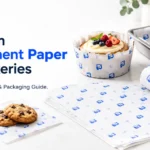
A bakery can make excellent products and still lose part of the customer experience to plain, poorly sized, or unsuitable packaging. Parchment paper is often used behind the scenes for baking and food preparation, but it can also become part of the finished presentation when the right paper, format, and branding are chosen.
For bakeries, custom parchment paper can serve several roles: baking liner, tray or basket liner, pastry presentation sheet, food-contact packaging layer, and branded packaging detail. The best choice depends on how the paper will be used, the type of food it will touch, the heat involved, and how your team handles it during production and service.
This guide explains where parchment paper fits in a bakery workflow, how sheets and rolls compare, what to consider for cookies, cakes, and pastries, and how custom printing can turn a functional paper into a consistent brand touchpoint.
What Is Parchment Paper for Bakeries?
Parchment paper is a treated paper commonly used in baking because it provides a non-stick surface and helps separate baked goods from pans or trays. USDA describes parchment paper as grease-resistant or greaseproof paper that is primarily used in baking as a pan liner or for wrapping foods for cooking.
In a commercial bakery, that makes parchment useful beyond a single baking sheet. Depending on the product specification and intended use, bakeries may use parchment paper for:
- Lining baking trays and pans
- Baking cookies and other items
- Lining cake pans
- Handling pastries and dough
- Separating baked goods
- Presenting finished products
- Supporting selected food-packaging applications
The key distinction is that not every paper product suits every food or temperature condition. A bakery should choose the material and format based on the actual application rather than assuming that all parchment or food-contact papers perform the same way.
Why Do Bakeries Use Parchment Paper for Baking?
The main reason is simple: parchment can make routine baking and handling easier.
A suitable parchment liner can help reduce direct contact between food and the baking surface, support easier release, and simplify cleanup. Professional baking guidance from King Arthur Baking regularly uses parchment for cookies, cakes, breads, pies, and other baked goods.
For a bakery, the value is operational as much as it is technical.
A consistent parchment workflow can help staff:
- Line pans quickly.
- Load products onto trays with less manual preparation.
- Remove baked goods more easily where the recipe and process call for parchment.
- Keep tray and pan cleanup more manageable.
- Repeat the same preparation method across production batches.
That consistency matters more in a commercial environment than it does in a home kitchen because the same process may be repeated across many trays each day.
Common Parchment Paper Uses for Bakeries
Parchment paper uses for bakeries vary by product and process. Some applications are directly tied to baking, while others are related to presentation and packaging.
Cookies
Parchment is widely used for cookies because it provides a practical liner for sheet pans. King Arthur Baking recommends parchment or silicone baking mats for cookies and notes that the lining material can affect how cookies spread.
For bakery operations, parchment can be useful for:
- Chocolate chip cookies
- Sugar cookies
- Shortbread
- Drop cookies
- Decorated cookies
- Small batch specialty cookies
It can also provide a clean surface for rolling, shaping, or transferring certain doughs.
Cakes
Parchment paper for cake baking is commonly used to line the bottom of cake pans. King Arthur Baking, for example, recommends lining the bottom of a cake pan with parchment and using it to help release the finished cake.
Pre-cut parchment rounds can be especially convenient for repeat cake production because the liner is ready to use instead of being measured and cut for each batch.
For bakeries producing multiple cake sizes, the practical question is not simply whether parchment works. It is whether the chosen format fits the pans your team uses most often.
Pastries
Parchment paper for pastries can support baking, handling, and presentation depending on the product.
It may be useful for:
- Pastries baked directly on trays
- Croissants and laminated doughs
- Danish pastries
- Tarts
- Scones
- Specialty dessert items
King Arthur Baking also uses parchment with pie and pastry applications, including lining pans and working with dough.
The exact construction still matters. A bakery should match the paper to the food, temperature, and intended contact conditions.
Parchment Paper Sheets vs. Rolls: Which Is Better for a Bakery?
Both formats can work well. The better choice depends on your workflow.
| Parchment format | Best suited to | Main advantage | Potential drawback |
| Pre-cut sheets | Repeat tray and pan sizes | Fast, consistent, ready to use | Less flexible for unusual sizes |
| Rolls | Mixed applications and variable dimensions | Adjustable length and less pre-cut restriction | Requires cutting and can curl during handling |
| Custom-sized sheets | Standardized commercial workflows | Matches a specific tray, pan, or packaging task | Requires more planning before ordering |
| Pre-cut rounds | Cake and round baking pans | No cutting needed | Useful mainly for compatible round-pan sizes |
King Arthur Baking highlights the workflow benefit of flat, pre-cut parchment sheets, while roll products are designed to be cut to the needed length.
Choose sheets when consistency matters most
Parchment paper sheets for baking can be a good fit when your bakery uses the same pan or tray dimensions repeatedly.
They can make sense when:
- Staff need to move quickly
- The same sizes are used throughout production
- You want a consistent sheet size
- Cutting paper during service adds unnecessary steps
- You are building a standardized prep process
Choose rolls when flexibility matters more
A parchment paper roll may be more practical when your bakery uses several different pan sizes or needs variable sheet lengths.
Rolls can make sense when:
- Pan sizes vary
- You need different lengths
- Your team is comfortable cutting sheets
- One roll can support several applications
The best format is the one that fits the workflow you already have. There is no universal winner.
What Makes the Best Parchment Paper for Baking?
The best parchment paper for baking is not simply the paper with the longest feature list. It is the paper that matches the bakery’s actual use.
Consider five factors.
1. Intended temperature and application
Check the supplier’s stated temperature limits and intended uses. Do not assume a parchment product is suitable for every oven, cooking method, or temperature.
For example, Reynolds Kitchens states that one of its parchment products is rated for conventional oven use up to 425°F and provides specific restrictions on open flame, broiling, and toaster-oven use.
That illustrates an important buying rule: read the product’s actual use instructions rather than relying on the word “parchment” alone.
2. Non-stick performance
Non-stick parchment paper is useful when the bakery needs cleaner food release from trays or pans.
For cookies, cakes, and pastries, release performance can influence how easily products move from the baking surface to the next stage of production.
3. Format
A bakery that uses standardized pan sizes may benefit from pre-cut sheets or rounds. A bakery with varied production may prefer rolls.
4. Food-contact suitability
Food-contact packaging must be appropriate for its intended use. FDA explains that food-contact substances and materials are evaluated based on the substance, the food involved, and the intended conditions of use.
5. Workflow fit
A theoretically excellent paper is not helpful if it slows production, does not fit your trays, or requires constant trimming.
The most useful specification is the one that works reliably in the real bakery environment.
Is Parchment Paper Food Safe?
Parchment paper can be suitable for food contact, but food safety should be evaluated based on the specific product and intended use.
FDA explains that food-contact substances can include packaging and components that directly contact food. When a food-contact substance is regulated as a food additive, its authorization applies to specific uses and conditions. FDA also provides food categories and conditions of use that can include bakery products and high-temperature applications.
That means a bakery should not treat “food-grade” as a blanket statement that makes every paper suitable for every application.
Before ordering, ask about the product’s:
- Intended food-contact use
- Temperature conditions
- Coating or treatment
- Suitable food types
- Relevant compliance documentation
- Printing and ink suitability when the paper is printed
This is particularly important when parchment will be used with hot, greasy, moist, or otherwise demanding foods.
What about PFAS?
PFAS is another issue worth understanding when evaluating grease-resistant food packaging.
FDA states that PFAS-containing grease-proofing agents are no longer being sold in the U.S. for use on paper food packaging and that the relevant food-contact notifications for those grease-proofing applications were determined no longer effective.
For a bakery, the practical takeaway is simple: ask suppliers what the paper is designed for and request appropriate documentation rather than making assumptions from marketing language alone.
Parchment Paper vs. Baking Paper: Are They the Same?
In US usage, “parchment paper” is the more common term for the baking paper used to line trays and pans.
The exact terminology can vary by market and supplier, so buyers may encounter phrases such as:
- Parchment paper
- Baking parchment
- Baking paper
- Parchment baking sheets
For US bakery purchasing, it is more useful to focus on the product’s construction and intended application than on the wording alone.
In other words, compare what the paper does, what food it is intended to contact, and what temperature conditions it supports.
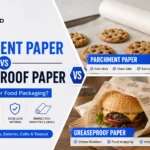
Parchment Paper vs. Greaseproof Paper for Bakeries
Parchment paper and greaseproof paper can overlap in some food-packaging applications, but they should not be treated as interchangeable products.
USDA describes parchment paper as greaseproof or grease-resistant and primarily used in baking as a pan liner or to wrap foods for cooking.
The distinction becomes more important when a bakery moves from baking to packaging.
For example:
| Need | Parchment paper | Greaseproof paper |
| Baking and pan lining | Common application | Depends on product |
| Non-stick baking surface | Commonly selected | Product dependent |
| Cookie and cake production | Strong fit | Not always the first choice |
| Food presentation | Can be suitable | Often useful for specific applications |
| Grease resistance | Common characteristic | Core purpose of many products |
| Branding | Possible with suitable specification | Possible with suitable specification |
The right choice depends on the paper’s intended use, not simply whether the label says “greaseproof.”
Your existing guide on Parchment paper vs. greaseproof paper can help when the decision is specifically between these two materials.
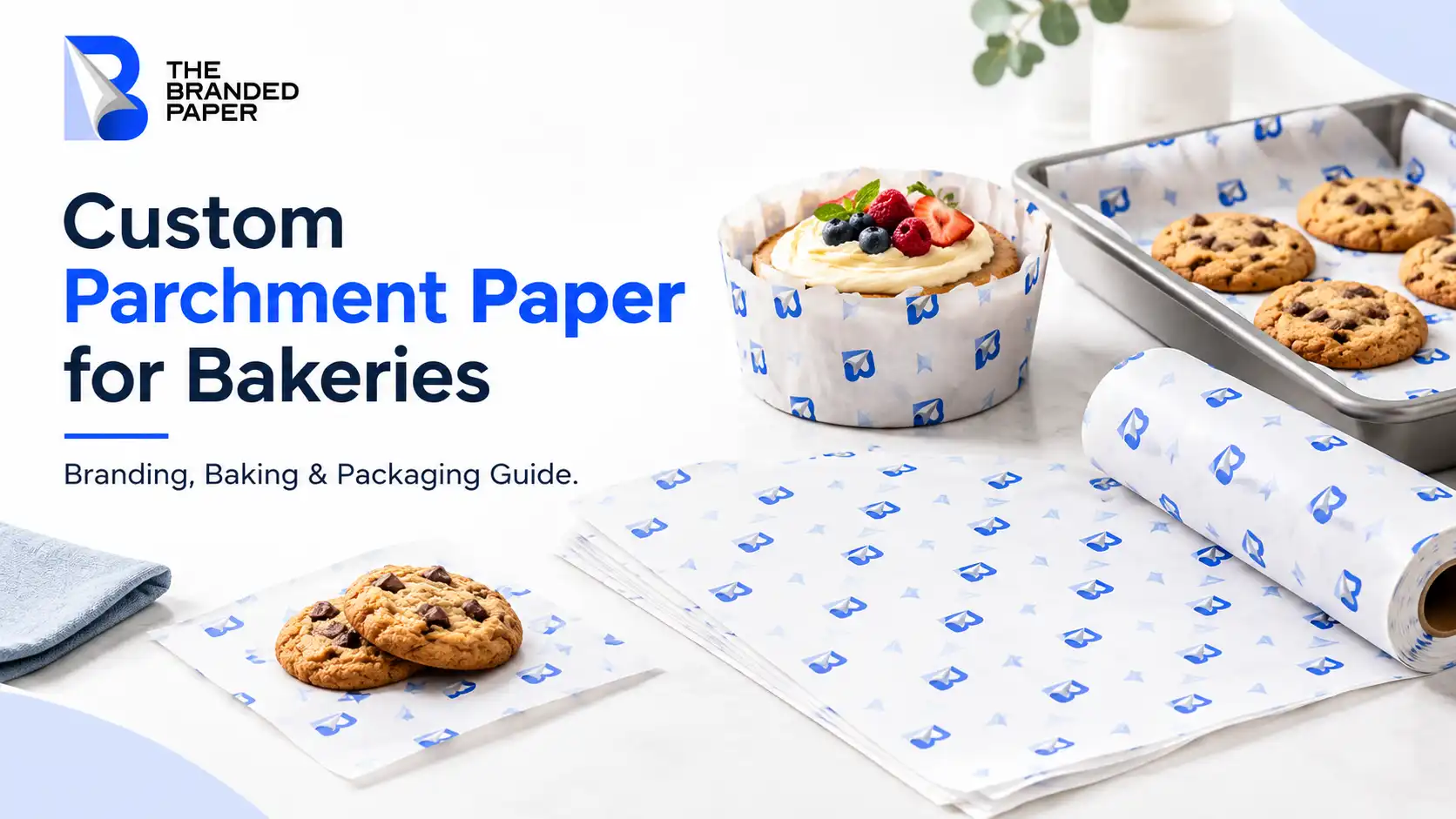
How Custom Parchment Paper Helps Bakeries Build Their Brand
Parchment paper becomes more interesting for a bakery when it moves from the production area into customer-facing packaging.
A plain sheet performs a function. A custom printed sheet can perform that function while also carrying the bakery’s visual identity.
The Branded Paper offers custom parchment paper for bakeries and other food businesses, with options for custom sizing and printed branding based on the intended application.
That can be useful for:
- Bakery box liners
- Pastry presentation
- Cookie packaging
- Branded food-service sheets
- Dessert presentation
- Selected wrapping applications
- In-box branded packaging
Keep the design practical
A custom parchment design should work when the paper is flat, folded, wrapped, or partly covered by the food.
A few practical approaches include:
Repeating logo pattern: Good when you want the brand visible from different angles.
Single-logo layout: Better suited to a cleaner, more understated look.
Brand-color pattern: Useful when the bakery already has a recognizable visual identity across boxes, bags, labels, and other packaging.
Seasonal artwork: Useful for limited-time products or holiday packaging without changing the core bakery identity.
The strongest design is not necessarily the most complicated one. It is the one that stays recognizable after the paper is actually used.
For additional design considerations, see Custom Printed Food Paper Design Guide.
How to Choose the Right Custom Parchment Paper for Your Bakery
Start with the workflow, not the logo.
Step 1: Identify the main food applications
List the products that will actually use the paper:
Cookies? Cakes? Pastries? Breads? Tray presentation? Packaging?
Different applications may require different formats or specifications.
Step 2: Measure the real dimensions
Measure the pan, tray, bakery box, basket, or food item involved.
Do not choose a sheet size based only on the product name.
Step 3: Decide between sheets and rolls
If your operation repeats the same dimensions every day, sheets may simplify preparation. If sizes vary, rolls may offer more flexibility.
Step 4: Confirm the intended use
Tell the supplier whether the parchment will be used for baking, food presentation, lining, wrapping, or another application.
This helps the supplier evaluate the proper material and specification.
Step 5: Plan the branding
Decide what customers should see:
- Logo
- Repeating pattern
- Brand colors
- Artwork
- Seasonal message
Keep the design readable at the final paper size.
Step 6: Test before committing to a large order
A sample or proof can reveal problems that are difficult to spot on a screen.
Test:
- Sheet size
- Folding
- Fit inside packaging
- Handling speed
- Print placement
- Grease or moisture performance
- Appearance after use
For a commercial bakery, a small amount of testing can be far more useful than choosing solely from a specification sheet.
A Practical Bakery Parchment Checklist
Before requesting a quote for custom parchment paper, prepare these details:
| Requirement | What to provide |
| Food application | Cookies, cakes, pastries, lining, packaging, etc. |
| Format | Sheets, rolls, rounds, or another format |
| Dimensions | Exact required width and length |
| Quantity | Approximate recurring or bulk requirement |
| Artwork | Logo or finished print file |
| Printing | Desired colors and layout |
| Temperature | Expected baking or heat conditions |
| Food contact | What the paper will directly touch |
| Packaging use | Box, tray, basket, wrap, or presentation |
| Testing | Whether a sample/proof is needed |
The more specific these inputs are, the easier it is to evaluate whether the selected parchment is a good match for the bakery’s operation.
Can Custom Parchment Paper Be Used for Food Packaging?
Yes, when the specific paper construction is suitable for the intended food-contact application.
A bakery may use custom parchment as a liner, presentation layer, or suitable packaging component. The Branded Paper positions its custom parchment paper for bakery, restaurant, café, catering, food-truck, and food-brand applications and offers custom sizing and printing options.
However, packaging use should not be assumed simply because a paper is suitable for baking. Food type, temperature, grease, moisture, contact time, and other conditions can affect suitability.
For broader takeout and wrapping considerations, see Food wrapping paper for takeout.
Common Mistakes Bakeries Make When Choosing Parchment Paper
Choosing paper based only on price
A lower unit price can lose its advantage if the format creates extra cutting, waste, or handling time.
Ordering the wrong sheet size
A sheet that is too small will not perform the job. One that is unnecessarily large can create extra material use and storage problems.
Treating all food papers as interchangeable
Parchment, wax paper, deli paper, and other food papers serve different purposes. Choose according to the intended application.
For a deeper comparison, see Wax paper vs. parchment paper.
Skipping a practical test
A paper can look perfect on a product page and still be inconvenient for your team’s actual workflow.
Designing before confirming the paper
Branding should be developed around the final sheet size, printing method, folding pattern, and application. Otherwise, the artwork may not look right once the paper is in use.
When Does Custom Parchment Paper Make Sense?
Custom parchment paper is worth considering when the bakery already has a repeatable need for parchment and wants the paper to do more than simply line a pan.
It can be particularly useful when you want to:
- Standardize packaging presentation
- Add branding to everyday food-service materials
- Create a more consistent look inside bakery boxes
- Support a recognizable visual identity
- Combine practical paper use with customer-facing branding
It is less useful to customize a paper that will never be seen by the customer or when your operation is still testing the basic material and format.
The sequence is simple:
Choose the right paper → confirm the application → test the format → finalize the design → order the quantity that fits the workflow.
Choosing the Right Parchment Paper for Your Bakery
For bakeries, parchment paper is not only a baking supply. Depending on the specification and intended use, it can support baking, pan lining, food handling, presentation, and selected packaging applications.
The right choice comes down to application, temperature, food-contact suitability, format, dimensions, workflow, and branding needs.
Sheets may be the better fit for repeat production sizes, while rolls offer more flexibility. Cookies, cakes, and pastries can all benefit from suitable parchment applications, but the paper should always be selected for its actual use rather than treated as a universal material.
For bakeries ready to move from plain paper to branded packaging, The Branded Paper offers custom parchment paper with custom sizing and printed branding options for food businesses.
Explore Custom Parchment Paper to review the available solution and prepare your size, artwork, quantity, and intended application for a quote.
Frequently Asked Questions
1. What is parchment paper used for in bakeries?
Parchment paper is commonly used for baking and pan lining, including cookies, cakes, pastries, and other baked goods. Depending on its specifications, it can also support food presentation and selected packaging applications.
2. Is parchment paper good for baking?
Yes. Suitable parchment paper is widely used for baking because it can provide a non-stick surface and help with food release and cleanup. Always follow the specific product’s temperature and use instructions.
3. Are parchment paper sheets better than rolls?
Neither is universally better. Pre-cut sheets can be more efficient for standardized bakery workflows, while rolls provide flexibility for different sizes and lengths.
4. Can parchment paper be used for cookies?
Yes. Parchment is commonly used to line cookie sheets and support easier handling and release. King Arthur Baking recommends parchment or silicone mats for cookie baking.
5. Can parchment paper be used for cakes?
Yes. Parchment is commonly used to line the bottom of cake pans, helping with release after baking.
6. Can bakeries use pre-cut parchment paper?
Yes. Pre-cut sheets or rounds can be useful when the bakery repeatedly works with standard tray or pan sizes. They can reduce the need to measure and cut each liner.
7. Is parchment paper food safe?
Food-contact suitability depends on the specific material, construction, and intended conditions of use. FDA regulates food-contact substances according to their authorized applications and conditions.
8. Is parchment paper the same as baking paper?
In US baking contexts, parchment paper is the common term, while “baking paper” may be used as a broader or regional term. Buyers should focus on the product’s construction and intended use rather than the name alone.
9. Can parchment paper be custom printed for a bakery?
Yes. The Branded Paper offers custom parchment paper with printed branding and custom sizing options for bakeries and other food businesses.
10. What should I provide when ordering custom parchment paper?
Provide the intended food application, sheet or roll format, dimensions, approximate quantity, artwork, printing requirements, and expected use conditions. This gives the supplier the information needed to evaluate the appropriate solution.
11. Is custom parchment paper suitable for food packaging?
It can be, provided the specific paper construction is suitable for the intended food-contact application. Baking suitability alone does not automatically mean the paper is appropriate for every packaging use.