Choosing between butcher paper sheets and rolls may seem like a small packaging decision. In a busy food business, however, the wrong format can slow down service, create unnecessary waste, increase packaging costs, and make finished orders look inconsistent.
The best choice depends on what you wrap, how many orders you handle, how much counter space you have, and whether presentation needs to remain consistent across every location.
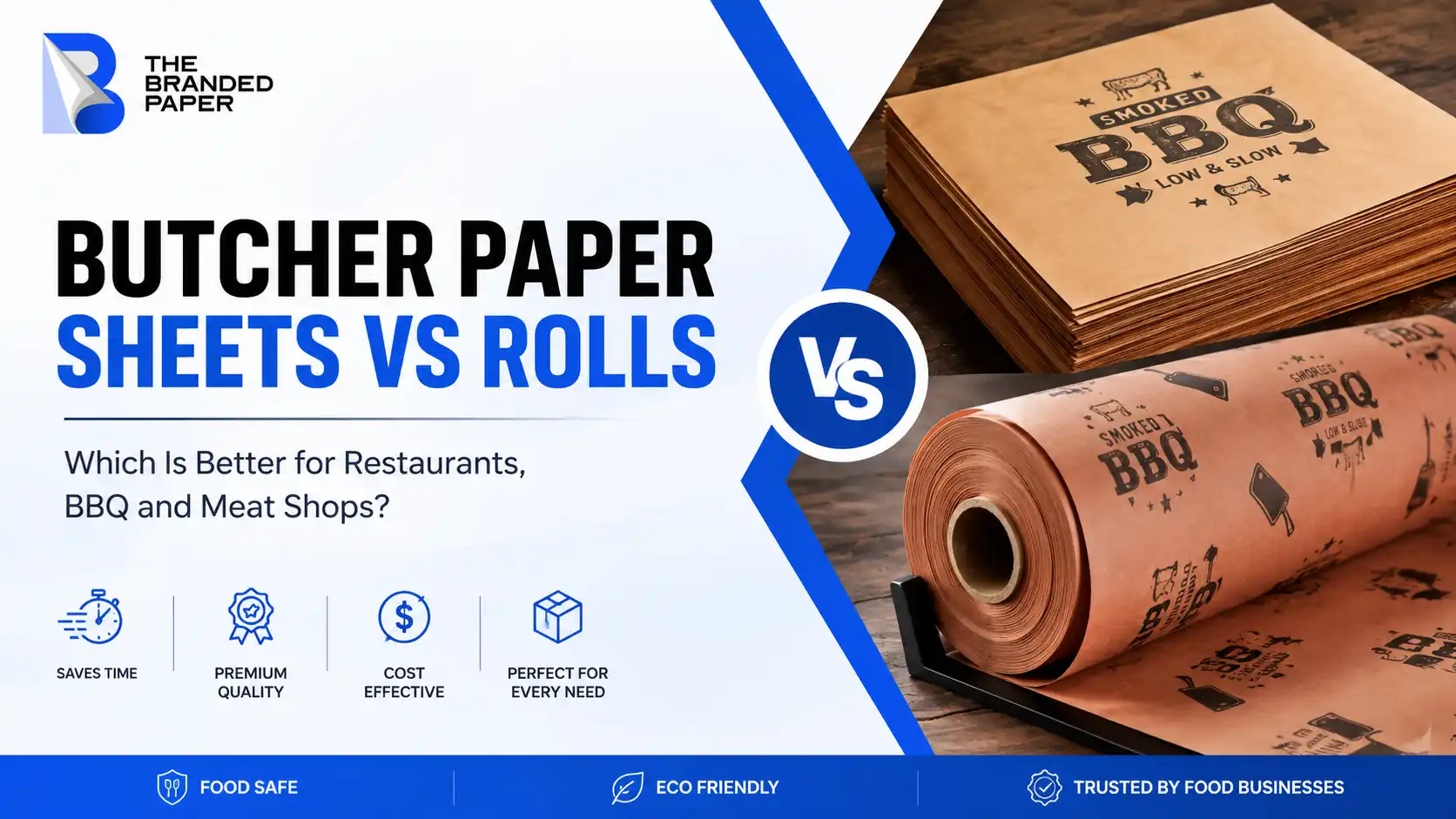
For most high-volume restaurants, pre-cut butcher paper sheets provide faster and more predictable service. Rolls offer greater flexibility when products vary in size, making them especially useful for BBQ kitchens and meat shops.
Butcher Paper Sheets vs Rolls: Quick Answer
| Business need | Better choice | Main reason |
| Fast sandwich and burger service | Sheets | Ready to grab and wrap |
| Consistent branded presentation | Sheets | Every piece has the same dimensions |
| Large briskets and meat cuts | Rolls | Length can be adjusted |
| Products with different sizes | Rolls | Less risk of using an undersized sheet |
| Tight cost and portion control | Sheets | Easier to track paper use |
| Small preparation counter | Sheets | No cutter or roll holder required |
| Custom logo visibility | Sheets | Print placement is easier to control |
| Catering and mixed packaging | Both | Each format covers different tasks |
Neither option is automatically better. Sheets improve speed and consistency, while rolls improve flexibility.
What Is Butcher Paper Used For?
Butcher paper is a durable wrapping paper commonly used for meat, sandwiches, barbecue, seafood, deli items, tray liners, and food presentation. Depending on the exact material, it may be breathable, moisture-resistant, grease-resistant, treated, or uncoated.
Common food-service uses include:
- Wrapping burgers, sandwiches, and subs
- Wrapping fresh cuts of meat
- Covering brisket during smoking
- Lining baskets, trays, and serving boards
- Separating meat portions
- Covering preparation tables
- Packaging deli and grab-and-go products
- Creating branded food presentation
Not every paper sold under the butcher paper name performs the same way. Pink, white, treated, untreated, coated, and uncoated papers can behave differently around heat, grease, moisture, and raw food.
Food businesses should match the paper to its intended use rather than choosing by color or price alone.
Butcher Paper Sheets: Best for Speed and Consistency
Butcher paper sheets arrive in fixed, pre-cut sizes. Employees can take one sheet, place the food in the center, and wrap it without measuring or cutting.
That small time saving becomes important during lunch rushes, weekend BBQ service, catered events, and high-volume takeout periods.
Benefits of Butcher Paper Sheets
Faster service
Pre-cut sheets remove the cutting step. Employees do not have to pull paper from a dispenser, estimate the required length, and operate a cutter for every order.
More consistent packaging
Every employee uses the same amount of paper for the same menu item. Orders look cleaner and more uniform, even when different team members prepare them.
Better paper-use control
Fixed sizes make it easier to estimate usage. If a location sells 500 sandwiches, management can predict approximately how many sheets will be needed.
Cleaner custom printing
Custom printed butcher paper sheets can be designed around fixed dimensions. The logo can be positioned so it remains visible after folding instead of disappearing under the food.
Simpler workstation setup
Sheets can be stored in a dispenser, drawer, or shelf near the wrapping area. No roll holder or cutting bar is required.
Limitations of Butcher Paper Sheets
Sheets are less flexible when products vary greatly in size. A sheet that works well for a burger may not cover a rack of ribs or a large brisket.
Using an oversized sheet for a small item also adds avoidable material cost. Using an undersized sheet can cause poor folds, exposed food, leaking juices, or weak packaging.
Sheets work best when a business has:
- Standard menu portions
- Repeatable packaging processes
- High order volume
- Limited preparation time
- A strong need for consistent presentation
Butcher Paper Rolls: Best for Flexible Sizing
Butcher paper rolls allow employees to cut the required length for each product. They are useful when food dimensions change from order to order.
A BBQ kitchen may wrap briskets, pork shoulders, ribs, and smaller smoked portions during the same shift. A butcher shop may package anything from small steaks to large roasts. A roll allows the wrapper to adjust without keeping many sheet sizes in stock.
Benefits of Butcher Paper Rolls
Flexible length
The employee can cut enough paper for the exact product instead of forcing the food into a standard sheet.
Suitable for larger items
Rolls are practical for whole briskets, racks of ribs, large fish, meat trays, preparation tables, and irregularly shaped products.
Fewer sheet sizes to manage
A business can use one or two roll widths for many tasks. That may simplify purchasing when product dimensions change frequently.
Useful for preparation work
Rolls can cover tables, protect work surfaces, create disposable preparation areas, or support large catering displays.
Limitations of Butcher Paper Rolls
Rolls take longer to handle. Each piece must be pulled, measured, and cut. During a rush, employees may cut too much paper or create uneven pieces.
A roll also requires:
- A stable dispenser or cutter
- Enough counter or wall space
- Employee training
- Clear size standards
- Regular monitoring to reduce waste
Rolls are most useful when flexibility matters more than wrapping speed.
Butcher Paper Roll vs Sheets for Packaging
The practical difference is not only the shape in which the paper is supplied. The format changes the packaging workflow.
With sheets, management decides the paper size before service starts. With rolls, the employee decides the paper length while wrapping the order.
That difference affects labor, waste, training, and consistency.
| Factor | Butcher paper sheets | Butcher paper rolls |
| Service speed | Faster | Slower |
| Size flexibility | Limited | High |
| Portion control | Easier | Depends on employee |
| Paper waste | Predictable | Can increase without standards |
| Branding consistency | Strong | Print placement may vary |
| Storage | Flat storage required | Roll storage required |
| Equipment | Usually none | Dispenser or cutter |
| Best environment | Standardized menu | Variable product sizes |
A standardized restaurant operation usually benefits from sheets. A production area handling different meat cuts often benefits from rolls.
Butcher Paper Sheets vs Rolls for Restaurants
Restaurants normally need packaging that is fast, clean, easy to train, and simple to restock.
For burgers, sandwiches, wraps, tacos, deli items, and basket liners, pre-cut sheets are usually the better operational choice. Employees can repeat the same wrapping method throughout the shift.
Sheets also make multi-location consistency easier. Each location can receive the same dimensions, print design, and packing instructions.
Rolls may still be valuable for:
- Catering orders
- Oversized sandwiches
- Family meal packages
- Table covering
- Large food trays
- Seasonal menu items
- Irregularly sized products
Many restaurants benefit from using sheets at the service station and a roll in the preparation or catering area.
Which Format Is Better for BBQ Restaurants?
BBQ businesses often need both formats because the packaging needs change throughout the cooking and serving process.
A roll is usually more practical for wrapping whole briskets, pork shoulders, and large racks of ribs. Employees can cut enough paper to create secure folds without squeezing the meat or leaving weak gaps.
For serving sliced brisket, pulled pork sandwiches, ribs, and side dishes, sheets are usually faster.
Pink or peach butcher paper is widely used for smoking because untreated versions allow some moisture to escape instead of sealing the meat as tightly as foil. That can help protect the bark while moving the meat through the later part of the cook. The paper selected for smoking must be specifically suitable for that use; wax-coated, plastic-coated, or unknown decorative papers should not be placed in a smoker.
A practical BBQ setup may include:
- A wide roll for wrapping briskets
- Medium sheets for ribs or sliced meat
- Smaller branded sheets for sandwiches and trays
- Separate paper for raw-meat handling and customer service
Wrapping paper does not replace safe cooking practices. Smoked meat still needs proper handling, temperature control, and verification with a food thermometer. USDA food-safety guidance recommends cooking meat and poultry to the minimum safe internal temperature for the specific product.
Which Format Is Better for Meat Shops?
Meat shops frequently handle products with different weights, shapes, and moisture levels. Rolls give employees more control when wrapping roasts, fish, poultry, bone-in cuts, and larger customer orders.
Sheets remain useful for standard products such as:
- Steaks
- Chops
- Ground meat portions
- Deli cuts
- Sausages
- Small seafood orders
- Counter displays
The most efficient setup often uses two or three sheet sizes for regular purchases and a roll for larger cuts.
For long-term freezing, ordinary butcher paper may not provide enough protection by itself. USDA guidance recommends additional airtight wrapping, such as freezer paper, heavy-duty foil, plastic wrap, or freezer-safe packaging when meat will be frozen for extended periods.
What Size Butcher Paper Do I Need?
The paper should provide enough room to cover the product and create secure overlapping folds. It should not be so large that employees waste material on every order.
Start by measuring the food after it has been portioned or placed in its tray. Include extra space for:
- Folding over the top
- Overlapping the edges
- Sealing with a sticker or label
- Holding juices or grease
- Keeping the logo visible
- Preventing the wrap from opening during delivery
Common Starting Sizes
| Food or task | Practical starting range |
| Cookies, pastries, or small items | 6 × 6 to 8 × 8 inches |
| Burgers and small sandwiches | 10 × 10 to 12 × 12 inches |
| Large sandwiches and subs | 12 × 15 to 15 × 18 inches |
| Basket and tray liners | Match the inside tray dimensions |
| Steaks and small meat portions | 12 × 12 to 15 × 18 inches |
| Ribs, roasts, and briskets | Wide roll or tested oversized sheet |
| Table and preparation covering | Wide roll |
These dimensions are starting points, not universal rules. Product height, moisture, wrapping style, and employee technique can change the size requirement.
The Branded Paper lists a broad selection of standard sheet dimensions and also accepts custom-size requests, allowing food businesses to match the paper more closely to their menu and packaging workflow.
Test the Fold Before Ordering in Bulk
Create a simple packaging test with the actual food container or a product of the same size.
Check whether the paper:
- Covers the food completely
- Folds without tearing
- Holds its shape after several minutes
- Stays manageable when exposed to normal grease or moisture
- Fits the packaging station
- Displays the printed logo correctly
- Uses no more material than necessary
A small size adjustment can reduce paper use across thousands of monthly orders.
Pink Butcher Paper vs Regular Butcher Paper
Color does not automatically determine performance. The paper’s treatment, weight, intended use, moisture resistance, and food-contact suitability matter more.
Pink or Peach Butcher Paper
Pink butcher paper is often associated with BBQ and meat wrapping. Its color helps hide some meat juices and creates a familiar smokehouse appearance.
Untreated pink paper is commonly selected for brisket because it is breathable and does not trap moisture as tightly as foil.
White Butcher Paper
White butcher paper creates a clean presentation for sandwiches, deli items, tray liners, and branded packaging. Printed colors may also appear brighter against a white background.
It can work well for restaurants that want:
- A clean visual identity
- High logo contrast
- Easy labeling
- Clear food presentation
- Consistent packaging across menu items
Natural Kraft Paper
Natural kraft Paper offers an earthy, simple appearance that fits BBQ restaurants, farm-to-table brands, bakeries, delis, and businesses seeking a less polished packaging style.
A brown appearance alone does not prove that a paper is recyclable, compostable, chemical-free, or more sustainable. Environmental claims should be based on the exact material, coating, ink, sourcing, and local waste system.
Is Butcher Paper Food Safe?
Butcher paper can be food safe when it is manufactured for the intended food-contact application. Safety should not be assumed from the product name alone.
The FDA treats packaging, coatings, colorants, adhesives, and other components that contact food as food-contact substances. Their suitability depends on the materials used and the intended conditions, including food type, temperature, and duration of contact.
Before buying, ask the supplier to confirm:
- The paper is intended for direct food contact
- The inks are appropriate for the intended application
- The food-contact side is clearly identified, where relevant
- The paper is suitable for hot, cold, dry, greasy, or moist foods as required
- The product is suitable for smoking or heating when that is the intended use
- Coatings or treatments are disclosed
- Storage instructions are provided
- Supporting compliance documentation is available
Avoid using craft paper, mailing paper, unknown printed paper, or decorative paper as a food wrap. The fibers, dyes, recycled content, surface treatments, and inks may not be intended for direct food contact.
Butcher Paper vs Parchment Paper for Food Packaging
Butcher paper and Parchment paper solve different problems.
| Feature | Butcher paper | Parchment paper |
| Main strength | Wrapping and presentation | Nonstick baking and lining |
| Surface | Usually more absorbent or breathable | Typically treated for nonstick performance |
| Best uses | Meat, sandwiches, BBQ, trays | Baking sheets, pastries, oven use |
| Moisture behavior | Varies by type | More resistant than untreated paper |
| Branding | Strong visual wrapping option | Useful for liners and bakery presentation |
Parchment paper is generally thinner and commonly has a nonstick treatment. Butcher paper is normally better suited to wrapping meat, sandwiches, and deli products.
The correct choice depends on whether the paper must breathe, resist sticking, absorb surface moisture, handle grease, or withstand a specific temperature.
Common Buying Mistakes
Choosing Based Only on Price
A lower paper price does not always reduce packaging costs. Thin or poorly matched paper may require double wrapping, cause leaks, or slow down employees.
Consider the total cost per packed order, including labor and waste.
Ordering One Size for Every Product
One sheet size rarely works efficiently for small sandwiches, large subs, meat cuts, and tray liners. The largest size may technically cover everything, but it increases waste on smaller orders.
Ignoring the Packaging Station
A large roll is not helpful if the counter cannot hold a dispenser. Large stacks of sheets can also become difficult to manage in a cramped kitchen.
Measure the storage and working area before ordering.
Skipping Real Food Testing
A dry sample may look strong but behave differently around hot grease, sauce, steam, or raw meat juices.
Test the paper under normal service conditions.
Printing Before Testing the Material
Approve the paper type, sheet size, fold, and food performance before placing a large custom printed order. A visually attractive design cannot fix an unsuitable material.
Focusing Only on the Unwrapped Design
A logo may look centered on a flat sheet but disappear after the paper is folded. Print placement should be tested on the finished package.
How to Choose Butcher Paper for Food Packaging
Use the following buying process:
- List the foods being wrapped. Note their dimensions, temperature, grease level, moisture, and holding time.
- Separate standard and irregular items. Use sheets for repeatable portions and rolls for large or changing sizes.
- Choose the correct paper construction. Confirm whether you need breathable, treated, uncoated, grease-resistant, or moisture-resistant paper.
- Test two or three sizes. Compare wrapping speed, fold security, appearance, and material waste.
- Review workstation space. Decide where sheets or rolls will be stored and how employees will access them.
- Calculate cost per packed order. Include paper waste, double wrapping, and handling time.
- Test the printed layout. Confirm that logos and important design elements remain visible after folding.
- Request compliance information. Match the paper, ink, and coating to the intended food-contact use.
- Approve a sample or proof. Review material performance and print clarity before bulk production.
- Document the wrapping method. Give employees a repeatable process for each menu item.
Sheets, Rolls, or Both?
Choose butcher paper sheets when your business needs fast service, standard portions, predictable inventory, and consistent branded presentation.
Choose butcher paper rolls when you package large cuts, irregular products, catering trays, or foods that require different paper lengths.
Choose both when cooking and customer service have different requirements. A BBQ restaurant may use a roll in the smoker area and branded sheets at the service counter. A butcher shop may use sheets for regular cuts and a roll for large customer orders.
The right format should make the operation easier, not create another task for employees.
The Branded Paper supplies custom butcher paper and other food wrapping options for restaurants, delis, butcher shops, BBQ businesses, and food brands across the United States. Businesses can request standard or custom sizes, select printing options, review a digital proof, and evaluate samples before committing to a wholesale order.
Request a custom quote or sample to compare the paper size, strength, print quality, and finished wrap before placing a bulk order.
Frequently Asked Questions
Are butcher paper sheets better than rolls?
Sheets are better for fast, repeatable wrapping. Rolls are better when food sizes vary or large products require adjustable paper lengths. Many food businesses use sheets for service and rolls for preparation.
What size butcher paper is best for burgers?
A 10 × 10-inch or 12 × 12-inch sheet is a practical starting point for many burgers. Large or heavily topped burgers may need more paper. Test the actual product and folding method before ordering.
What size butcher paper should I use for brisket?
Brisket usually requires a wide roll because the length can be adjusted around the cut. The paper should provide enough coverage for secure overlapping folds without creating excessive layers.
Is pink butcher paper the best paper for smoking meat?
Untreated, food-grade pink or peach butcher paper is commonly used for smoking meat because it can allow some moisture to escape while protecting the meat. Confirm that the exact paper is intended for smoking or cooking before using it around heat.
Can I use butcher paper instead of parchment paper?
It depends on the task. Butcher paper is generally better for wrapping meat and sandwiches. Parchment is generally better for baking and nonstick pan lining. Do not treat them as interchangeable in every application.
Is butcher paper the same as wax paper?
No. Wax paper has a waxed surface that provides moisture resistance. Butcher paper is generally stronger and may be breathable, treated, or uncoated. Wax paper should not be used for smoking or high-heat cooking unless the manufacturer specifically states that it is suitable.
Can butcher paper be custom printed?
Yes. Food businesses can print logos, patterns, and brand elements on custom butcher paper. The paper and ink must be suitable for the intended food-contact application, and the design should be tested after wrapping.
Should a restaurant buy butcher paper in bulk?
Bulk ordering can reduce the unit cost and simplify restocking when paper sizes and monthly usage are predictable. Restaurants should confirm the material, dimensions, artwork, storage capacity, and order quantity before making a large purchase.