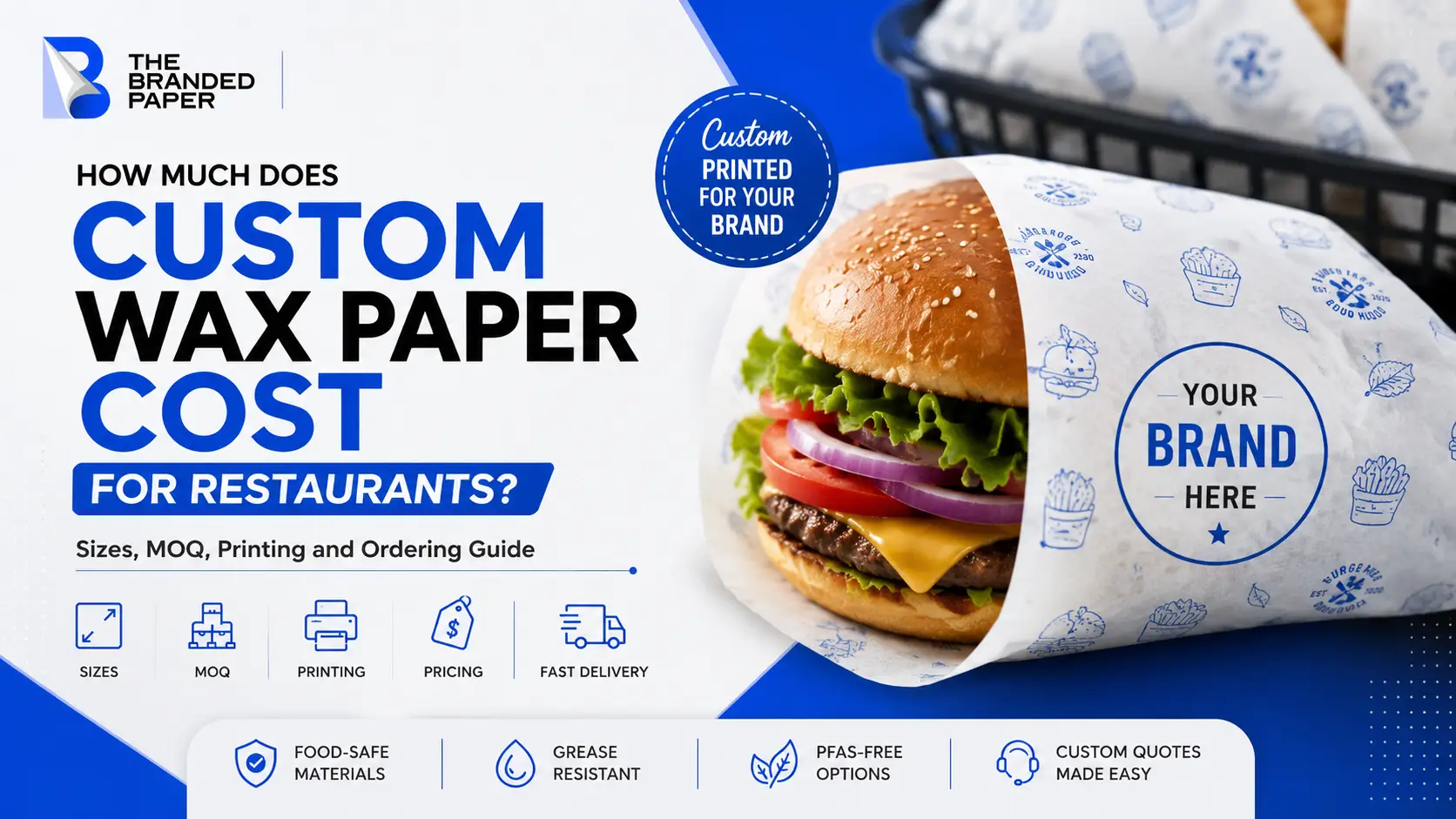
Custom wax paper can make a burger, sandwich, or pastry look more professional. It can also keep grease under control and place your logo directly in the customer’s hands.
The difficult part is understanding the price.
Many suppliers do not display a fixed custom wax paper price because every order is different. Sheet size, quantity, paper type, print colors, coating, artwork, shipping, and production method can all change the final cost.
A restaurant ordering 500 full-color sheets for a short promotion may pay far more per sheet than a multi-location brand ordering 50,000 one-color sheets. The lowest quote is not always the lowest operating cost either. Paper that tears, leaks, wastes space, or slows down the wrapping station can cost more during daily service.
How Much Does Custom Wax Paper Cost?
Custom wax paper often costs about $0.08 to $0.30 or more per sheet, depending on the specifications and order volume.
Publicly listed examples show why prices can vary:
- A 500-unit custom wax paper listing may cost around $0.30 per unit
- A 1,000-sheet custom food-wrap listing may cost around $0.15 per sheet
- A 5,000-sheet custom grease-resistant paper listing may cost close to $0.08 per sheet
These examples are not equal product comparisons. Paper size, material, coating, print quality, freight, and country of production may differ. They are useful only as early budgeting references. A final custom printed wax paper cost should come from a quote based on the restaurant’s exact requirements.
Quick Cost Estimate
| Order quantity | General planning range per sheet | Best suited for |
| 500–999 sheets | $0.20–$0.40+ | Pop-ups, new cafés, events and test orders |
| 1,000–4,999 sheets | $0.12–$0.30 | Independent restaurants and bakeries |
| 5,000–24,999 sheets | $0.07–$0.18 | Busy restaurants and growing food brands |
| 25,000+ sheets | Custom wholesale quote | Chains, franchises and distributors |
These ranges are broad planning estimates, not guaranteed selling prices. A small sheet with one-color printing will usually cost less than a large, heavy sheet with full-color artwork.
The most useful number is not always the lowest custom wax paper price per sheet. Restaurants should compare the complete landed cost and the number of usable wraps received.
Use this formula:
Landed cost per sheet = total product, setup, and delivery cost ÷ usable sheet quantity
A quote that excludes freight, plate charges, artwork fees, or delivery can appear cheaper than it really is.
What Changes the Custom Wax Paper Price?
The main price factors are quantity, size, paper construction, print coverage, color count, production method, and delivery requirements.
The Branded Paper’s custom wax paper quote form asks buyers to choose the standard size, paper type, quantity, and one-, two-, or four-color printing. Those are some of the first details a supplier needs before giving an accurate price.
1. Order Quantity
Quantity usually has the largest effect on cost per sheet.
Custom printing requires preparation before production begins. The supplier may need to review the file, prepare plates or digital settings, adjust ink, cut the paper, create a proof, and set up packing.
Those setup costs are spread across the whole order.
For example:
- A $100 setup cost spread across 500 sheets adds $0.20 per sheet
- The same cost spread across 5,000 sheets adds $0.02 per sheet
- Spread across 50,000 sheets, it adds only a small fraction of a cent
This is why bulk custom wax paper discounts can lower the unit price. The restaurant buys more material, but the fixed production work is shared across more sheets.
Do not order a year of stock only to reach a lower tier. Printed packaging uses storage space, and branding can change. Menu redesigns, logo updates, new phone numbers, and seasonal campaigns can leave old paper unusable.
A practical order should balance:
- Monthly usage
- Available storage
- Cash flow
- Reorder lead time
- Expected brand changes
- Supplier price breaks
2. Sheet Dimensions
Larger sheets require more paper and take up more space during packing and shipping. A 15-by-15-inch sheet will normally cost more than a 6-by-6-inch sheet with the same material and print design.
Oversized paper can also create hidden waste.
A restaurant wrapping 5-inch burgers with a 15-inch sheet may spend more on every order without improving food protection. Paper that is too small creates another problem: staff may use two sheets instead of one.
The correct size should fully cover the item with enough overlap for a secure fold, but not so much that large sections are discarded.
Common Custom Wax Paper Sizes
Custom wax paper sizes differ among suppliers, but commonly offered dimensions include 6 by 6 inches, 10 by 10 inches, 12 by 12 inches, 12 by 16.5 inches, and 15 by 15 inches. Custom dimensions may also be available.
| Food or use | Practical starting size | Important consideration |
| Cookies and small pastries | 6″ × 6″ | Allow enough space to fold without crushing the item |
| Small burgers and breakfast sandwiches | 10″ × 10″ | Test with the tallest finished burger, not the bun alone |
| Standard burgers and sandwiches | 12″ × 12″ | Check the amount of overlap after wrapping |
| Subs, burritos and large sandwiches | 12″ × 16″ or larger | Longer sheets support end folds |
| Baskets and serving trays | Based on inside dimensions | Decide whether the paper should cover the base or extend over the sides |
| Bakery boxes | Based on box dimensions | Avoid folds that hide the printed design |
What Size Wax Paper Is Best for Sandwiches?
A 12-by-12-inch sheet is a useful starting point for many standard sandwiches. Smaller items may fit a 10-by-10-inch sheet, while subs, wraps, and heavily filled sandwiches may need a rectangular sheet.
Measure the finished food, including toppings and packaging height.
A flat bread measurement is not enough. A sandwich that is five inches wide may become seven or eight inches across once fillings are added and the paper is folded around it.
A simple test can prevent a costly size mistake:
- Prepare the largest normal sandwich on the menu.
- Wrap it with plain paper cut to the proposed size.
- Check the overlap and end folds.
- Repeat the test during a busy service period.
- Ask staff whether the sheet is easy to grab and fold.
What Size Wax Paper Is Best for Burgers?
A 10-by-10-inch or 12-by-12-inch sheet works as a starting point for many burgers.
Choose the larger option when the burger includes:
- Double patties
- Tall toppings
- Loose sauces
- Oversized buns
- A second outer fold for takeout
The burger should remain covered when a customer holds it, but the sheet should not feel bulky.
Paper Weight and Coating Can Affect Cost
Paper weight is commonly described in GSM, which means grams per square meter. A higher custom wax paper GSM generally means more material is used, but a heavier sheet is not automatically better.
The correct weight depends on the food.
Light paper may work for:
- Cookies
- Dry pastries
- Candy
- Box liners
- Short-contact bakery use
A stronger grease-resistant food wrapping paper may be more suitable for:
- Burgers
- Fried food
- Saucy sandwiches
- Deli products
- Extended takeout service
Ask the supplier how the paper performs with the actual food, contact time, moisture level, and serving temperature. A sample test with a warm burger can reveal more than a product description.
Dry Wax Paper vs Wet Wax Paper
The terms can vary between manufacturers, so buyers should confirm the exact construction rather than relying on the name alone.
Dry wax paper usually has wax pressed into the paper structure. It often feels less heavily coated and may work well for deli applications, sandwich separation, and bakery handling.
Wet wax paper usually has a more noticeable surface coating. It may offer a stronger moisture barrier for certain foods.
Neither option is best for every menu. The choice depends on:
- Grease level
- Moisture
- Contact time
- Food temperature
- Required release
- Desired appearance
Request performance details and test samples before approving a large order.
Wax Paper vs Greaseproof Paper
Wax paper and greaseproof paper are related food-wrapping options, but they are not always the same product.
Wax paper gains barrier properties from a wax-based treatment. Greaseproof paper is manufactured or treated to resist oil penetration and may use a different barrier system.
The right choice depends on the restaurant’s application.
| Decision factor | Wax paper | Greaseproof paper |
| Moisture barrier | Often strong | Depends on grade and treatment |
| Grease resistance | Suitable for many food uses | Designed for grease resistance |
| Food release | Often smooth | Varies by construction |
| Printing | Available | Widely available |
| Oven use | Usually not recommended | Not automatically oven-safe |
| Best use | Wrapping, separating and lining | Burgers, sandwiches, baskets and fried foods |
Do not assume that “grease-resistant,” “waxed,” “parchment,” and “oven-safe” mean the same thing. Confirm the intended temperature and food-contact use with the supplier.
How Printing Options Change the Price
Custom wax paper printing options commonly include one-color, two-color, and full-color designs.
One-Color Printing
One-color printing is often the most economical option for large orders.
It works well for:
- Repeating logos
- Simple patterns
- Brand names
- Social handles
- Short messages
- Minimal packaging designs
A strong one-color design can look more consistent than a complicated full-color design, especially on kraft paper.
Two-Color Printing
Two colors create more contrast while keeping the design controlled.
This option works well when a logo depends on two main brand colors or when the restaurant wants a repeating pattern with a second accent.
Full-Color Printing
Full-color printing is useful for:
- Detailed illustrations
- Promotional artwork
- Seasonal campaigns
- Photo-style elements
- Multicolor brand systems
It can increase cost because the production method, ink coverage, proofing, and color-control needs may be more complex.
When comparing one-color vs full-color printing, consider the value of the extra colors. Customers may not notice a detailed four-color design when the paper is folded around a burger.
A bold repeating logo may deliver better visibility at a lower cost.
Food-Contact Safety Should Be Part of the Quote
Price matters, but the paper will touch food.
In the United States, substances used in paper and paperboard food-contact surfaces are addressed under federal food-contact regulations, including 21 CFR 176.170 for aqueous and fatty foods and 21 CFR 176.180 for dry foods.
Ask the supplier for documentation that applies to the specific paper, coating, and ink system being quoted.
Useful questions include:
- Is the material suitable for direct food contact?
- What type of food is it intended to touch?
- Is it suitable for fatty, moist, or dry foods?
- Is printing placed on the food-contact side?
- Are the inks suitable for the intended use?
- Can compliance documents be provided?
- Is the paper PFAS-free?
- Is the material safe at the restaurant’s serving temperature?
Avoid relying only on the phrase “FDA approved.” The more useful question is whether the components and finished construction comply with the applicable food-contact requirements for the intended use.
Ask About PFAS-Free Food Packaging Paper
PFAS chemicals were historically used in some grease-proofing applications. The FDA announced in February 2024 that grease-proofing substances containing PFAS were no longer being sold by manufacturers for food-contact use in the U.S. market. In January 2025, the FDA determined that 35 related food-contact notifications were no longer effective.
Restaurants should still ask suppliers to confirm whether the quoted paper, coating, and treatment are PFAS-free.
A written specification is more useful than a vague sustainability statement.
What Is the Minimum Order Quantity?
A custom wax paper minimum order quantity, or MOQ, is the smallest production run a supplier accepts.
Current suppliers advertise minimums ranging from about 100 to 500 sheets for some short-run products, while other commercial programs require several cases or much larger quantities. One U.S. compostable deli-paper supplier, for example, lists minimums of 10 to 17 cases and a four-to-six-week turnaround.
The MOQ depends on:
- Printing process
- Standard or custom sheet size
- Paper material
- Number of colors
- Supplier equipment
- Domestic or overseas production
- Stock or special-order coating
- Packing requirements
A low custom printed wax paper MOQ is helpful for a first order, but it may come with a higher price per sheet.
A high MOQ can lower the unit price, but it creates more inventory risk.
Calculate the Right Order Quantity
Use average sales rather than guesswork.
Estimated monthly sheets = wrapped food items per day × open days per month
Then add a reasonable allowance for:
- Damaged sheets
- Staff training
- Double wrapping
- Samples
- Promotions
- Unexpected sales increases
For example, a restaurant wrapping 250 items per day for 30 days uses about 7,500 sheets per month. With an 8% operating allowance, the practical monthly requirement is about 8,100 sheets.
This calculation makes supplier price tiers easier to compare.
Custom Wax Paper Sheets vs Rolls
Sheets and rolls serve different workflows.
| Format | Main benefit | Main drawback | Best fit |
| Pre-cut sheets | Fast and consistent | Less flexible for unusual sizes | Burgers, sandwiches, baskets and pastries |
| Rolls | Flexible cutting length | Slower without a good dispenser | Variable products and prep stations |
| Interfolded sheets | Quick one-at-a-time access | May limit size choices | High-volume counters |
| Custom-cut sheets | Better product fit | May require a higher MOQ | Brands with consistent menu items |
Pre-cut sheets usually support faster service. Staff can grab one sheet without measuring or cutting.
Rolls can reduce the need to stock several sizes, but they may slow down a busy station. The result depends on dispenser placement, staff training, and menu consistency.
For most quick-service restaurants, the labor saved by pre-cut sheets may be worth more than a small material-price difference.
Artwork Requirements That Prevent Delays
Clear artwork reduces revisions and protects print quality.
Common custom wax paper artwork requirements may include:
- Vector PDF, AI, or EPS file
- High-resolution PNG when vector artwork is unavailable
- Outlined fonts
- Defined Pantone, CMYK, or approved spot colors
- Correct pattern dimensions
- Safe margins
- Clear repeat spacing
- Separate layers for multiple colors
The Branded Paper accepts common logo formats through its quote form, including PDF, PNG, JPG, JPEG, and EPS files.
Ask whether the supplier will create a repeating pattern or whether the file must already include the repeat.
Small logos can disappear inside folds. Large logos may be cut off. A staggered repeat often gives the brand a better chance of remaining visible after the food is wrapped.
Always Review Samples and Proofs
Custom wax paper samples and proofs help answer two different questions.
A material sample shows how the paper feels and performs.
A digital proof shows how the design is expected to appear.
Before production, check:
- Logo direction
- Pattern spacing
- Print scale
- Brand colors
- Sheet orientation
- Bleed
- Margins
- Contact-side placement
- Legal marks or required text
Digital proofs are useful, but they cannot fully show paper texture, ink absorption, grease resistance, or wrapping performance.
Test a physical sample with the actual food whenever possible. Let the wrapped item sit for the normal takeout or delivery period. Then check for grease marks, tearing, ink transfer, sticking, and loss of structure.
How Long Does Custom Wax Paper Take?
Custom wax paper turnaround time varies widely.
Some suppliers advertise production in approximately five to eight business days after artwork approval. Larger commercial or specialized paper programs may take several weeks. Shipping time is often separate from production time.
The clock may not start when the quote is accepted. It may start after:
- Payment is received
- Artwork is approved
- The proof is signed
- Material is available
- Compliance details are confirmed
Ask the supplier for four separate dates:
- Proof delivery
- Production completion
- Shipment departure
- Expected arrival
Restaurants should reorder before reaching emergency inventory levels. Rush production and expedited freight can erase the savings gained from bulk pricing.
How to Order Custom Wax Paper
A clear order process reduces errors and shortens approval time.
1. Define the Food Application
List the foods that will touch the paper.
Include temperature, grease level, moisture, and expected contact time.
2. Measure the Finished Food
Measure the full prepared item, not only the bread, bun, tray, or box.
Test possible sheet dimensions with plain paper.
3. Estimate Monthly Usage
Use sales data from the point-of-sale system when available.
Include a small operating allowance.
4. Choose Sheets or Rolls
Consider service speed, storage, dispensers, menu variety, and staff workflow.
5. Prepare the Artwork
Use a high-quality logo file and identify the required print colors.
Keep the design simple enough to remain visible after folding.
6. Request a Detailed Quote
Provide:
- Sheet or roll dimensions
- Quantity
- Paper color
- Paper weight
- Coating type
- Print colors
- Print coverage
- Shipping ZIP code
- Required delivery date
7. Compare the Complete Cost
Check product cost, setup, plates, proofs, freight, taxes, and possible reorder fees.
8. Approve the Proof Carefully
Confirm size, colors, repeat direction, logo placement, and food-contact orientation.
9. Test Before Scaling
A smaller first run may cost more per sheet, but it can prevent a much larger purchasing mistake.
10. Plan the Reorder Point
Base the reorder point on daily use and realistic lead time.
Do not wait until the last case is opened.
How to Reduce Cost Without Lowering Quality
Restaurants do not always need to choose the cheapest paper. Better specifications can lower waste and make service faster.
Practical ways to control cost include:
- Use one strong print color instead of four weak colors
- Select a standard sheet size when it fits the food
- Increase order quantity only when stock will be used
- Use separate sizes for small and large menu items
- Remove artwork details that do not print clearly
- Avoid unnecessary full-sheet ink coverage
- Combine purchasing across several locations
- Request price tiers before choosing a quantity
- Keep approved artwork ready for reorders
- Order before rush production is necessary
The best savings often come from better planning, not thinner paper.
Common Ordering Mistakes
Choosing Paper by Price Alone
A low-cost sheet may fail with hot, greasy, or moist food. Test performance before comparing price.
Ordering a Sheet That Is Too Large
Extra paper becomes permanent waste on every order.
Using a Sheet That Is Too Small
Staff may double-wrap the food, which can double material usage.
Approving Artwork Without a Wrapped Mockup
A logo that looks perfect on a flat proof may disappear inside folds.
Forgetting Shipping Cost
Large paper orders can be bulky. Compare delivered cost, not only factory price.
Assuming Every Food Paper Is Oven-Safe
Wax paper should not be treated as parchment paper. Confirm temperature limits and intended use.
Making Unsupported Environmental Claims
Terms such as recyclable, biodegradable, compostable, and PFAS-free should be supported by product-specific documentation.
Waiting Too Long to Reorder
Emergency freight and rushed production can quickly increase the final cost.
What to Ask a Custom Wax Paper Supplier
A useful quote should answer more than “How much?”
Ask these questions before approving an order:
- What is the landed cost?
- What is the price at each quantity tier?
- Are setup or plate charges included?
- Is the paper suitable for the intended food?
- What are the paper weight and coating?
- Is documentation available for food-contact compliance?
- Is the product PFAS-free?
- What inks and printing process are used?
- Can the supplier provide a physical sample?
- Is a digital proof included?
- When does production begin?
- How long are production and delivery?
- What happens if the print does not match the approved proof?
- Will reorders use the same specifications?
- How should the paper be stored?
A supplier that asks detailed questions about food, size, temperature, quantity, and workflow is more likely to recommend a practical specification.
Turn Everyday Wrapping Into Useful Brand Space
Custom wax paper is both packaging and a customer touchpoint.
A restaurant already pays for paper to wrap food, line baskets, or protect boxes. Custom printing uses that required surface to reinforce the logo, colors, and brand experience.
The right order should not begin with the lowest price. It should begin with the food, the service workflow, and the number of sheets the restaurant can use without waste.
The Branded Paper supplies Custom wax paper for restaurants, cafés, bakeries, food trucks, delis, and growing food brands across the USA. Buyers can choose paper, quantity, size, and printing options based on their packaging needs.
Request a custom quote based on your food, sheet size, artwork, quantity, and delivery location.
Frequently Asked Questions
How much does custom wax paper cost for restaurants?
Custom wax paper may cost roughly $0.08 to $0.30 or more per sheet. Small orders, large sheets, heavy paper, and full-color printing usually cost more per sheet. High-volume orders commonly receive lower unit pricing.
What is the minimum order for custom printed wax paper?
Some short-run suppliers start between 100 and 500 sheets. Other commercial programs require several cases or thousands of sheets. The minimum depends on the printing process, material, size, and supplier.
Is 500 sheets enough for a restaurant?
It may be enough for a test, event, or low-volume café. A restaurant using 200 sheets per day would use 500 sheets in less than three operating days. Calculate daily usage before ordering.
What size wax paper should I use for burgers?
A 10-by-10-inch or 12-by-12-inch sheet is a practical starting point for many burgers. Double patties, tall toppings, and large buns may require a bigger sheet.
What size wax paper should I use for sandwiches?
Many standard sandwiches fit a 12-by-12-inch sheet. Smaller sandwiches may use 10-by-10-inch paper, while subs and large wraps may need a rectangular sheet such as 12 by 16 inches.
Is one-color printing cheaper than full-color printing?
It often is, especially for large production runs. The exact difference depends on the supplier’s printing method, setup, ink coverage, and quantity.
Can I get a sample before ordering?
Many suppliers offer stock samples, printed samples, digital proofs, or custom prototypes. Ask whether the sample shows only the material or the exact paper, coating, and print planned for the final order.
How long does custom wax paper production take?
Some suppliers advertise about five to eight business days after proof approval. Specialized, high-volume, or domestic commercial programs can take several weeks. Shipping time may be additional.
Is custom wax paper safe for direct food contact?
It can be when the paper, coating, and inks are suitable for the intended food-contact use. Request documentation that applies to the quoted product and confirm whether the printed side is designed to touch food.
Are custom wax paper sheets better than rolls?
Sheets are often faster and more consistent for busy wrapping stations. Rolls offer flexible lengths but require cutting and a suitable dispenser. The best choice depends on menu variety and workflow.
Does ordering more always save money?
A larger quantity normally lowers the cost per sheet, but it does not always lower the total business cost. Excess inventory can create storage problems and become waste after a branding or menu change.
What information is needed for an accurate quote?
Provide the paper dimensions, quantity, food type, paper color, paper weight, coating, number of print colors, artwork file, shipping ZIP code, and required delivery date.