Restaurants need packaging that does more than hold food. It should help control grease, keep food presentable, fit the portion, and support a consistent brand experience. That becomes harder when the same paper has to work for burgers, sandwiches, baskets, trays, bakery items, and takeout orders.
Custom parchment paper for restaurants gives food businesses a practical way to combine food packaging with branded presentation. Restaurants can choose sheet sizes, printing, and formats based on how food is prepared and served. The right choice depends on the food, packaging method, portion size, and whether the paper is used for serving, wrapping, or takeout.
What Is Custom Parchment Paper for Restaurants?
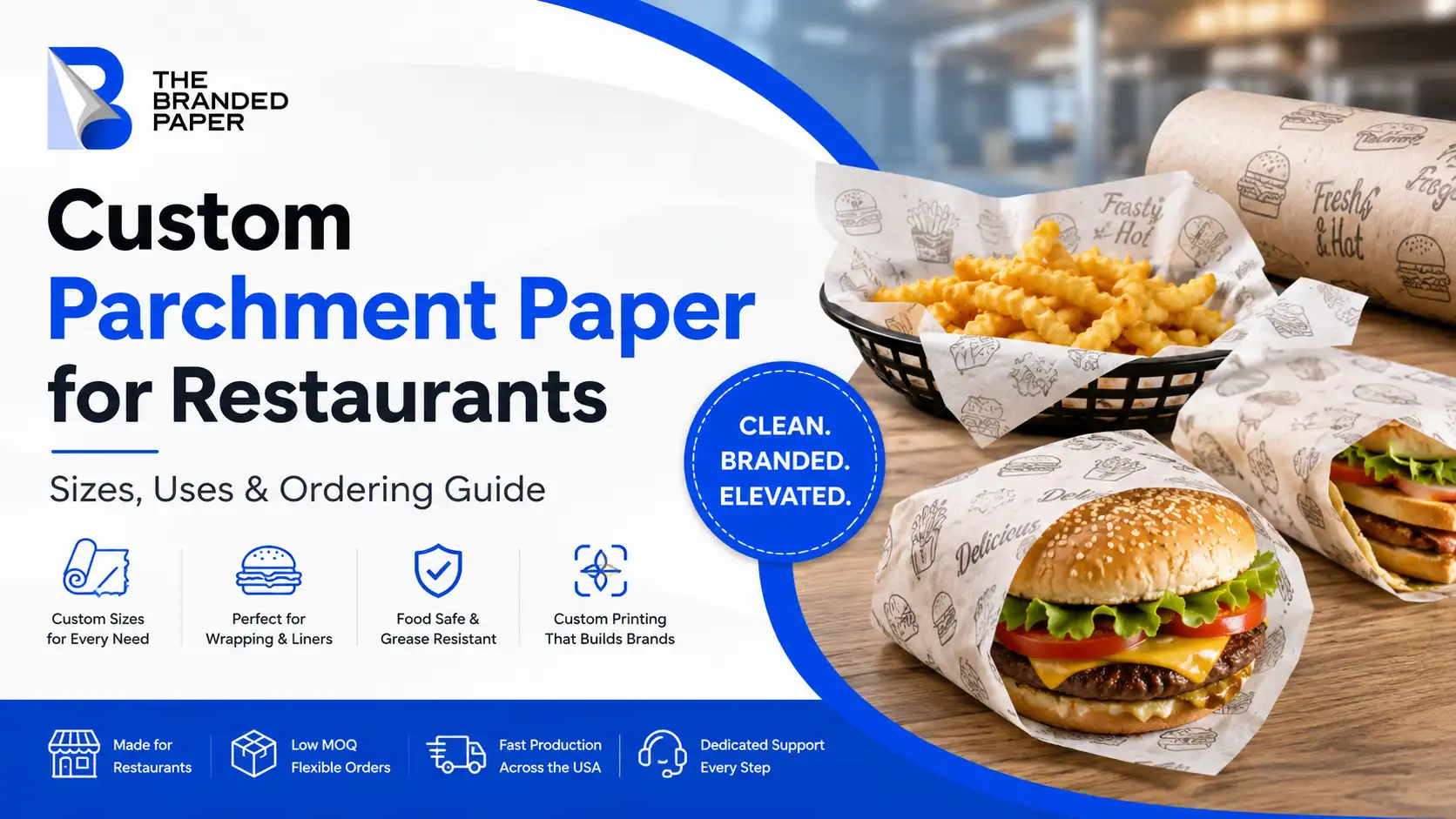
Custom parchment paper for restaurants is food-contact paper designed for restaurant serving, wrapping, lining, or presentation and printed with a restaurant’s branding. Depending on the intended application, restaurants may use it as a wrapper, basket liner, tray liner, deli-style sheet, or food presentation layer.
The main benefit is practical: one piece of packaging can perform a useful food-service job while also carrying a logo, pattern, colors, or other brand elements.
For restaurants, the most common considerations are:
- Food-contact suitability
- Grease and moisture resistance
- Sheet size and format
- Printing requirements
- Food type and portion size
- Wrapping or lining method
- Storage and handling
- Order quantity and overall cost
Food-contact packaging is regulated based on the substance and its intended conditions of use. The FDA explains that food-contact substances include packaging and components that come into contact with food, so the material and its intended application both matter.
Why Do Restaurants Use Parchment Paper for Food Packaging?
Restaurants use parchment paper because it can create a clean barrier between food and serving surfaces while improving presentation. It is especially useful for foods that are served directly on paper, wrapped for customers, or placed in baskets and trays.
Parchment can also reduce the need for separate presentation materials. A printed sheet can line a basket, wrap a sandwich, or sit beneath a burger while keeping the restaurant’s branding visible.
Ordinary restaurant uses include:
- Burger wrapping: A sheet can help wrap individual burgers and support cleaner handling.
- Sandwich wrapping: Parchment can be folded around sandwiches for counter service or takeout.
- Basket liners: Printed sheets can line food baskets for burgers, fries, appetizers, and other menu items.
- Tray liners: Sheets can create a branded presentation layer beneath food.
- Bakery packaging: Restaurants with bakery items can use suitable parchment formats around pastries and baked foods.
- Takeout presentation: Sheets can be used as part of a broader food-packaging system for prepared orders.
The exact suitability depends on the paper construction and intended use. A restaurant should select paper based on its specific food-contact conditions rather than assuming every parchment product works for every application.
What Are the Best Uses for Parchment Paper in a Restaurant?
The best application depends on the type of food and how it reaches the customer. Thin sheets may work well for lining and presentation, while a larger format may be more useful when wrapping a full sandwich or burger.
| Restaurant Use | What the Paper Does | Useful Format |
| Burger wrapping | Wraps or partially wraps individual burgers | Medium or large sheets |
| Sandwich wrapping | Covers food and supports clean handling | Medium to large sheets |
| Basket liners | Creates a branded layer under food | Pre-cut sheets |
| Tray liners | Covers serving trays or trays used for takeout | Large sheets |
| Bakery items | Helps with food presentation and handling | Small to medium sheets |
| Takeout food | Supports wrapping and presentation | Size based on food |
| Counter service | Adds branded presentation beneath food | Pre-cut sheets |
For restaurants, food packaging paper should be selected around the workflow, not only the logo. Think about where the sheet is stored, how employees grab it, how food is placed on it, and how quickly the package must be assembled during a busy service.
What Parchment Paper Size Should a Restaurant Choose?
The right parchment paper size is the smallest sheet that comfortably performs the intended job without creating unnecessary waste. A burger wrap may need a very different sheet size from a tray liner, and a sandwich wrapper may require enough extra paper for folding and securing the package.
There is no single standard size that works for every restaurant. The best size depends on the food dimensions and the wrapping or lining technique.
Before ordering, consider:
- Measure the food or serving area. Start with the actual burger, sandwich, basket, or tray.
- Allow room for folding. Wrappers need extra material around the food.
- Consider overlap. A sheet should cover the area that customers will actually touch or see.
- Test the handling process. A sheet that looks right on paper may be awkward for staff to fold.
- Reduce unnecessary overhang. Oversized sheets can increase paper use and storage needs.
For custom parchment paper sizes, a simple sample test can prevent a costly bulk-order mistake. Test the actual food, fold pattern, and packaging speed before committing to a large production run.
Common Parchment Paper Sheet Sizes
Restaurant packaging suppliers may offer standard sheet sizes as well as custom dimensions. The best choice depends on the application rather than the name of the food alone.
For example, a restaurant might use:
- Smaller sheets for pastries or individual bakery items
- Medium sheets for sandwiches and small servings
- Larger sheets for burgers or full-food wrapping
- Extra-large sheets for trays and multi-item presentation
The useful size is determined by finished package dimensions, not simply by the size of the food.
A burger that measures 5 inches across may need considerably more than a 5-by-5-inch sheet if the paper must wrap around the sides and overlap underneath. The same principle applies to sandwiches.
Parchment Paper Sheets vs. Rolls: Which Is Better?
Pre-cut parchment paper sheets are usually easier for fast restaurant service, while rolls offer more flexibility when staff need variable lengths. The better format depends on packaging speed, storage, equipment, and the type of food being wrapped.
| Factor | Pre-Cut Sheets | Rolls |
| Speed | Fast and consistent | Requires cutting or tearing |
| Portion control | Easy | More variable |
| Size consistency | High | Depends on cutting |
| Storage | Simple stacking | Requires roll storage |
| Best for | Liners, wrappers, repeat sizes | Flexible wrapping applications |
| Waste control | Predictable | Can vary by cut length |
| Staff workflow | Simple grab-and-use | More handling |
For a busy restaurant with a repeatable menu, pre-cut sheets can make packaging more consistent. A business that wraps different food sizes may prefer the flexibility of rolls.
Testing both formats during a normal service period can reveal which option works better for employees.
Is Parchment Paper Food Safe?
Parchment paper can be suitable for food contact when the specific paper construction and intended use meet applicable food-contact requirements. Restaurants should not rely on the word “parchment” alone. They should ask suppliers for material information appropriate to the intended application.
The FDA treats food packaging as a food-contact application and evaluates substances based on their intended uses and conditions of use. Those conditions can include the type of food, temperature, and storage or processing conditions.
For commercial purchasing, ask about:
- Food-contact suitability
- Intended food types
- Temperature limitations
- Coatings or treatments
- Printing inks and other components
- Supplier documentation
- Intended use conditions
This matters especially for restaurants using paper with hot, oily, wet, acidic, or high-fat foods. The FDA’s food-contact framework distinguishes between different food types and conditions rather than treating every food-packaging application as identical.
What About PFAS in Food Packaging?
PFAS has become an important purchasing consideration for food-service packaging. The FDA states that PFAS-containing grease-proofing substances are no longer being sold by manufacturers for food-contact use on paper food packaging in the U.S., following a market phase-out, and the agency announced in January 2025 that related food-contact notifications were no longer effective.
For a restaurant evaluating custom packaging, it is reasonable to ask suppliers whether the intended paper construction and treatments meet the restaurant’s current food-contact and material requirements.
How Should Restaurants Choose Parchment Paper for Food Packaging?
Restaurants should choose parchment paper based on food type, packaging method, size, operating conditions, and branding requirements. A sheet that works well as a cool-food basket liner may not be the best option for another application with different temperature or food-contact conditions.
Use this decision process:
1. Start with the food
Identify what the paper will contact.
Burgers, sandwiches, fries, pastries, and baked foods create different packaging needs. A greasy food may require stronger grease resistance than a dry food.
2. Define the application
Decide whether the paper will be used for:
- Wrapping
- Basket lining
- Tray lining
- Food presentation
- Takeout packaging
- Bakery packaging
3. Determine the required size
Measure the food and allow enough material for folding, overlap, or lining.
4. Decide between sheets and rolls
Choose the format that fits your staff workflow and daily order volume.
5. Review printing requirements
A restaurant may use a simple logo, repeating pattern, brand colors, or a more detailed design. The artwork should remain clear at the actual sheet size.
6. Confirm material and food-contact requirements
Ask the supplier for the documentation and specifications relevant to the intended use.
7. Order samples when possible
A sample can reveal practical issues that specifications alone cannot. Test folding, tearing, grease handling, logo visibility, and speed of use during a normal shift.
How Does Custom Printing Improve Restaurant Packaging?
Custom printing turns a functional parchment sheet into part of the customer’s dining experience. Instead of using plain restaurant food packaging paper, a business can use its logo, brand pattern, colors, or other visual elements to create a more consistent presentation.
For example, a restaurant can use the same visual system across:
- Burger wrappers
- Sandwich sheets
- Basket liners
- Tray liners
- Takeout packaging
- Bakery presentation
The strongest designs are usually easy to recognize at a glance. A large logo, repeating brand mark, or simple pattern can work better than packing the entire sheet with small text.
Custom printed food wrapping paper should also be considered from an operational point of view. The design needs to work on the actual paper size and remain useful even when folded around food.
You can explore Custom food wrapping paper for broader branded wrapping applications or see the options available for custom parchment paper.
What Affects Custom Parchment Paper Cost?
Custom parchment paper cost depends on several factors, including paper size, quantity, printing specifications, material construction, format, and shipping. There is no useful single price for every restaurant because a 1,000-sheet small-format order is very different from a large bulk order with custom dimensions and full-color printing.
Key cost factors include:
| Cost Factor | How It Can Affect the Order |
| Sheet size | Larger sheets use more material |
| Order quantity | Larger runs may improve unit economics |
| Printing | More complex printing can affect production cost |
| Number of colors | Printing requirements vary by project |
| Custom dimensions | Non-standard sizes may affect setup |
| Sheets vs. rolls | Production and handling differ |
| Packaging | Shipment and storage requirements vary |
| Shipping | Weight, volume, and destination affect delivered cost |
The most useful way to compare quotes is to evaluate the delivered cost per usable sheet, not only the advertised unit price.
For example, a cheaper oversized sheet may create more waste than a slightly higher-priced sheet that fits the food perfectly. Likewise, a roll can appear economical until staff time and cutting waste are considered.
How Can Restaurants Reduce Parchment Paper Waste?
Restaurants can reduce packaging waste by matching paper size to the actual application and standardizing common packaging formats.
A practical approach is to identify the restaurant’s top three or four packaging tasks and create a specific sheet size for each one. This avoids using one oversized sheet for every menu item.
Useful steps include:
- Standardize common wrapper sizes.
- Use pre-cut sheets for repeat applications.
- Test folds before approving a final size.
- Avoid excessive overlap.
- Train employees on the intended folding method.
- Review actual paper usage after launch.
Better sizing can improve both packaging speed and material efficiency.
Common Mistakes When Ordering Custom Parchment Paper
The biggest ordering mistakes usually happen before production begins. Restaurants often focus on appearance first and discover later that the sheet is too small, too large, awkward to fold, or poorly suited to the intended application.
Choosing the logo before choosing the application
Start with how the paper will be used. Then build the design around the available surface.
Ordering one size for everything
A single sheet size may work for some menu items but create waste or poor coverage for others.
Ignoring the staff workflow
Packaging should be easy to grab, fold, and place during busy service.
Comparing price without comparing specifications
A quote is only useful when the paper size, quantity, printing, format, and intended use are comparable.
Skipping sample testing
A sample lets employees test the actual paper under real working conditions before the full order.
When Should a Restaurant Choose Custom Parchment Paper?
Custom parchment paper makes sense when a restaurant wants a combination of functional food packaging and consistent brand presentation. It is especially useful for businesses that regularly serve wrapped or lined foods and want packaging that looks intentional instead of generic.
It can be a strong option for:
- Burger restaurants
- Sandwich shops
- Cafés
- Delis
- Bakeries
- Food trucks
- Fast-casual restaurants
- Catering businesses
- Growing food brands
The more frequently a restaurant uses a particular wrapper or liner, the more valuable it becomes to standardize the size, format, and design.
Custom Parchment Paper for Restaurants: A Practical Ordering Checklist
Before requesting a quote, have these details ready:
- Food or menu item being packaged
- Intended application
- Preferred sheet or roll format
- Approximate paper dimensions
- Estimated order quantity
- Logo and artwork
- Preferred print colors
- Food-contact requirements
- Expected food temperature and conditions
- Shipping destination
Having this information ready helps suppliers recommend an appropriate construction and prepare a more useful quotation.
The Branded Paper provides custom branded food packaging solutions for restaurants and food businesses across the USA, including custom parchment paper designed around your application, size, and branding needs.
Explore Custom Parchment Paper to review the product options, or see Personalized Parchment Paper for Food Businesses for more branding ideas.
Can restaurants order custom parchment paper in different sizes?
Yes. Custom dimensions can be specified based on the restaurant’s food, wrapping method, basket, or tray. A sample run can help confirm the right dimensions before placing a larger order.
Custom parchment paper works best when the paper, size, printing, and packaging workflow are designed together. For restaurants, that means starting with the food and service process, then choosing the material and format that fit those needs.
For a branded packaging solution built around your restaurant’s requirements, Request custom parchment paper from The Branded Paper.
Frequently Asked Questions
1. What is custom parchment paper used for in restaurants?
Custom parchment paper can be used for burger wrapping, sandwich wrapping, basket liners, tray liners, bakery presentation, and other food-packaging applications. The correct paper construction depends on the intended food-contact conditions.
2. What size parchment paper is best for burgers?
There is no single best size for every burger. The sheet should be large enough to cover the burger and provide enough material for the restaurant’s preferred folding or wrapping method. Testing a sample with the actual burger size is the safest way to select dimensions.
3. Are parchment paper sheets better than rolls for restaurants?
Pre-cut sheets are often easier for repeat restaurant applications because they provide consistent sizes and quick handling. Rolls offer more flexibility when different food sizes require different lengths.
4. Can parchment paper be custom printed with a restaurant logo?
Yes. Custom parchment paper can be produced with restaurant branding, depending on the supplier’s printing capabilities and the specific paper construction. Artwork should be designed for the final sheet size and intended folding pattern.
5. Is custom parchment paper food safe?
A parchment product is suitable for food contact only when its specific construction and intended application meet applicable food-contact requirements. Restaurants should review supplier documentation rather than assuming that every parchment product is suitable for every food or temperature.
6. Does parchment paper work for greasy food?
Parchment is commonly selected for food-service applications where grease resistance is useful, but performance depends on the specific paper construction and intended use. Restaurants should confirm the product’s suitability for the foods they serve.
7. How much does custom parchment paper cost?
Pricing varies based on sheet dimensions, order quantity, printing, material specifications, format, packaging, and shipping. The best comparison is the delivered cost for the exact specifications the restaurant needs.