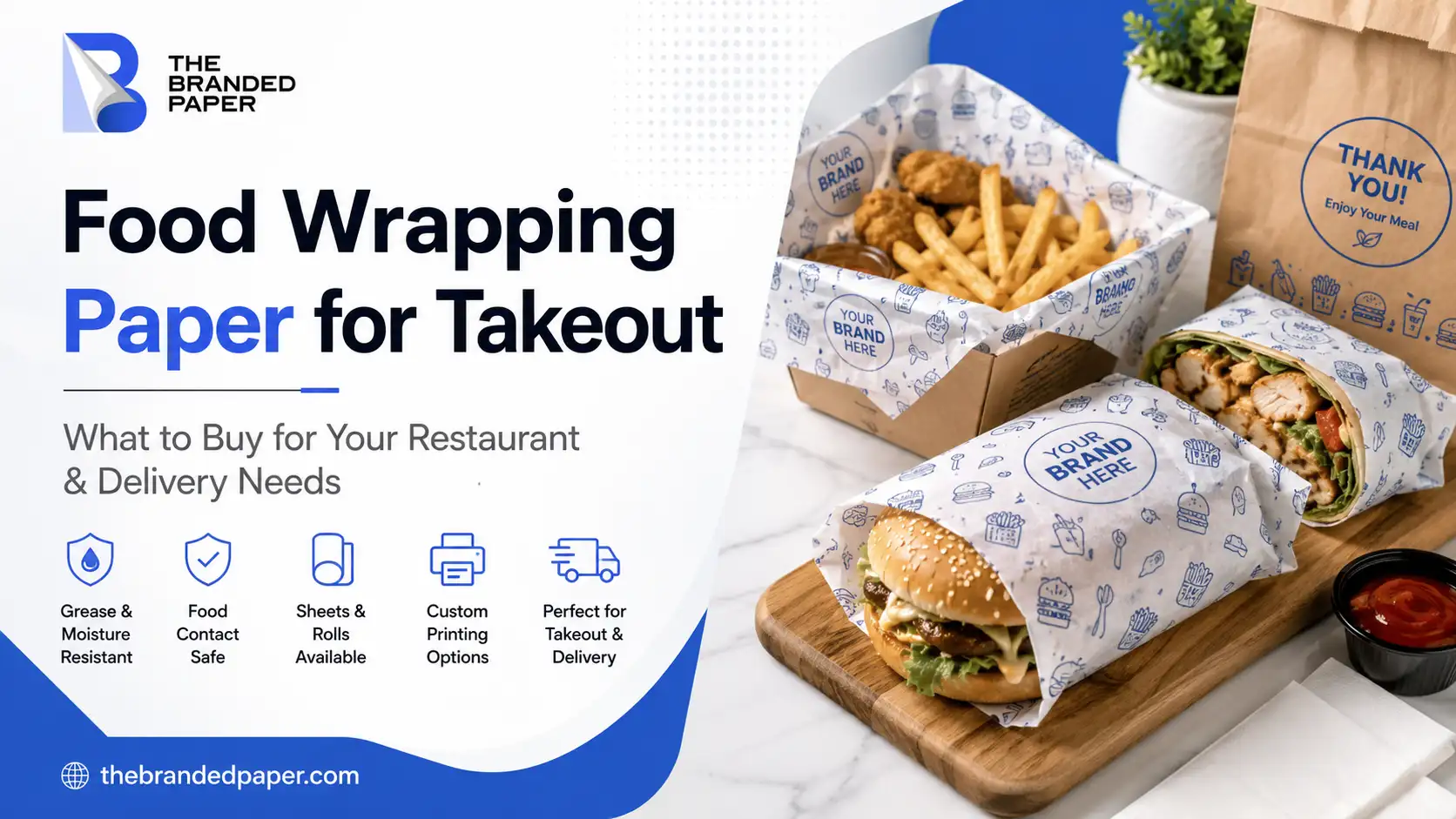
Food wrapping paper for takeout needs to do more than hold food together. The right paper helps control grease, protect food during handling, reduce moisture problems, and give your restaurant a cleaner, branded presentation. The wrong choice can leave sauces leaking through the wrap, make fried food soggy, or create a poor experience when an order arrives.
For restaurants, cafés, food trucks, delis, bakeries, and other food businesses, the best choice depends on the food being served, how long it will be wrapped, whether it will be delivered, and how much branding you want. A burger may need stronger grease resistance than a dry sandwich, while a pastry may need a different surface altogether.
What Is the Best Food Wrapping Paper for Takeout?
The best food wrapping paper for takeout depends on the food, grease level, moisture, holding time, and packaging format. Greaseproof, wax, parchment, deli, and kraft papers can all work for different applications. The key is matching the paper to the food rather than choosing one material for every menu item.
For most restaurant takeout operations, start with these factors:
- Grease resistance for burgers, fried foods, meats, and oily sauces
- Moisture resistance for foods that release steam or liquids
- Food-contact suitability for direct contact with the intended food
- Paper strength for wrapping, folding, lining, and handling
- Sheet or roll format based on your packaging workflow
- Printing quality if the paper is part of your brand presentation
Food-contact packaging is regulated differently from ordinary paper because materials that touch food can transfer substances into the food. The FDA defines food-contact substances to include packaging components and substances applied to packaging surfaces, so suppliers should be able to explain the intended food-contact use of their materials.
Which Paper Should Restaurants Use for Takeout Food?
Different papers solve different packaging problems. Wax paper is useful for moisture and release, greaseproof paper is designed around grease resistance, parchment is suited to heat-related and food-contact applications, deli paper works well as a liner or wrapper, and kraft paper provides a natural paper look with strong visual appeal.
| Paper type | Best for | Main advantage | Takeout consideration |
| Wax paper | Sandwiches, burgers, snacks | Moisture and release properties | Choose based on the food and intended contact conditions |
| Greaseproof paper | Fried foods, burgers, greasy foods | Grease and oil resistance | Good option when grease control is the priority |
| Parchment paper | Baked foods, sandwiches, food preparation | Heat and food-contact versatility | Better suited to applications where heat performance matters |
| Deli paper | Sandwiches, baskets, trays | Lightweight and practical | Often used as a liner or food wrapper |
| Butcher paper | BBQ, meats, sandwiches | Strong, durable paper | Useful for heavier food items |
| Kraft paper | Natural-style wrapping and packaging | Strength and presentation | Best when appearance and paper feel matter |
The final choice should account for the food’s oil, water, temperature, and holding time. A paper that works well for a dry pastry may not perform as well around hot fried food.
What Makes Food Wrapping Paper Good for Takeout?
Good takeout wrapping paper protects the food without creating a new packaging problem. Grease resistance, moisture control, strength, food-contact suitability, and practical sizing matter more than simply choosing the thickest paper available.
Consider the following before ordering:
Grease resistance
Grease and oil can quickly move through unsuitable paper. This is especially common with burgers, fried chicken, fries, bacon, meats, and foods served with oily sauces.
Grease-resistant food packaging helps keep oil from soaking through the wrapper and onto bags, trays, counters, or customers’ hands.
Moisture control
Hot food releases steam. Saucy foods can also add moisture to the wrapper.
A moisture-resistant food paper can help reduce premature breakdown, but the wrapper still needs to allow the food to be packaged appropriately. Over-wrapping hot food can trap steam and affect texture.
Strength
A takeout wrapper needs to survive folding, gripping, stacking, carrying, and opening.
Thin paper may be fine for a light sandwich. Heavier food or larger portions may need a stronger paper structure.
Food-contact suitability
A food wrapper should be selected for its intended food-contact application rather than treated as ordinary printing paper.
Ask suppliers about the material, coatings, inks, and intended food-contact use. FDA guidance recognizes packaging materials and components as food-contact substances when they come into contact with food.
What Paper Is Best for Burgers and Greasy Takeout Food?
For burgers, fried foods, and oily menu items, grease-resistant or greaseproof paper is usually a better starting point than ordinary uncoated paper. The right specification depends on how much oil the food releases, how hot it is, and how long it will remain wrapped.
For Paper for wrapping burgers for takeout, look for:
- Good grease resistance
- Enough strength for folding
- A suitable sheet size
- Food-contact suitability
- Printing that remains clear on the selected paper
The wrapper also needs to match the way your kitchen works. A paper that looks good but takes too long to fold or tears during service can slow down packaging.
For especially greasy menu items, test the actual wrapper with the food before placing a large order. Performance on a sample can reveal issues that are not obvious from a paper specification alone.
What Paper Is Best for Sandwiches and Deli Foods?
Sandwiches generally need a wrapper that balances grease control, strength, appearance, and easy opening. Deli paper, wax paper, parchment-style paper, and other food wrapping papers can all be suitable depending on the sandwich and holding conditions.
For Paper for wrapping sandwiches for takeout, consider:
- How much sauce or oil the sandwich contains
- Whether it will be eaten immediately or delivered
- Whether the wrapper needs to stay folded
- Whether the sandwich needs visibility or branding
- Whether the paper will also line a tray or basket
A dry grilled sandwich and a sauce-heavy hot sandwich can behave very differently after 20–30 minutes in packaging. Your paper selection should reflect the actual menu rather than a generic “sandwich paper” label.
Should You Use Sheets or Rolls for Takeout Wrapping?
Sheets are usually easier for fast, repeatable individual wrapping, while rolls can provide more flexibility for custom cutting and different food sizes. The better format depends on your packaging workflow, storage space, equipment, and daily order volume.
Food wrapping paper sheets
Food wrapping paper sheets for restaurants are useful when staff need ready-to-use pieces during busy service.
Advantages include:
- Consistent sizes
- Fast application
- Easy stacking
- Simple storage
- Less cutting during service
Sheets work particularly well when your menu uses standard sizes.
Rolls
Rolls can be useful when restaurants need variable lengths or want to cut paper to different food sizes.
They may make more sense when packaging requirements change frequently or when the operation already uses roll-fed packaging equipment.
What Size Food Wrapping Paper Should You Buy?
The right sheet size depends on the food and wrapping method. Small sandwiches, burgers, large wraps, baskets, and platters should not automatically use the same sheet size.
Before ordering, measure the actual food and test the folding method your employees use.
| Use case | What to consider |
| Small sandwiches | Compact sheet with enough overlap |
| Burgers | Large enough for a secure fold |
| Large sandwiches or wraps | Extra coverage around the food |
| Fried foods | Enough paper to contain grease |
| Tray or basket lining | Size should cover the eating surface |
| Large BBQ portions | Stronger paper and more coverage |
A good test is simple: wrap the largest typical portion, fold it the way staff normally do, and check whether the paper stays closed without excessive material.
Is Food Wrapping Paper Safe for Takeout?
Food wrapping paper should be selected specifically for its intended food-contact use. Do not assume that any printed or coated paper is automatically suitable for direct food contact. Ask the supplier what material and coatings are intended for the application and what documentation is available.
Printing also needs attention. Food packaging can contain several components beyond the paper itself, including inks, coatings, adhesives, and other treatments. FDA guidance explains that substances applied to packaging surfaces can fall within the food-contact framework.
For restaurants buying custom packaging, ask about:
- Paper material
- Coating or treatment
- Intended food-contact use
- Printing inks
- Available compliance documentation
- Suitable food and temperature conditions
What about PFAS-free takeout wrapping paper?
PFAS has received particular attention in grease-resistant food packaging. The FDA announced in February 2024 that grease-proofing substances containing PFAS were no longer being sold by manufacturers for food-contact use in the U.S. market. In January 2025, the FDA also determined that 35 related food-contact notifications were no longer effective after the uses were abandoned.
For restaurants looking for food-contact-safe paper, it is reasonable to ask suppliers whether their grease-resistant paper is PFAS-free and what supporting documentation they can provide.
How to Choose Food Wrapping Paper for Takeout
Choosing the right wrapper becomes much easier when you start with the food and packaging workflow rather than the paper name.
1. Start with the menu
Group your foods by packaging needs.
For example:
- Burgers and fried foods → prioritize grease resistance
- Sandwiches → balance grease, moisture, and easy folding
- BBQ and meats → prioritize strength and coverage
- Baked goods → consider heat and food-contact requirements
- Dry foods → simpler paper may be sufficient
2. Consider the delivery time
Food packaging for delivery has to work beyond the kitchen counter. Consider how the food will behave during holding, transport, and handoff.
A wrapper that performs perfectly for immediate service may not be the best choice for a delivery order that sits in a bag for longer.
3. Select the right format
Choose takeout packaging paper sheets when consistency and speed matter. Choose rolls when flexibility in length is more useful.
4. Test before buying in bulk
A sample run can answer practical questions quickly:
- Does oil soak through?
- Does the paper tear?
- Does it stay folded?
- Does steam affect the food?
- Does the print remain clear?
- Can staff wrap orders quickly?
5. Add your brand when it makes sense
Custom printing turns a basic wrapper into part of the customer experience. A restaurant logo, brand pattern, color system, website, or social handle can make plain food packaging feel more intentional.
Is Custom Food Wrapping Paper Worth It for Restaurants?
Custom food wrapping paper can be worthwhile when packaging is visible to customers and the restaurant wants a consistent branded experience. Instead of treating the wrapper as a disposable afterthought, businesses can use it as another touchpoint for their logo and visual identity.
For custom food wrapping paper for restaurants, consider:
- Logo placement
- Brand colors
- Repeating patterns
- Print coverage
- Sheet size
- Paper type
- Order quantity
- Packaging workflow
The goal should not be to fill every inch with graphics. A clear logo and simple repeat pattern can often create a cleaner result than an overcrowded design.
The Branded Paper provides custom printed food packaging options for U.S. food businesses, including custom wax paper, butcher paper, food wrapping paper, parchment paper, kraft wrapping paper, and paper bags.
Explore Custom Food Wrapping Paper
Common Mistakes When Buying Takeout Wrapping Paper
Buying the cheapest paper or choosing a material based only on appearance can create problems later. The most common mistakes are simple to avoid.
Using one paper for every food: Different foods release different amounts of oil and moisture.
Skipping sample testing: Packaging should be tested with real food and normal holding conditions.
Choosing the wrong sheet size: Too small makes wrapping difficult. Too large wastes material and slows packing.
Ignoring printing requirements: Some papers may produce a different visual result depending on the print coverage and surface.
Forgetting delivery conditions: Packaging should perform during the full journey, not only at the prep counter.
Assuming “food grade” covers every application: Food-contact suitability depends on the intended use and the materials involved.
Make Your Takeout Packaging Work Harder
The right food wrapping paper for takeout should protect the food, support efficient service, and fit the way your customers receive their orders. There is no single paper that is perfect for every menu.
Start with the food. Then consider grease, moisture, temperature, holding time, sheet size, and delivery conditions. Once the material performs properly, custom printing can turn the wrapper into a useful part of your restaurant’s brand experience.
For restaurants and food businesses that need branded packaging, The Branded Paper offers custom-printed food wrapping paper designed around different food types, sizes, and branding requirements.
Get a Custom Food Packaging Quote
Frequently Asked Questions
1. What is the best paper for takeout food?
The best paper depends on the menu. Greaseproof or grease-resistant paper is often a strong option for oily foods, while deli, wax, parchment, butcher, or kraft papers can suit other applications. Test the paper with the actual food before ordering in bulk.
2. What paper is best for greasy takeout food?
Greaseproof or grease-resistant paper is generally the first category to consider for greasy foods such as burgers, fried chicken, fries, and BBQ. The specific paper should still be matched to the food’s oil level and holding conditions.
3. Can food wrapping paper be custom printed?
Yes. Food wrapping paper can be custom printed with logos, colors, patterns, and other brand artwork. The paper type, print coverage, sheet size, and order quantity should be selected together.
4. Are Paper sheets better than rolls for restaurants?
Neither is universally better. Sheets provide ready-to-use, consistent pieces, while rolls offer flexibility for different lengths. Your order volume and packaging process should determine the better format.
5. Is PFAS-free paper available for takeout packaging?
Yes. Restaurants can request PFAS-free grease-resistant or greaseproof paper and ask suppliers for supporting information. The FDA announced in 2024 that PFAS-containing grease-proofing substances were no longer being sold for food-contact use in the U.S. market.
6. How do I choose the right size of takeout wrapping paper?
Measure the food you actually serve and test the normal folding method. The sheet should provide enough coverage to close securely without requiring excessive paper.