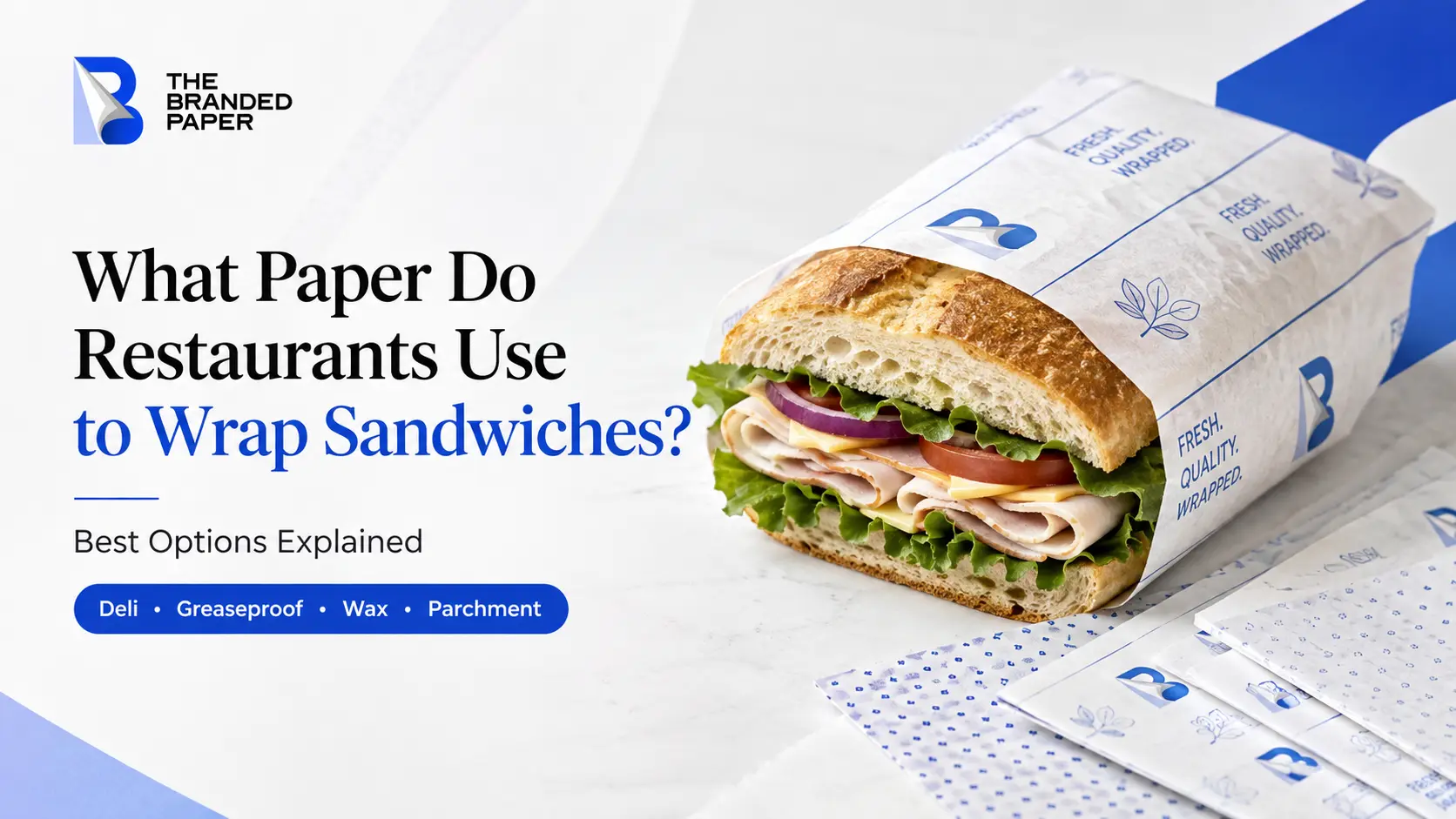
Not every sheet of paper belongs around a sandwich. Some papers handle grease well but struggle with moisture. Others keep food neat but are unnecessary for a simple cold sandwich.
The best paper for wrapping sandwiches depends on what is inside the sandwich, how hot it is, how long it will stay wrapped, and whether it is being served in-store, carried away, or delivered.
Restaurants commonly use deli paper, greaseproof paper, wax paper, and food-grade wrapping paper. Parchment can also work in certain situations. The right choice keeps the sandwich easier to hold, limits grease marks, supports a cleaner presentation, and helps the kitchen pack orders faster.
What Paper Is Used to Wrap Sandwiches?
For most restaurants, deli paper and greaseproof paper are the best choices for wrapping sandwiches.
Deli paper works well for everyday sandwiches, subs, wraps, burgers, and counter service. Greaseproof paper is usually the better choice when sandwiches contain oily fillings, melted cheese, sauces, butter, or grilled ingredients.
Wax paper can be useful for cold or room-temperature foods, while parchment paper makes more sense when heat resistance is part of the job.
| Paper Type | Best For | Grease Resistance | Heat Use | Restaurant Fit |
| Deli paper | Subs, sandwiches, wraps | Good | Limited | Excellent |
| Greaseproof paper | Hot, oily, saucy sandwiches | High | Depends on grade | Excellent |
| Wax paper | Cold sandwiches, storage | Good | Low | Good |
| Parchment paper | Warm food, kitchen prep | High | High within rated limits | Moderate |
| Butcher paper | Large or heavy sandwiches | Moderate | Varies | Situational |
| Kraft food paper | Rustic presentation, light foods | Varies | Varies | Situational |
Restaurants already use these paper types for different food-service jobs, and the material should be selected around the food rather than its name alone.
Deli Paper Is the Everyday Choice for Sandwich Shops
Deli paper for sandwiches works because it is simple, light, and fast to handle.
During a lunch rush, employees do not want packaging that takes several steps to close. A properly sized deli sheet can be placed under the sandwich, folded around it, and handed to the customer within seconds.
It is commonly useful for:
- Cold deli sandwiches
- Subs and hoagies
- Breakfast sandwiches
- Wraps
- Burgers
- Bagels
- Pastries
- Basket and tray liners
Deli paper also gives restaurants flexibility. The same sheet may serve as the wrapping, a food liner, or part of the final presentation.
That can matter more than it sounds.
If a sandwich shop serves hundreds of orders each day, even a small packaging step repeated on every order affects prep speed. Easy-to-grab sheets can be more practical than bulky packaging that needs assembly.
Is Deli Paper the Same as Wax Paper?
Not necessarily.
“Deli paper” describes a food-service use more than one exact material construction. Depending on the supplier, deli sheets may have different grease-resistant or moisture-resistant properties.
Wax paper specifically uses a wax treatment to help create a moisture-resistant surface.
For a restaurant buyer, the better question is not simply whether the sheet is called deli paper. Ask what it is designed to handle:
- Direct food contact
- Oil and grease
- Moisture
- Warm food
- Printing
- Folding
- Short-term holding
Those details tell you more than the product name.
Greaseproof Paper Works Better for Messy Sandwiches
A turkey sandwich with lettuce behaves very differently from a cheesesteak loaded with melted cheese and sauce.
That is where greaseproof paper for sandwiches becomes useful.
Greaseproof paper is designed to slow oil and grease from passing through the sheet. It can help keep the outside of the package cleaner when wrapping foods with fatty or oily ingredients.
It is a strong choice for:
- Grilled sandwiches
- Cheesesteaks
- Breakfast sandwiches
- Burgers
- Melted cheese sandwiches
- Sandwiches with mayonnaise or oily sauces
- Fried chicken sandwiches
- Foods served with butter or dressing
The biggest benefit is not simply appearance.
When grease quickly passes through weak wrapping paper, customers may end up with oily hands, stained bags, or a wrapper that becomes difficult to hold.
A suitable grease-resistant paper for food wrapping creates a better barrier between the sandwich and everything around it.
More Grease Resistance Is Not Always Better
Packaging buyers sometimes choose the heaviest or strongest barrier they can find.
That can add cost without solving a real problem.
A cold turkey sandwich may only need a lightweight deli sheet. A double cheeseburger with sauce may need a much stronger grease barrier.
Matching the material to the menu usually makes more sense than putting every item in the same high-performance paper.
Wax Paper Works Best Away From High Heat
Wax paper for sandwiches can work well when the food is cold or near room temperature.
The wax treatment helps the sheet resist moisture and sticking, making it useful for:
- Cold sandwiches
- Bakery items
- Cheese
- Prepared snacks
- Food separation
- Short-term refrigerated storage
Wax paper should not automatically be treated as a replacement for parchment paper.
Wax-treated sheets generally are not selected for ovens or other high-heat cooking applications. Parchment is designed for heat-related kitchen jobs where the product is rated for those temperatures.
Can You Wrap Sandwiches in Wax Paper?
Yes, when the paper is intended for direct food contact, and the sandwich suits the material.
It can be practical for cold lunches, deli items, and food that will be eaten fairly soon.
For very hot, greasy, or saucy sandwiches, greaseproof food wrapping paper may be a better fit.
Parchment Paper Can Wrap Sandwiches, but It Is Often More Than You Need
Can you wrap sandwiches in parchment paper? Yes.
Parchment has good release properties and is known for handling heat better than wax paper. That makes it useful in bakeries and kitchens for baking, roasting, tray lining, and other heated food preparation.
For basic sandwich service, however, parchment may provide features the restaurant does not need.
A cold sandwich shop usually cares more about:
- Fast folding
- Grease control
- Easy stacking
- Cost per order
- Print quality
- Customer presentation
Deli or greaseproof sandwich wrapping paper often matches those needs more closely.
Parchment makes more sense when the same paper also needs to perform a heat-related kitchen task.
What About Butcher Paper and Kraft Paper?
Butcher and kraft papers can be useful, but they should not automatically replace food wrapping paper.
Butcher Paper for Sandwiches
Butcher paper may work for large sandwiches, barbecue sandwiches, oversized subs, and foods where a larger, sturdier sheet is useful.
It can create a classic food-service look, especially for barbecue concepts.
Its grease and moisture performance depends on the exact construction, so a restaurant should check the paper specification before using it for oily sandwiches.
Kraft Paper for Food Wrapping
Brown Kraft paper gives food packaging a natural, simple appearance. It can work well for cafés, bakeries, delis, and brands that prefer a less glossy presentation.
But the brown color does not automatically make a paper food-safe, greaseproof, recyclable, or compostable.
Those are separate characteristics.
Businesses interested in Eco-friendly food wrapping paper should ask specific questions about the paper fibers, coatings, inks, disposal route, and any environmental certifications instead of relying only on words such as “kraft” or “natural.”
Best Paper for Wrapping Sandwiches by Food Type
There is no single winner for every menu.
A practical way to choose is to look at what the sandwich will do to the wrapper.
| Sandwich Type | Practical Paper Choice | Why |
| Cold turkey or ham sandwich | Deli paper | Fast, lightweight wrapping |
| Italian sub with oil | Greaseproof paper | Better oil resistance |
| Cheesesteak | Greaseproof paper | Handles grease and melted cheese |
| Breakfast sandwich | Greaseproof or deli paper | Depends on butter, cheese, and oil |
| Grilled cheese | Greaseproof paper | Helps control butter and cheese |
| Cold lunch sandwich | Deli or wax paper | Simple short-term wrapping |
| Fried chicken sandwich | Greaseproof paper | Better for fried, oily food |
| Large BBQ sandwich | Greaseproof or suitable butcher paper | Better coverage for heavier food |
| Bakery sandwich or croissant | Deli paper | Clean presentation and easy handling |
A restaurant should test the paper with the actual menu before placing a large order.
A wrapper that performs perfectly around a cold sandwich may behave very differently after 20 minutes around a hot burger with sauce.
Paper Wrap vs Plastic Wrap for Sandwiches
Plastic wrap can create a tight moisture barrier. Paper usually gives restaurants better handling, presentation, and customer access.
The better choice depends on what happens after the sandwich is packed.
Paper wrapping works well when:
- The sandwich will be served soon
- Fast counter service matters
- Grease needs to be contained
- Customers need an easy-to-eat wrap
- Branding is important
- The wrapper doubles as a liner
Plastic wrap can make sense when:
- The sandwich must be sealed for storage
- Visibility is important
- Moisture retention is the main priority
- Food is displayed in a refrigerated case
The trade-off is important.
A very tight wrap can trap moisture around bread and warm ingredients. Paper may allow a different moisture balance, depending on the material and folding method.
The best way to wrap sandwiches for lunch or takeout is therefore not always the material that creates the strongest seal. It is the one that matches the sandwich, holding time, and service method.
How to Keep Sandwiches From Getting Soggy
Good sandwich wrapping starts before the wrapper touches the food.
If hot, wet ingredients are packed incorrectly, even high-quality paper cannot fix the whole problem.
Restaurants can reduce sogginess by controlling the sandwich itself.
Keep wet ingredients away from the bread
Tomatoes, pickles, sauces, and juicy vegetables can release moisture.
Cheese, lettuce, meat, or another lower-moisture ingredient can sometimes act as a buffer between wet fillings and bread.
Avoid wrapping steaming food too quickly
Hot food can release steam after it is wrapped.
If that moisture has nowhere to go, the bread may soften during holding or delivery.
The right process depends on food-safety requirements and the product, but packaging teams should account for steam instead of treating every hot sandwich like a cold one.
Control sauce portions
More sauce often means more pressure on the paper barrier and greater risk of soggy bread.
Consistent portioning helps both the food and the packaging perform more predictably.
Match the paper to delivery time
A sandwich eaten five minutes after wrapping has different packaging needs from one sitting inside a delivery bag for 30 minutes.
Test both situations if your restaurant handles dine-in and delivery.
How to Wrap a Sandwich in Paper
A good wrap should hold the sandwich without crushing it.
One common method is:
- Place the sandwich near the center of the paper.
- Bring two opposite sides over the sandwich.
- Pull the paper snug enough to hold the food together.
- Fold or roll the sandwich forward.
- Tuck or fold the open ends underneath.
- Add a label only if the package needs identification or extra closure.
Avoid wrapping so tightly that soft bread, toppings, or fillings are compressed.
For restaurant use, the sheet size matters too. Too little paper creates weak folds. Too much paper wastes material and can slow down packing.
Common Sandwich Wrapping Mistakes
Small packaging problems become expensive when they happen across hundreds of orders.
Choosing Paper Only by Price
A cheaper sheet is not a saving if employees need two sheets for one sandwich or grease regularly reaches the outer bag.
Compare cost per properly packed order, not only cost per sheet.
Using One Paper for the Whole Menu
Different foods create different amounts of oil, steam, moisture, and pressure.
A deli may be able to standardize most orders around one sheet, but high-grease menu items may need a separate option.
Ordering the Wrong Sheet Size
Oversized paper creates unnecessary waste. Undersized sheets make wrapping difficult and can lead to open edges.
Test the actual sandwich dimensions before deciding.
Ignoring Kitchen Workflow
Beautiful packaging can still fail if employees struggle to separate sheets during a rush.
Paper should be easy to stack, grab, fold, and store near the packing station.
Confusing “Food-Safe” With “Suitable for Every Use”
Food-contact packaging needs to match its intended conditions.
The FDA regulates substances used in food-contact materials, including components that can help prevent grease from leaking through paper packaging. Buyers should confirm the intended food-contact and temperature conditions rather than assuming one paper works for every application.
Food-Safe Sandwich Paper Deserves a Closer Look in 2026
For U.S. food businesses, the material behind the grease barrier matters.
FDA information states that PFAS-containing substances used as grease-proofers on paper and paperboard food packaging were phased out of the U.S. market, and related food-contact authorizations were determined to be no longer effective.
When buying food-safe paper for wrapping sandwiches, useful supplier questions include:
- Is the paper suitable for direct food contact?
- What creates its grease-resistant barrier?
- What temperatures and food types is it intended to handle?
- Is it suitable for hot food?
- What inks are used for printed areas?
- Is printing positioned appropriately for the intended food-contact setup?
- Does the paper contain a coating?
- What disposal claims can be supported for the finished printed product?
Specific answers are more useful than a broad “food-grade” label.
Custom Sandwich Wrapping Paper Can Do Two Jobs at Once
Wrapping paper already has a functional job. It keeps the sandwich together and makes it easier to serve.
Custom printing allows the same sheet to become part of the restaurant’s visual identity.
A logo or simple pattern can appear on:
- Sandwich wraps
- Burger wraps
- Basket liners
- Deli sheets
- Bakery wraps
- Takeout presentation
That means the brand can appear inside the food bag instead of relying only on a sticker or outer box.
The key is restraint.
A clear repeated logo, simple brand pattern, or one-color print is often easier to recognize than covering every inch of the paper with detailed artwork.
For busy restaurants, consistency also matters. Using the same visual style across wraps, liners, bags, and other food packaging can make separate menu items feel like they came from one brand.
The Branded Paper offers custom printed food wrapping paper for restaurants and food brands in the United States, including options intended for sandwiches, burgers, deli foods, bakery items, and takeaway service.
If plain sandwich wrapping is doing the job but doing nothing for your presentation, custom food paper is a practical way to strengthen the customer experience without adding another piece of packaging.
Which Sandwich Wrapping Paper Should You Choose?
Start with the food, not the paper name.
Choose deli paper when you need fast, flexible wrapping for everyday sandwiches and counter service.
Choose greaseproof paper when oils, sauces, cheese, butter, or fried ingredients put more pressure on the wrapper.
Choose wax paper for suitable cold and low-heat wrapping tasks where moisture resistance is useful.
Choose Parchment paper when heat resistance is actually part of the job.
Then test the paper with a real sandwich. Wrap it, hold it for the normal service time, place it inside the usual takeout bag, and see what happens.
That simple test can reveal more than a specification sheet alone.
Restaurants ready to turn plain wrapping into branded packaging can Request custom food wrapping paper based on their menu, sheet size, print needs, and order volume from The Branded Paper.
Frequently Asked Questions
1. What is the best paper for wrapping sandwiches?
Deli paper works well for most everyday sandwiches. Greaseproof paper is usually a better choice for oily, saucy, grilled, or fried sandwiches. The best option depends on grease, moisture, temperature, and holding time.
2. Can you wrap sandwiches in parchment paper?
Yes. Parchment paper can be used to wrap sandwiches, especially when heat resistance is useful. For normal restaurant sandwich service, deli or greaseproof paper may be more practical and economical.
3. Can you wrap sandwiches in wax paper?
Yes, wax paper can be suitable for cold or room-temperature sandwiches when the product is designed for direct food contact. It should not be treated like oven-safe parchment paper.
4. What is deli paper used for?
Deli paper is commonly used for sandwiches, burgers, wraps, pastries, basket liners, and other quick-service foods. Restaurants like it because sheets are easy to handle and can also support branded presentation.
5. What is greaseproof paper?
Greaseproof paper is designed to resist the movement of oil and fat through the sheet. Restaurants commonly use it around burgers, fried foods, sandwiches, pastries, and other foods that can leave grease marks.
6. How do you keep sandwiches fresh when wrapped?
Use paper suited to the sandwich, control wet ingredients, avoid excessive sauce, and consider how long the food will remain wrapped. Hot sandwiches also need a packaging setup that accounts for steam and condensation.
7. Is deli paper the same as wax paper?
No. Deli paper is a broader food-service paper category, while wax paper has a wax-treated surface. Some deli papers may have special treatments, so buyers should check the exact product construction and intended use.
8. Is paper better than plastic wrap for sandwiches?
Neither is always better. Paper works well for fast restaurant service, easy handling, grease control, and presentation. Plastic wrap can be useful when a tight seal and refrigerated display are more important.