A burger wrapper may look like a small purchasing decision. In practice, the wrong paper can cause grease leaks, soggy buns, slow prep, wasted sheets, and poor delivery presentation.
Custom burger wrapping paper should protect the food, fit the wrapping station, and keep the restaurant’s branding visible. It also needs to suit the burger’s temperature, grease level, sauces, holding time, and delivery method.
A thin sheet may work for a simple slider served at the counter. A double cheeseburger with hot patties, melted cheese, and loose sauce needs stronger grease and moisture resistance. Choosing the best paper starts with how the burger is prepared and served—not with the logo design.
What Paper Is Used to Wrap Burgers?
Restaurants commonly use greaseproof paper, deli paper, wax-coated paper, or kraft food paper to wrap burgers. These names are sometimes used loosely, but the materials do not always perform the same way.
For most restaurant burgers, the best paper is:
- Approved or suitable for direct food contact
- Resistant to grease and moisture
- Easy for employees to fold
- Strong enough for hot, heavy burgers
- Sized to cover the burger without excess waste
- Printable with inks suitable for the intended food-contact use
The best choice depends on the menu and service model.
| Paper type | Main benefit | Common restaurant use | Main concern |
| Greaseproof paper | Controls oil and grease | Burgers, fried food, sandwiches | Performance varies by grade |
| Deli paper | Fast handling and good presentation | Counter service, baskets, sandwiches | May need added grease resistance |
| Wax paper | Moisture and release properties | Cold or room-temperature wrapping | Not automatically suitable for high heat |
| Kraft food paper | Natural appearance and branding | Burgers, wraps, basket liners | Print colors may appear darker |
| Parchment paper | Heat resistance and nonstick performance | Baking and kitchen preparation | Often unnecessary for finished burgers |
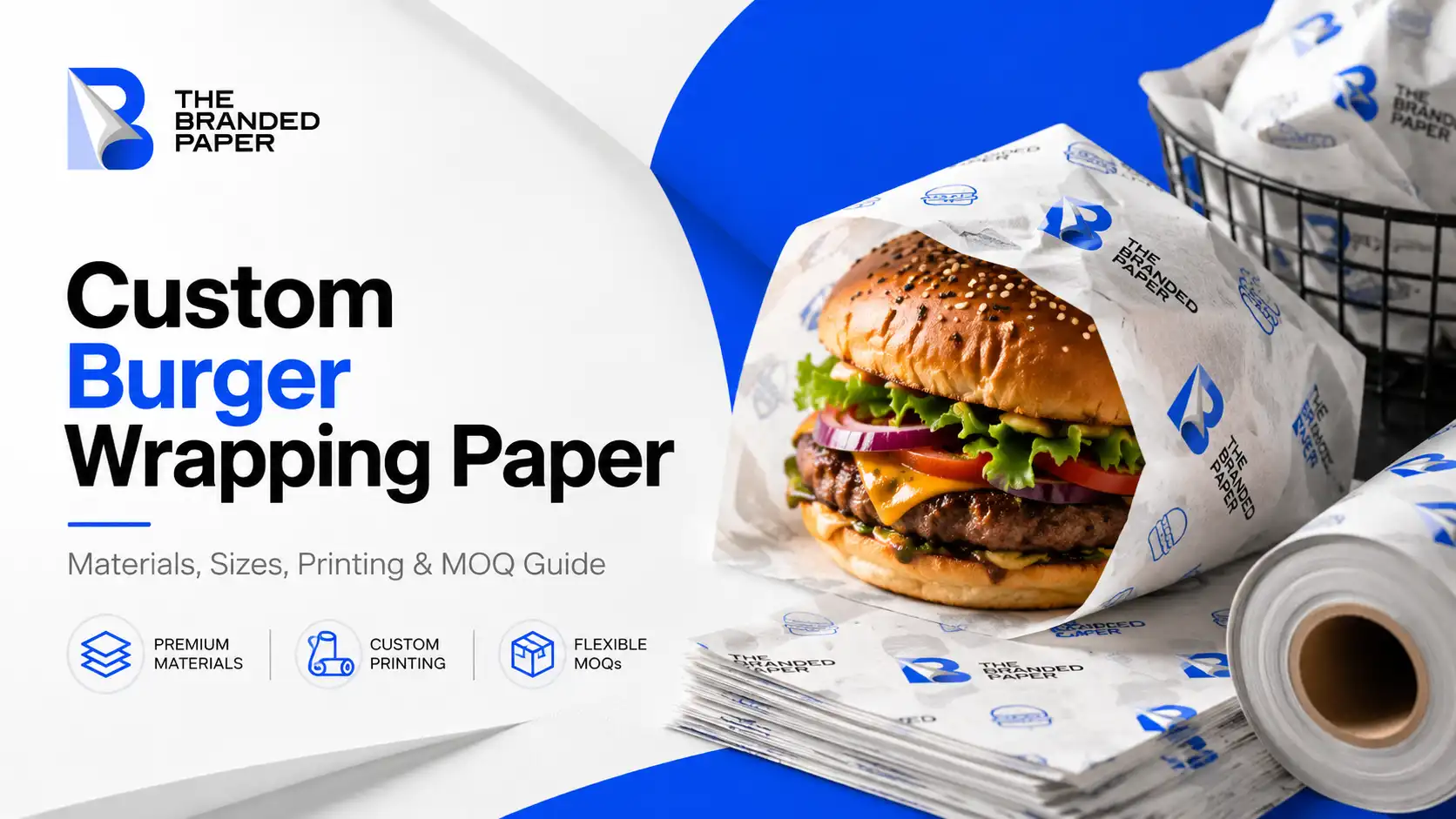
The Branded Paper offers food-grade white and kraft paper options, optional wax or PE coatings, 30–50 GSM paper, sheets or rolls, and one- to four-color printing. Standard listed sheet sizes include 10 x 10, 12 x 12, and 15 x 15 inches, with custom sizes available.
The Best Paper Depends on the Burger
There is no single best paper for wrapping every burger.
A restaurant serving thin smash burgers has different packaging needs from a restaurant selling tall gourmet burgers. A wrapper that performs well during five minutes of counter service may fail during a 30-minute delivery.
For greasy or heavily sauced burgers
Use a grease-resistant food paper that remains strong after contact with oil, cheese, and sauce.
Look for:
- Reliable grease holdout
- Resistance to wet tearing
- Enough strength for double patties
- A surface that folds without cracking
- Minimal show-through on the outside
A material sample should be tested with the greasiest burger on the menu. Testing with a plain bun or an empty wrapper does not show how the paper will behave during real service.
For fast counter service
Custom printed Deli paper or lightweight greaseproof sheets often work well when orders are served quickly.
Pre-cut sheets help employees:
- Grab one wrapper at a time
- Make consistent folds
- Avoid cutting paper during service
- Keep portions and presentation uniform
A paper roll can offer flexibility, but cutting each piece may slow a busy assembly line.
For takeout and delivery
Delivery packaging must manage both heat and steam.
A tightly sealed wrapper may keep a burger warm, but it can also trap moisture. Steam moves into the bun and softens the crust. When that wrapped burger is placed in a closed box and then in an insulated delivery bag, the moisture problem can worsen.
For delivery, consider:
- Grease-resistant paper around the burger
- A vented or breathable outer container
- Separate packaging for wet toppings when practical
- Short holding times before driver pickup
- A wrapper that does not collapse against the bun
The goal is not simply to trap as much heat as possible. It is to balance warmth, airflow, moisture control, and structure.
Greaseproof Paper vs. Wax Paper
Greaseproof paper and wax paper can both be used for food wrapping, but they gain their barrier properties in different ways.
Greaseproof paper is designed to slow the movement of oil through the sheet. Its performance depends on the paper construction and any applied barrier treatment.
Wax paper uses a wax-based treatment to create release and moisture-resistant properties. It may work well for wrapping and separating foods, but buyers should not assume it is suitable for use in ovens or other high-temperature applications.
| Decision factor | Greaseproof paper | Wax paper |
| Grease control | Designed for oily foods | Can perform well depending on coating |
| Moisture resistance | Varies by grade | Often a key strength |
| Hot burger wrapping | Common application | Must match the supplier’s rated use |
| Baking | Not automatically oven-safe | Generally not selected for oven use |
| Custom printing | Widely available | Available on suitable constructions |
| Best fit | Burgers, fries, fried food | Wrapping, separating, and certain deli uses |
Do not select paper based only on its product name. Ask for the exact construction, temperature limits, grease resistance, moisture resistance, and intended food-contact conditions.
Deli Paper vs. Wax Paper
Deli paper is commonly selected for service speed and presentation. It is often used for burgers, sandwiches, pastries, food baskets, and counter-service meals.
Wax paper is more closely associated with moisture resistance, food separation, and release.
Choose deli paper when:
- Employees need to wrap food quickly
- The printed design is important
- The paper will double as a basket liner
- The food is served soon after preparation
Consider wax-coated paper when:
- Moisture control is a major concern
- Food release is important
- The supplier confirms suitability for the burger’s temperature
- The coating matches the restaurant’s disposal and sustainability goals
Some products sold as deli paper already include a grease-resistant or wax-treated construction. Always compare specifications rather than relying on the label alone.
Wax Paper vs. Parchment Paper for Food
Wax paper and parchment paper are not direct substitutes.
Parchment is normally selected for heat-resistant kitchen tasks such as baking and tray lining. Wax paper is generally used for wrapping, separation, and food storage applications where oven heat is not involved.
For a finished restaurant burger, parchment may add cost without improving the customer experience. A properly selected greaseproof or deli wrapper is often easier to print, fold, stack, and use at a fast-moving service station.
The key question is simple: Will the paper be used to cook the food or to package it after cooking?
Use a paper rated for heat when it enters an oven or other high-temperature process. Use purpose-built wrapping paper when the burger has already been cooked and is being prepared for service.
Food-Contact Safety Matters More Than Marketing Terms
“Food grade” and “FDA approved” are often used broadly in packaging sales. Restaurant buyers need more specific information.
The FDA treats packaging components such as coatings, adhesives, and colorants as food-contact substances when they are used in materials that touch food. Food-contact substances that meet the legal definition of food additives must be authorized for their intended use before being marketed in the United States.
Ask a supplier to confirm:
- Whether the paper is suitable for direct food contact
- Whether the coating matches hot and greasy foods
- Whether the printed side is intended to touch food
- Whether the inks are suitable for the proposed application
- Whether testing or compliance documents are available
- Whether any restrictions apply to temperature or contact time
A general certificate for a different paper, coating, or print construction may not cover the product being quoted.
Food contact safe paper should be evaluated as a complete construction. The base paper, barrier, ink, adhesive, and final intended use all matter.
PFAS-Free Burger Wrapping Paper
PFAS were historically used in some grease-proofing applications for paper and paperboard packaging.
In February 2024, the FDA announced that grease-proofing agents containing PFAS were no longer being sold for food-contact use in the U.S. In January 2025, the agency determined that 35 related food-contact notifications were no longer effective because those uses had been abandoned.
Restaurants should still request written confirmation about the exact paper they are buying.
Useful questions include:
- Is the paper intentionally manufactured without added PFAS?
- Does the statement cover the coating as well as the base paper?
- Does it apply to the exact product code on the quote?
- Can the supplier provide a current specification or declaration?
A clear document is more useful than an unsupported “eco-friendly” badge.
How to Choose the Right Burger Wrapping Paper Size
The correct burger wrapping paper size should cover the complete burger with enough overlap for secure folds. It should not leave so much extra paper that the wrap becomes bulky or expensive.
Common starting points include:
| Sheet size | Possible use |
| 10 x 10 inches | Sliders and smaller standard burgers |
| 12 x 12 inches | Many regular and medium burgers |
| 15 x 15 inches | Tall burgers, double patties, or large buns |
| Custom rectangle | Long sandwiches, wraps, or unusual menu items |
These are starting points, not fixed rules. A five-inch burger may need far more than five inches of paper because the wrapper must travel over the top, around the fillings, and under the base.
Test the size during a real shift
- Prepare the largest normal burger on the menu.
- Include the usual cheese, sauce, and toppings.
- Cut plain paper to the proposed dimensions.
- Wrap the burger using the normal staff method.
- Check the overlap, bottom fold, and side coverage.
- Place it in the delivery box or bag.
- Repeat the test during a busy service period.
Ask employees whether the paper is easy to grab and fold. A size that looks efficient on a desk may be awkward when the kitchen is handling several orders at once.
Paper that is too small can be more expensive than a larger sheet because employees may use two wrappers. Paper that is too large adds material cost and waste to every order.
Paper GSM Is Not a Quality Score
GSM means grams per square meter. It describes paper weight, but it does not tell the complete performance story.
A higher paper GSM for food packaging can provide more body and strength. It may also become harder to fold around a small burger.
A lighter paper can be easier to handle and less expensive, but it may fail when exposed to heavy grease or moisture.
The correct weight depends on:
- Burger size and weight
- Grease level
- Sauce quantity
- Contact time
- Delivery distance
- Folding method
- Barrier treatment
- Whether the sheet also lines a basket or box
The Branded Paper lists a 30–50 GSM range for its custom food wrapping paper options. The practical choice should be confirmed through material testing rather than GSM alone.
Printing Choices That Work After the Burger Is Wrapped
A design may look attractive on a flat sheet and disappear once the paper is folded.
Effective custom food wrapping paper design ideas account for the final shape of the package.
Use a repeating logo pattern
A staggered repeat gives the logo several chances to remain visible. It works well when employees do not place every burger in the same position.
Keep important details away from folds
Do not depend on one large logo in the center. It may end up underneath the burger or hidden inside the fold.
Avoid placing critical information where it may be:
- Covered by grease
- Folded under the burger
- Cut off at the sheet edge
- Distorted by the wrapping method
Choose print colors for the paper
White paper gives colors a cleaner and brighter base.
A kraft paper food wrap creates a natural, casual appearance, but lighter ink colors and detailed photographs may lose contrast. Bold, simple artwork often performs better on kraft.
Start simple when budget matters
One-color printing can produce a strong result with:
- A repeating logo
- A short slogan
- A social media handle
- A simple icon pattern
- A brand name and location
Full-color printing is useful when the artwork depends on several colors, illustrations, or campaign graphics. More colors and heavier ink coverage may affect price, setup, and production options.
Ask about food-grade printing inks
The correct question is not only whether the ink is called “food safe.” Ask whether the ink system, curing process, printed surface, and final paper construction are suitable for the intended contact conditions.
Also confirm whether the printed side should face away from the food. Food-contact requirements apply to the intended use, not simply to the ink name.
How to Wrap a Burger in Paper
A secure wrap protects the burger without crushing the bun.
- Place the sheet diagonally or square to the worker, depending on the fold style.
- Set the burger slightly below the center.
- Bring the lower section up over the burger.
- Fold the left and right sides inward.
- Roll or fold the burger forward.
- Tuck the final edge underneath.
- Keep the seam away from the customer’s first bite area.
For dine-in service, the top of the wrapper can remain slightly open so customers can hold the burger without touching the fillings.
For delivery, use a more secure fold while avoiding excessive compression. A tight wrap can push sauces into the bun and flatten a soft top.
Train employees on one repeatable method. Consistent wrapping improves speed, appearance, and paper usage.
How to Keep Burgers Warm Without Making Buns Soggy
Soggy buns usually come from moisture, not from a lack of packaging.
Hot patties, vegetables, cheese, and sauces release steam. When that steam cannot escape, it condenses inside the wrapper or box.
To protect delivery quality:
- Do not leave cooked burgers sitting under closed packaging
- Use packaging with controlled ventilation
- Avoid placing very wet toppings directly against the bottom bun
- Drain excess grease before final assembly
- Keep cold toppings cold until assembly
- Use sauces in controlled portions
- Match driver pickup timing with food completion
- Test the complete delivery setup for 15, 30, and 45 minutes
Burger wrap vs. burger box
| Packaging choice | Main advantage | Main drawback | Best use |
| Paper wrap | Compact, branded, and easy to hold | Limited crush protection | Counter service and short trips |
| Burger box | Protects burger shape | Can trap steam | Tall burgers and longer delivery |
| Wrap inside a box | Grease control plus structure | More material and labor | Premium or fragile burgers |
| Open paper sleeve | Easy eating and airflow | Less protection | Immediate dine-in service |
The best takeout packaging for hot food may combine two materials. A light burger wrap can control grease while a vented box protects the bun from being crushed.
Do not add a box automatically. More packaging does not always mean better food quality.
How MOQ Affects Cost and Inventory
MOQ means minimum order quantity. It is the smallest custom production run a supplier will accept.
MOQ can change based on:
- Printing process
- Sheet size
- Paper material
- Number of print colors
- Custom coating
- Packing method
- Production location
- Whether the size is standard or custom
A low MOQ reduces inventory risk, but the price per sheet may be higher. A large order can lower the unit cost while creating storage and cash-flow pressure.
Do not order a year of printed paper only to reach a better price tier. Logos change. Menu concepts change. Phone numbers, websites, colors, and promotional messages can also become outdated.
Calculate a practical order quantity
Use this basic formula:
Expected sheets per month = wrapped items per day × operating days
Then add an allowance for:
- Damaged sheets
- Staff training
- Double wrapping
- Samples
- Promotions
- Sales increases
For example, a restaurant wrapping 200 burgers per day for 26 days needs 5,200 sheets. Adding an 8% operating allowance brings the planning quantity to about 5,616 sheets per month.
Compare that amount with:
- Supplier price breaks
- Storage capacity
- Reorder lead time
- Seasonal demand
- Planned branding changes
Ask for pricing at several quantity levels. The lowest unit price is not always the lowest-risk decision.
Biodegradable vs. Compostable Packaging
“Biodegradable” and “compostable” do not mean the same thing.
A compostable claim should identify where the material can be composted. Some products require a commercial composting facility and may not break down properly in a home compost pile.
The FTC states that compostable claims should be qualified when a product cannot be composted safely and within a reasonable time at home. Claims may also need qualification when suitable municipal or institutional facilities are not widely available. The FTC also warns against broad biodegradable claims for products that normally enter landfills, incinerators, or recycling facilities.
Before choosing compostable food wrapping paper, ask:
- Is the whole construction compostable?
- Does that include the ink and barrier?
- Is certification available?
- Is industrial composting required?
- Do customers have access to suitable facilities?
- Will food contamination affect the local disposal route?
Eco-friendly burger packaging should match real disposal conditions. A certified material placed in a trash bin may not deliver the outcome customers expect.
A Practical Ordering Checklist
Before requesting a quote for custom burger wrapping paper, prepare:
- Finished burger dimensions
- Largest burger height
- Grease and sauce level
- Dine-in, takeout, or delivery use
- Expected contact time
- Required sheet size
- Preferred white or kraft paper
- Desired grease and moisture resistance
- Approximate GSM or sample reference
- Monthly sheet usage
- Print color count
- Logo or vector artwork
- Delivery ZIP code
- Target reorder schedule
Request a material sample when performance is uncertain. A digital proof confirms artwork placement, but it cannot show how the paper handles grease, heat, folds, or moisture.
The strongest approval process uses both:
- A physical material sample for performance
- A digital or printed proof for branding
Choose Paper Around the Food, Not the Catalog
The right custom burger wrapping paper should make the restaurant easier to run.
It should help employees wrap faster, keep grease off customers’ hands, protect delivery presentation, and show the brand without adding unnecessary packaging.
Start with the burger’s real behavior:
- How hot is it when wrapped?
- How much grease does it release?
- How long does it stay packaged?
- Does the bun soften during delivery?
- Which parts of the logo remain visible after folding?
- How many sheets can the restaurant use before the design changes?
The Branded Paper supplies custom-printed food wrapping paper for restaurants, cafés, food trucks, delis, and food brands across the United States. Buyers can select food-grade white or kraft paper, standard or custom sizes, sheets or rolls, coating options, and one- to four-color printing based on their service needs.
Request paper samples and a custom quote based on your burger size, daily volume, artwork, and delivery requirements.
Frequently Asked Questions
1. What is the best paper for wrapping burgers?
Greaseproof paper or grease-resistant deli paper is often the best choice. The exact material should match the burger’s grease level, temperature, sauces, contact time, and delivery method.
2. What size paper is used to wrap a burger?
A 10 x 10-inch or 12 x 12-inch sheet can work as a starting point for many burgers. Tall burgers, oversized buns, and double patties may need 15 x 15-inch paper or a custom size.
3. Is wax paper safe for hot burgers?
It depends on the wax paper’s construction and rated use. Do not assume every wax-coated paper is suitable for hot food. Confirm temperature, contact time, and food-contact specifications with the supplier.
4. Is parchment paper good for wrapping burgers?
Parchment can wrap a burger, but it is normally selected for heat-resistant cooking and baking. Greaseproof or deli paper is often more practical and cost-effective for restaurant wrapping.
5. How can a restaurant keep burger buns from getting soggy?
Control steam and wet ingredients. Use suitable grease-resistant paper, avoid over-sealing the outer package, drain excess grease, limit loose sauce, and test the complete delivery package over the expected travel time.
6. Can custom burger paper be used as a basket liner?
Yes. Many restaurants use the same custom food basket liners for burgers, sandwiches, fries, and other counter-service food. Confirm that the sheet size fits both wrapping and basket-lining tasks.
7. What is a good MOQ for custom burger paper?
A good MOQ is an amount the restaurant can use before the design becomes outdated. Calculate monthly usage, add an operating allowance, compare supplier price tiers, and account for storage space and reorder time.
8. Is compostable burger wrapping paper always better?
Not always. Compostable packaging provides the most value when the full paper construction is suitable for composting, and customers have access to the required composting system. Disposal conditions should be checked before making environmental claims.