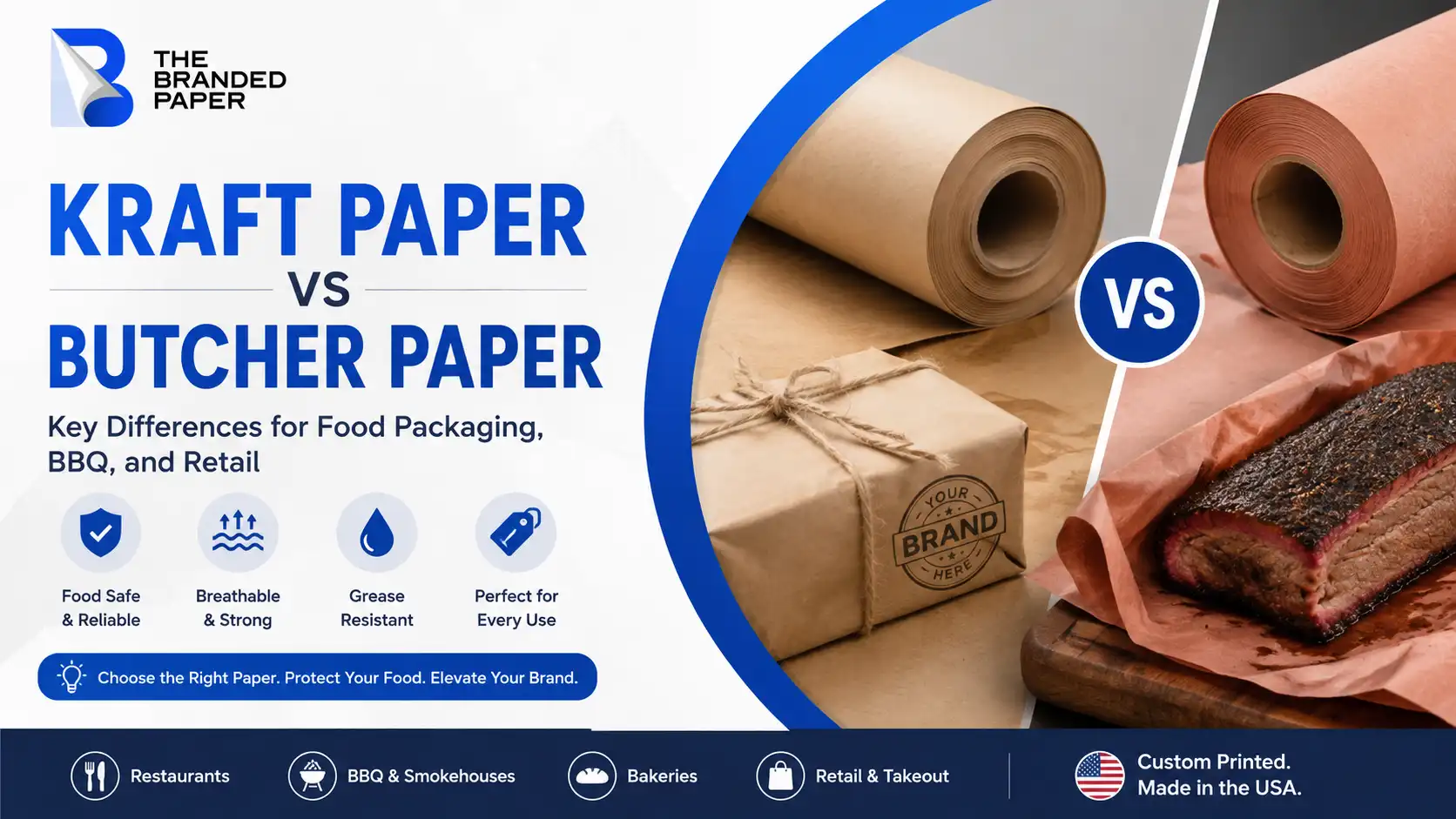
Kraft paper and butcher paper can look almost identical. Both may be brown, strong, and sold in large rolls. That similarity often causes restaurants, BBQ businesses, retailers, and home cooks to treat them as interchangeable.
They are not always interchangeable.
The main difference in kraft paper vs butcher paper is the intended use. Kraft paper is a broad paper category used for bags, shipping, retail wrapping, and many other packaging jobs. Butcher paper is generally made for food handling, meat wrapping, serving, or low-and-slow smoking.
Choosing the wrong paper can lead to grease leaks, torn wraps, softened brisket bark, poor freezer protection, or unsafe direct food contact. The right choice depends on the food, temperature, storage time, and presentation you need.
Kraft Paper vs Butcher Paper at a Glance
| Factor | Kraft Paper | Butcher Paper |
| Basic definition | A broad family of strong paper made through the kraft pulping process | A food-use paper commonly made from kraft pulp |
| Typical uses | Shopping bags, shipping, void fill, gift wrap, retail packaging and tray liners | Wrapping meat, deli service, BBQ smoking, food preparation and serving |
| Direct food contact | Only when specifically produced and documented for food contact | Usually intended for food contact, but specifications still matter |
| Surface | May be coated, uncoated, recycled, printed or treated | Often uncoated or lightly treated, depending on its purpose |
| Breathability | Varies by grade and coating | Usually breathable, especially smoker-grade butcher paper |
| Grease handling | Regular grades may absorb oil and weaken | Food-grade versions generally handle meat juices and grease better |
| Cooking use | Ordinary kraft paper should not be used for cooking | Certain food-grade, unwaxed products may be used for low-temperature smoking or roasting |
| Freezer protection | Ordinary kraft is not a strong moisture barrier | Standard butcher paper is not ideal for long-term freezing |
| Branding potential | Strong option for bags, wraps and retail presentation | Strong option for branded BBQ, deli and restaurant service |
Is Kraft Paper the Same as Butcher Paper?
No. Butcher paper is commonly made from kraft pulp, but not every kraft paper is butcher paper.
Think of kraft paper as the larger material family. It includes many grades designed for different jobs:
- Paper grocery bags
- Shipping paper
- Retail wrapping
- Corrugated packaging
- Protective void fill
- Food-contact wrapping
- Butcher paper
Butcher paper is a more specific product within that family. It is normally selected for strength when wet, food handling, absorbency, and breathability.
A roll of brown paper from an art, shipping, or hardware store may resemble butcher paper. That does not mean it is suitable for direct contact with brisket, burgers, cheese, sandwiches, or raw meat.
Is Kraft Paper Food Safe?
Kraft paper is food safe only when it is manufactured for the intended food-contact use.
The brown color does not prove that paper is food grade. The same is true for labels such as “natural,” “recycled,” or “unbleached.”
Food safety depends on the complete paper specification, including:
- Fibers used in the paper
- Processing aids
- Added sizing agents
- Surface coatings
- Adhesives
- Printing inks
- Intended food type
- Contact temperature
- Length of contact
- Whether the food is dry, wet, acidic, or greasy
The FDA regulates substances used in food-contact materials, including components of paper and paperboard. A packaging supplier should be able to provide documentation showing that the material is suitable for its stated food-contact conditions.
Is Brown Kraft Paper Food Safe?
Some brown kraft paper is food safe, but ordinary brown kraft paper should not be assumed safe.
Before placing food directly on brown kraft paper, confirm that it is:
- Manufactured for food contact
- Suitable for the specific food
- Free from unsuitable coatings or treatments
- Printed with an appropriate food-packaging ink system
- Approved by the supplier for the expected temperature
- Traceable to a reliable material specification
A restaurant wrapping a dry baguette has different requirements from a BBQ business wrapping a hot, fatty brisket. “Food grade” should describe the real application, not just the appearance of the paper.
Food-Grade Kraft Paper vs Regular Kraft Paper
The practical difference is not always visible.
| Decision Point | Food-Grade Kraft Paper | Regular Kraft Paper |
| Intended use | Made and documented for direct or indirect food contact | Made for general packaging, crafts, shipping or industrial use |
| Material controls | Selected according to food-contact requirements | May include materials not evaluated for direct food contact |
| Odor and cleanliness | Controlled to reduce contamination and unwanted odor | Standards may focus on strength rather than food protection |
| Ink and coating choice | Chosen for the intended food-packaging application | Printing system may not be intended for contact with food |
| Grease performance | Available with food-safe grease-resistant properties | May quickly absorb oils and weaken |
| Supplier documentation | Food-contact statements may be available | Food-contact documentation may not exist |
| Best use | Food wraps, tray liners, bakery packaging and serving applications | Shipping, product wrapping, void fill and non-food packaging |
Virgin Kraft Paper vs Recycled Kraft Paper
Virgin kraft paper is made from new wood pulp. It often provides more consistent strength, appearance, odor control, and material traceability. These qualities can be valuable for direct food contact, especially with hot or greasy foods.
Recycled kraft paper contains recovered fibers. It can be a practical choice for shopping bags, outer packaging, carryout bags, shipping materials, and other secondary uses.
Recycled content is not automatically unsafe. However, buyers should not assume that every recycled paper is suitable for direct food contact. The supplier must confirm the intended use and applicable compliance requirements.
Can You Use Kraft Paper Instead of Butcher Paper?
You can use kraft paper instead of butcher paper only when the kraft paper meets the same practical requirements.
For meat wrapping or smoking, it should be:
- Food-contact compliant
- Unwaxed
- Uncoated or specifically designed to remain breathable
- Strong when wet
- Suitable for contact with fatty food
- Rated by the manufacturer for the expected temperature
- Free from unknown dyes, inks, or chemical treatments
Do not use shipping paper, masking paper, construction paper, grocery-bag paper, or craft paper as a butcher paper substitute simply because it is brown.
For cold retail wrapping or secondary packaging, food-grade kraft paper may work well. For a smoker, purpose-made peach butcher paper is the safer and more predictable choice.
Can You Use Kraft Paper for Smoking Meat?
Ordinary kraft paper should not be used for smoking meat.
Smoking creates heat, moisture, rendered fat, and long contact times. A paper that performs well around a retail box may fail when wrapped around a brisket for several hours.
Use smoker-grade butcher paper that is:
- Clearly marked as food grade
- Unwaxed
- Uncoated
- Strong when saturated with meat juices
- Approved for low-and-slow cooking
- Kept away from flames, burners, and direct heat
Temperature limits vary by product. For example, one major manufacturer rates its pink butcher paper for temperatures up to 300°F and warns against open flames or direct heat. Always follow the limit supplied with the paper you purchase rather than treating 300°F as a universal rating.
Why Use Butcher Paper for Brisket?
Butcher paper creates a balance between moisture retention and airflow.
A brisket can lose a large amount of moisture during a long smoke. Wrapping reduces direct surface evaporation and helps the meat move through the stall. However, a completely sealed wrap can trap steam and soften the bark.
Uncoated butcher paper remains somewhat breathable. This offers several benefits:
- It reduces moisture loss without fully steaming the meat.
- It protects the bark from becoming too dark or dry.
- It absorbs some rendered fat and meat juices.
- It allows more airflow than foil.
- It is easier to shape tightly around a large cut.
- It supports a firm bark better than a sealed foil wrap.
Butcher paper is not leakproof. Fat may soak through it, and a loosely wrapped brisket can lose heat or dry unevenly. The result depends on wrapping technique as much as paper choice.
When to Wrap Brisket in Butcher Paper
Do not wrap brisket based only on the clock.
The best time is usually when:
- The bark has developed a dark, firm surface.
- The seasoning no longer wipes away when lightly touched.
- The meat has absorbed enough smoke.
- Evaporative cooling has slowed the rise in internal temperature.
- The brisket has entered the stall.
The stall often occurs around an internal temperature of 160°F to 170°F, but every brisket behaves differently. Size, fat content, smoker airflow, humidity, and cooking temperature can shift that timing.
Wrapping too early may create soft bark. Waiting too long may increase moisture loss and extend the cook.
How to Wrap Brisket in Butcher Paper
A tight wrap limits air pockets and prevents the paper from opening as the brisket shrinks.
- Place two wide sheets of food-grade butcher paper on a clean surface. Overlap them enough to cover the full brisket.
- Put the brisket near one end with the presentation side facing down.
- Fold the lower edge over the meat and pull it tight.
- Fold both sides inward to create snug edges.
- Roll the brisket forward while keeping steady tension on the paper.
- Tuck the final edge underneath the brisket.
- Return it to the smoker with the seam facing down.
- Keep the wrapped meat away from flames and direct heat.
Avoid using so many layers that the paper stops breathing. At the same time, thin or torn coverage can allow excessive moisture to escape.
Butcher Paper vs Foil for Brisket
Both materials can reduce cooking time during the stall, but they produce different results.
| Result | Butcher Paper | Aluminum Foil |
| Bark | Firmer and drier | Softer and sometimes wet |
| Steam retention | Moderate | High |
| Smoke exposure after wrapping | Some exposure remains | Smoke is largely blocked |
| Cooking speed | Faster than leaving meat unwrapped | Usually faster than butcher paper |
| Leak resistance | May absorb and release juices | Strong liquid barrier when sealed |
| Final texture | Balanced bark and moisture | Very tender, braised texture |
| Best for | Pitmasters prioritizing bark | Cooks prioritizing speed and moisture |
Foil creates a tight barrier and traps more steam. It can help a brisket cook faster, but extended time in foil may soften the bark.
Butcher paper is a useful middle ground. It does not seal as tightly, so the cook may take longer than with foil. In return, the bark generally stays in better condition.
Pink Butcher Paper vs Brown Butcher Paper
Pink butcher paper is also called peach butcher paper. It is popular for brisket because many products in this category are unbleached, unwaxed, breathable, and made for smoking.
Brown paper is a less precise term. It may describe:
- Food-grade butcher paper
- Natural kraft wrapping paper
- Steak paper
- Shipping paper
- Recycled packing paper
- General-purpose craft paper
That makes color a poor buying standard.
Choose paper by its specification rather than its shade. A darker brown roll is not necessarily stronger, safer, or more natural than peach butcher paper.
For smoking, look for an explicit statement covering food contact, coatings, wet strength, cooking use, and temperature limits.
White Butcher Paper vs Brown Butcher Paper
White butcher paper is often selected when clean presentation and strong print contrast are important. It can work well for butcher counters, sandwich shops, seafood service, tray liners, and branded food wraps.
Brown or natural paper creates a more rustic appearance and can complement BBQ, farm-market, organic, or craft-style branding.
The better option depends on the customer experience:
White butcher paper works well when you need:
- Bright logo colors
- A clean deli or seafood-counter appearance
- High contrast for product labels or stamps
- A neutral background for food presentation
Brown or peach paper works well when you need:
- A natural or rustic presentation
- BBQ and smokehouse branding
- A less processed visual style
- An unbleached smoker-grade option
Bleached paper is not automatically unsafe, and unbleached paper is not automatically food safe. Both need proper food-contact documentation.
Coated vs Uncoated Butcher Paper
Coatings change how paper handles grease, moisture, air, and heat.
Uncoated butcher paper is usually preferred for smoking because it stays breathable. It can absorb rendered fat while allowing some moisture and vapor to escape.
Coated food wrapping paper may be better for burgers, fried food, sandwiches, cheese, and takeaway service. A suitable coating can slow grease penetration and help keep trays, hands, and delivery bags cleaner.
The trade-off is breathability. A heavily coated paper may trap steam and change the texture of hot food.
Businesses should ask suppliers:
- How is grease resistance achieved?
- Is the coating suitable for direct food contact?
- Is it intended for hot, cold, wet or fatty food?
- Can the paper be used in a smoker or oven?
- Does the coating affect recyclability or compostability?
- Is current food-contact documentation available?
The FDA announced in February 2024 that PFAS-containing grease-proofing substances for food-contact paper and paperboard were no longer being sold by manufacturers into the U.S. market. Buyers should still request current information about the coatings used in their packaging.
Butcher Paper vs Parchment Paper
Parchment paper is designed for non-stick baking and roasting. It is less breathable than butcher paper and is commonly treated to provide a release surface.
Butcher paper is more absorbent and breathable. It is better suited to wrapping meat during low-and-slow smoking.
| Use | Better Choice |
| Smoking brisket | Butcher paper |
| Baking cookies | Parchment paper |
| Roasting vegetables | Parchment paper |
| Wrapping fresh meat for short-term handling | Butcher paper |
| Preventing baked food from sticking | Parchment paper |
| Preserving BBQ bark | Butcher paper |
Do not use parchment paper as the first choice for a smoker. Although many parchment products tolerate higher oven temperatures, their smoother, less breathable surface can trap more steam around the meat.
Butcher Paper vs Freezer Paper
Freezer paper is built to resist air and moisture. It normally has a barrier coating on one side, which is placed against the food.
That barrier makes freezer paper useful for longer cold storage. It also makes it unsuitable for smokers and ovens unless a manufacturer specifically states otherwise.
Standard butcher paper allows too much air movement for dependable long-term freezer protection. It may also stick to wet meat.
For freezing meat, use:
- Freezer paper
- Freezer-grade bags
- Vacuum-sealed packaging
- Another moisture-vapor-resistant material made for freezing
Packaging made specifically for freezing helps limit dehydration, off-odors, and freezer burn.
Butcher Paper vs Wax Paper
Wax paper has a wax coating that creates a smoother, more moisture-resistant surface. It is useful for cold food preparation, separating items, wrapping certain ready-to-eat foods, and other non-direct-heat tasks.
Butcher paper has no wax when it is made for smoking. It absorbs some moisture and allows vapor to pass through.
Wax paper should not be exposed directly to oven or smoker heat. The coating can melt, smoke, or transfer to surfaces. Parchment paper is the better paper choice for baking, while uncoated food-grade butcher paper is the better choice for low-temperature smoking.
Can Butcher Paper Go in the Oven?
Certain butcher paper can go in an oven at low temperatures, but the answer depends on the product.
Before using it, check that the paper is:
- Food grade
- Unwaxed
- Approved for oven use
- Used below its stated temperature limit
- Kept away from heating elements
- Not placed under a broiler
- Not exposed to an open flame
One manufacturer allows its butcher paper in low-temperature oven applications up to 300°F. That rating applies to its specific product, not every roll sold as butcher paper.
When no heat rating is available, do not place the paper in an oven or smoker.
What Is the Best Butcher Paper Substitute for Smoking?
There is no perfect substitute because each wrap changes the meat differently.
Aluminum foil
Best when speed and moisture retention matter most. It traps steam and can soften bark.
Uncoated food-grade kraft paper
Potentially suitable only when the supplier confirms that it is safe for smoking, fatty food contact, and the expected temperature.
Parchment paper
Heat-resistant for baking, but less breathable. It may produce softer bark and is not generally the preferred material for smoking.
No wrap
Produces strong bark and maximum smoke exposure. The cook usually takes longer, and the meat may lose more moisture.
Never substitute Wax paper, freezer paper, printed shipping paper, grocery bags, or unknown craft paper in a smoker.
Choosing Paper for a Food Business
A butcher shop, BBQ restaurant, bakery, deli, and retail brand should not order paper based only on color and price.
Start with the food and workflow.
For BBQ and smoked meats
Choose breathable, unwaxed butcher paper with strong wet strength and a clear temperature rating.
For burgers and fried foods
Choose food-safe wrapping paper with enough grease resistance to protect hands, trays, and takeaway bags.
For fresh meat counters
Choose paper that handles moisture, folds cleanly, and remains strong during weighing and handoff.
For bakery products
Match the paper to the product. Dry bread may need simple food-grade wrapping, while buttery pastries may need stronger grease resistance.
For retail and secondary packaging
Standard custom kraft paper may be suitable when it does not directly touch food. It can support branding, protect product boxes, and improve the unboxing experience.
What to Confirm Before Ordering Custom-Printed Paper
Custom printing adds another layer to the buying decision. Attractive artwork will not compensate for paper that leaks, tears, blocks airflow, or does not match the food.
Ask the packaging supplier for:
- Intended-use confirmation: Is the paper suitable for direct contact with the specific food?
- Temperature limits: Can it handle hot food, an oven, or a smoker?
- Coating details: Is it coated, waxed, grease-resistant, or uncoated?
- Fiber information: Is it virgin, recycled, bleached, or unbleached?
- Wet-strength performance: Will it stay intact around meat juices, sauces, or steam?
- Printing details: Is the ink system appropriate for food packaging?
- Print placement: Can artwork be positioned to reduce the chance of direct ink-to-food contact?
- Roll or sheet format: Which format fits staff speed, storage space, and portion consistency?
- Sample testing: Can the paper be tested with the actual food before a bulk order?
- Food-contact documentation: Is current supporting documentation available?
A practical test should copy real service conditions. Wrap the actual product, hold it for the normal service time, expose it to expected grease and heat, and check for tearing, color transfer, odor, sticking, and oil penetration.
Custom Paper Should Match the Food, Not Just the Brand
The right paper protects the product first. Branding comes next.
A smokehouse may need breathable peach butcher paper that holds together around a hot brisket. A burger restaurant may need grease-resistant sheets that prevent oil from reaching the customer’s hands. A butcher counter may value clean folds, wet strength, and clear product labeling. A retail brand may need kraft wrapping that presents well without touching unpackaged food.
The Branded Paper supplies custom food wrapping paper, butcher paper, wax paper, parchment sheets, kraft paper, and paper bags for food businesses across the United States. Available branding options can turn a functional wrap into a visible customer touchpoint without ignoring food performance.
Before placing a full order, Request a sample and test it with your real food, equipment, holding time, and service process. That single step can prevent expensive problems after printing.
Frequently Asked Questions
1. Is kraft paper the same as butcher paper?
No. Kraft paper is a broad category of paper. Butcher paper is a specific food-use paper commonly made from kraft pulp. Not every kraft paper is suitable for food contact or smoking.
2. Can you use kraft paper instead of butcher paper?
Only when the kraft paper is confirmed as food-grade, unwaxed, suitable for fatty food, strong when wet, and rated for the required temperature, ordinary kraft or shipping paper should not be used.
3. Is brown kraft paper food safe?
It can be, but brown color does not prove food safety. Check the supplier’s food-contact documentation and intended-use statement.
4. Can you use kraft paper for smoking meat?
Use only a food-grade kraft paper specifically approved for smoking or low-temperature cooking. General-purpose kraft paper may contain coatings, recycled fibers, dyes, or processing aids not intended for that application.
5. Why is pink butcher paper used for brisket?
Pink or peach butcher paper is often unwaxed and breathable. It reduces moisture loss while helping the brisket keep a firmer bark than it would in foil.
6. Can butcher paper go in the oven?
Some butcher paper can be used for low-temperature oven cooking. Follow the manufacturer’s temperature limit, keep it away from heating elements, and never use it under a broiler or near an open flame.
7. Can you freeze meat in butcher paper?
Standard butcher paper is not the best option for long-term freezing because it is breathable. Use freezer paper, a freezer-grade bag, or vacuum packaging for stronger protection against air and moisture.
8. Is white butcher paper better than brown butcher paper?
Neither is automatically better. White paper offers a clean appearance and stronger color contrast for printing. Brown or peach paper offers a natural look and is common in BBQ settings. Food-contact suitability and performance matter more than color.