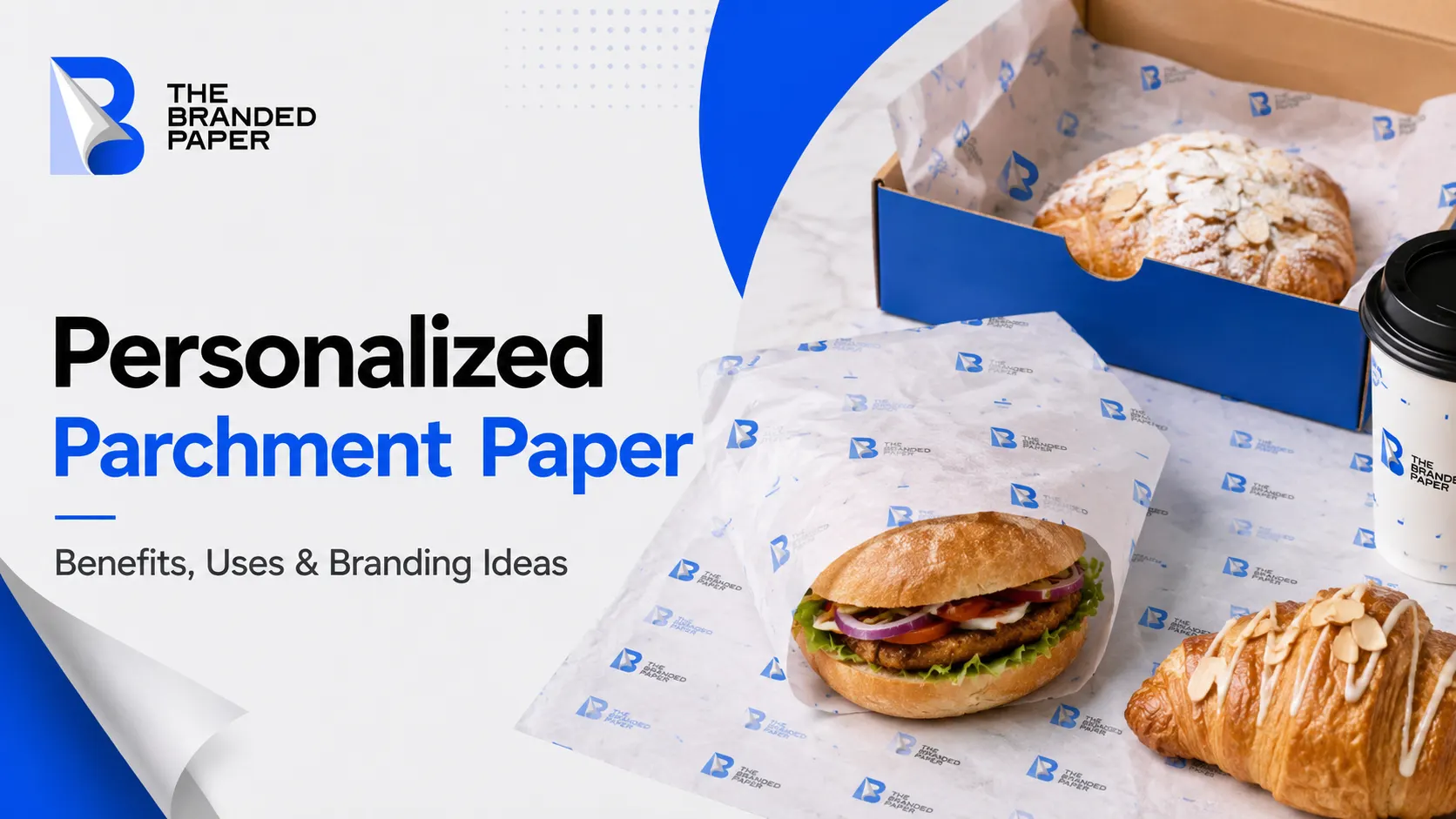
Plain parchment paper can protect food, simplify cleanup, and improve presentation. Personalized parchment paper does the same job while adding something standard paper cannot: your brand.
For restaurants, bakeries, cafés, delis, food trucks, and growing food brands, small packaging details matter. A burger wrapped in paper printed with your logo feels different from one served in a plain white sheet. The food may be identical, but the branded presentation feels more intentional.
That does not mean every business should order custom parchment without checking the details. Paper type, size, coating, printing method, heat resistance, and intended food use all affect performance.
Understanding those factors makes it easier to choose packaging that looks good and works well during a busy service.
What Is Personalized Parchment Paper?
Personalized parchment paper is parchment-style food paper printed with a business logo, pattern, message, or other brand artwork.
Depending on the product specification, it may be used for:
- Wrapping sandwiches and burgers
- Lining baskets and trays
- Presenting cookies and pastries
- Separating baked goods
- Packaging bakery orders
- Serving café and deli foods
- Adding branded presentation inside boxes
The main difference between standard and personalized parchment is simple: plain paper performs a packaging function, while personalized paper can perform a packaging and branding function at the same time.
For a food business sending hundreds of orders through its counter, pickup area, or delivery operation, that repeated brand exposure can add up.
Why Food Businesses Use Personalized Parchment Paper
Packaging is often one of the last things a customer sees before eating the food.
That makes it valuable brand space.
1. It makes everyday packaging look more intentional
Custom boxes and bags are useful, but they are not the only way to create a branded experience.
A printed parchment liner can make a standard:
- Burger basket
- Bakery box
- Takeout tray
- Sandwich container
- Pastry display
- Food basket
Feel more connected to the brand.
This can be especially useful for businesses that use simple stock containers but still want distinctive presentation.
2. It keeps the brand visible during the meal
A logo on an exterior bag may disappear once the customer opens the order.
Printed parchment stays close to the food.
Customers may continue seeing the logo while eating a sandwich, sharing pastries, opening a bakery box, or taking a photo of the meal.
That makes personalized paper useful for restaurants trying to create a consistent experience beyond the storefront.
3. It can improve food presentation
Good packaging should not compete with the food.
It should frame it.
A simple repeating logo, small pattern, or restrained brand color can make food look more finished without overwhelming the presentation.
This matters for products such as:
- Artisan sandwiches
- Burgers
- Cookies
- Croissants
- Donuts
- Bread
- Pastries
- Café items
- Takeout meals
For many businesses, a simple print often works better than filling the entire sheet with large graphics.
4. It supports a consistent brand experience
Customers build brand recognition through repetition.
The logo on the sign, menu, bag, box, cup, and food paper should feel like part of the same business.
Personalized parchment can help connect those touchpoints.
That consistency becomes more valuable as a restaurant adds locations, increases delivery orders, works with catering customers, or starts selling packaged products.
Personalized Parchment Paper vs Other Food Papers
Not every food paper performs the same job.
The right material depends on what you serve and how the paper will be used.
| Paper Type | Common Strength | Typical Uses | Key Consideration |
| Parchment paper | Non-stick and heat-resistant options are available | Baking, lining, wrapping, bakery use | Heat rating and coating vary |
| Greaseproof paper | Helps resist oils and grease | Sandwiches, pastries, tray liners | Not automatically suitable for high oven temperatures |
| Butcher paper | Strong and breathable | Meat, BBQ, wrapping | Different moisture and heat behavior |
| Freezer paper | Designed for freezer storage | Meat and frozen food | Usually has a coated side and serves a different purpose |
| Wax paper | Moisture-resistant surface | Cold food and wrapping | Generally not intended for exposed high oven heat |
This is why butcher paper vs parchment paper or greaseproof paper vs parchment paper cannot be answered by saying one is always better.
The food and workflow decide.
A BBQ restaurant may value butcher paper for smoked meat. A bakery may need non-stick parchment for production. A sandwich shop may care more about grease resistance, presentation, and easy wrapping.
Where Personalized Parchment Paper Works Best
Restaurants and burger shops
Parchment can be used as a liner underneath burgers, sandwiches, fries, and other foods.
A branded liner helps transform an ordinary basket or tray into something that feels specific to the restaurant.
It can also simplify presentation because staff do not need to add separate branded inserts to every order.
Bakeries
Parchment paper for bakeries can serve more than one purpose, but businesses should separate baking requirements from packaging requirements.
Commercial baking parchment may be selected for:
- Cookies
- Bread
- Pastries
- Cakes
- Roasted products
- Sheet-pan production
Branded parchment may instead be used after baking for presentation, wrapping, or box liners.
Do not assume custom-printed wrapping parchment can go directly into an oven. Confirm the temperature rating, coating, ink, and intended use with the supplier.
Cafés and coffee shops
Cafés can use personalized parchment for croissants, muffins, cookies, sandwiches, and other grab-and-go foods.
It creates branding without requiring a heavily printed box for every small item.
Delis and sandwich shops
Sandwiches are handled, wrapped, carried, opened, and often eaten directly from their packaging.
That makes food paper part of the customer experience.
A grease-resistant food paper suited to the menu can help maintain a cleaner presentation while custom printing keeps the brand visible.
Food trucks
Food trucks often have limited space and serve quickly.
Packaging needs to be simple.
One branded sheet can function as a tray liner, basket liner, food wrap, or presentation layer depending on the product and paper specification.
That flexibility can reduce the number of different packaging components staff need to manage.
Parchment Paper Sheets vs Rolls: Which Is Better?
The better format depends on the operation.
Pre-cut parchment paper sheets
Sheets are useful when speed and consistency matter.
Benefits can include:
- Faster setup
- Consistent portioning
- Less cutting during service
- Easier staff training
- Predictable presentation
- Less time spent handling rolls
A restaurant wrapping the same sandwich hundreds of times may benefit from a fixed sheet size.
Parchment paper rolls
Rolls provide more flexibility.
They can make sense when:
- Products vary in size
- Staff need custom lengths
- The paper serves several purposes
- Storage space suits rolled material
The trade-off is labor. Every cut takes time, and inconsistent cuts may also create unnecessary waste.
In high-volume food service, saving a few seconds per order can add up over an entire shift.
Choosing the Right Parchment Paper Size
Do not choose a sheet size just because it is common.
Start with the food.
A practical sizing test should answer three questions:
- Does the sheet cover or wrap the food properly?
- Is there enough room to show the printed design?
- Is excess paper being wasted?
For wrapping, test the actual finished product rather than estimating from the container dimensions.
For tray or basket liners, measure the usable interior area.
For baking operations, pan sizes matter. Common commercial sheet pans include approximately 18 × 26 inches for a full-size pan and 13 × 18 inches for a half-size pan. Commercial parchment liners are often cut slightly smaller, so they sit inside the pan rather than matching its outside dimensions exactly.
A sample test before a large custom order can prevent an expensive sizing mistake.
Food-Safe Parchment Paper: What Buyers Should Check
“Food safe” should mean more than a marketing phrase.
Food packaging may involve paper, coatings, colorants, printing inks, adhesives, and other substances that can come into contact with food. The FDA regulates food-contact substances according to their intended use and conditions of contact.
When ordering personalized paper, ask the supplier about:
- Intended direct-food-contact use
- Paper composition
- Coating
- Printing inks
- Printed-side food contact
- Heat limitations
- Grease resistance
- Storage recommendations
- Documentation relevant to the intended application
This becomes particularly important when oily, moist, acidic, or hot foods are involved.
Food-safe ink for packaging should be selected for the intended printing and food-contact application rather than treating ordinary decorative printing ink as automatically suitable.
Can Personalized Parchment Paper Go in the Oven?
Sometimes—but never assume it can.
Commercial and consumer parchment products have different heat specifications.
For example, Reynolds lists its parchment paper as oven-safe up to 425°F, while King Arthur lists one professional-grade parchment product as oven-safe to 450°F. Those ratings apply to those specific products, not every parchment paper on the market.
Custom printing adds another consideration.
The paper may be suitable for food wrapping but not designed for baking with printed inks at high temperatures.
Before using printed parchment in an oven, confirm:
- Maximum temperature
- Oven compatibility
- Coating type
- Ink suitability
- Whether direct heat exposure is allowed
- Whether the sheet can contact oven walls or flames
Never use a generic temperature assumption for all parchment products.
Silicone-Coated Parchment Paper and Non-Stick Performance
Many baking parchment products use a silicone-based release coating to provide a non-stick surface.
That can help baked goods release cleanly and reduce the need to grease pans.
A non-stick parchment paper may be useful for cookies, breads, pastries, roasting, and similar kitchen work.
But again, production parchment and printed packaging parchment may have different specifications.
If your main goal is branded food wrapping, focus first on:
food contact + grease performance + print quality + sheet size.
If your goal is commercial baking, prioritize:
release performance + temperature rating + pan fit + durability.
Trying to make one paper perform every job can create unnecessary compromises.
How to Print on Parchment Paper for a Food Business
A restaurant does not simply need a logo placed on paper.
The print needs to work with the food, brand, and production process.
Start with simple artwork
Repeating logos are popular because they remain visible even after the paper is folded or wrapped.
Other options include:
- Brand icons
- Short slogans
- Pattern designs
- Social media handles
- Website addresses
- Small illustrations
- Seasonal graphics
Avoid putting important information in one exact position unless every sheet will be folded the same way.
Design around the finished use
A beautiful flat sheet can look completely different after it wraps a burger.
Test how the artwork behaves when the paper is:
- Folded
- Crumpled
- Wrapped
- Placed under food
- Inserted in a box
- Used as a basket liner
The logo should still be recognizable after normal handling.
Keep print coverage practical
More ink is not always better.
Heavy artwork can make packaging feel busy and may increase production complexity or cost depending on the printing process.
A clean repeating pattern often gives a stronger branded effect with less visual clutter.
Branding Ideas That Work on Parchment Paper
Good personalization does not have to stop at a logo.
Use a repeating brand pattern
A small repeating logo creates visibility regardless of how the sheet is folded.
This is one of the safest options for restaurants serving different menu items with the same paper.
Add a short brand message
A bakery could add a short line connected to freshness or craftsmanship.
A restaurant could use a brief thank-you message.
Keep it short enough to be noticed without turning packaging into an advertisement.
Create seasonal paper
Limited designs can support:
- Holidays
- Product launches
- Anniversaries
- Sporting events
- Local events
- Seasonal menu promotions
This approach works best when order quantities and inventory turnover are planned carefully. Otherwise, seasonal paper can become unusable stock after the promotion ends.
Design paper customers want to photograph
Food presentation now travels beyond the table.
A distinctive pattern underneath a burger, pastry, or sandwich can become part of customer photos.
The food should remain the focal point. The branding should be visible without dominating the image.
Bleached vs Unbleached Parchment Paper
Color affects both appearance and brand style.
Bleached parchment
Usually has a cleaner white appearance.
It may suit brands that want:
- Bright presentation
- Strong print contrast
- Minimalist packaging
- A clean bakery aesthetic
Unbleached parchment
Typically has a natural brown or tan appearance.
It may suit:
- Artisan bakeries
- Rustic restaurants
- Organic-style branding
- Kraft packaging systems
- Natural visual themes
Performance cannot be judged by color alone.
Choose based on the complete paper specification rather than assuming unbleached paper is automatically more sustainable or bleached paper automatically performs better.
Is Parchment Paper Compostable?
Some parchment products are compostable. Others may not be.
Coatings, inks, additives, and product construction matter.
BPI includes parchment and baking paper among foodservice product categories that can fall within its compostability certification system, and its certification process uses recognized compostability standards. BPI also distinguishes commercial compostability from home compostability.
That means a business should not label personalized parchment “compostable” simply because the base material is paper.
Ask for evidence supporting the claim for the finished product, including its coating and printing.
Local composting infrastructure matters too. A package may meet a compostability standard while local facilities still do not accept that material.
What About PFAS-Free Parchment Paper?
PFAS became an important food-packaging issue because certain PFAS substances were historically used as grease-proofing agents in paper and paperboard.
The FDA announced in 2024 that PFAS-containing grease-proofing substances were no longer being sold by manufacturers for paper food-packaging applications in the U.S. market. In January 2025, the FDA determined that 35 related food-contact notifications were no longer effective after those uses were abandoned.
For buyers, the practical lesson is straightforward:
Ask what creates the grease resistance rather than assuming every grease-resistant paper uses the same chemistry.
A supplier should be able to explain the material and coating specifications for the product being quoted.
Can You Reuse Parchment Paper?
Some baking parchment can be reused when it remains clean, intact, and suitable for the next baking task.
King Arthur, for example, describes one of its professional-grade parchment products as reusable multiple times.
Reuse makes less sense for food-service wrapping that has already contacted grease, sauces, meat, dairy, or customer food.
In commercial operations, food safety and workflow consistency should come before trying to save a single used sheet.
Common Mistakes When Ordering Personalized Parchment Paper
Choosing paper based only on price
A lower unit price does not help if the sheet tears, absorbs too much grease, does not fit the product, or produces poor print results.
Ordering before testing the size
A sheet that is two inches larger than necessary can create substantial paper waste across thousands of orders.
Using baking and wrapping parchment interchangeably
Different jobs can require different coatings, heat ratings, thicknesses, and printing specifications.
Overcomplicating the design
Large graphics can disappear into folds.
Simple repeating artwork is often more reliable.
Ignoring the actual food
A dry cookie and a greasy burger create very different packaging demands.
Test the paper using the exact menu items it will touch.
Making environmental claims without documentation
Terms such as eco-friendly, compostable, and PFAS-free should be supported by the relevant product specification or certification rather than used as vague marketing language.
How to Choose Personalized Parchment Paper for Your Business
Before ordering, build the specification around the way your staff actually works.
Consider:
- Food type: dry, greasy, moist, hot, cold, or frozen
- Use: wrapping, lining, baking, separating, or presentation
- Size: based on the real product or container
- Format: sheets or rolls
- Paper appearance: white, natural, or another available option
- Grease resistance: matched to the menu
- Heat exposure: if the paper will enter an oven
- Printing: logo size, repeat pattern, colors, and coverage
- Food contact: paper, coating, and ink suitability
- Order quantity: based on realistic usage and storage
- Sustainability needs: supported claims and local disposal options
A good custom order should make service easier, not add another problem for employees to solve.
Is Personalized Parchment Paper Worth It?
Personalized parchment paper makes the most sense when the business already uses food paper and wants that necessary packaging component to do more.
Instead of adding another promotional item, the business turns an existing operational expense into a brand touchpoint.
The value is strongest when:
- Customers regularly see the paper
- Food presentation matters
- Takeout or delivery is important
- Social sharing matters to the brand
- Packaging consistency is a priority
- Order volume supports custom production
- The same sheet can serve several menu items
For a growing restaurant or bakery, the goal is not simply to put a logo everywhere.
It is to create packaging customers recognize while keeping service practical.
The Branded Paper supplies custom printed food packaging for restaurants, bakeries, cafés, delis, food trucks, and food brands across the United States. Businesses considering personalized parchment can request a quote based on their required sheet size, printing, quantity, artwork, and food-packaging application.
Better Packaging Starts With the Right Specification
Personalized parchment paper can make a simple food order feel more polished without changing the food or slowing service.
But good branded packaging starts before the logo is printed.
The paper needs to fit the food, handle the grease or moisture, work with the restaurant’s workflow, and meet the intended food-contact conditions. Once those basics are right, custom printing can turn an everyday sheet into a consistent part of the customer experience.
For restaurants, bakeries, cafés, delis, food trucks, and other food businesses ready to compare custom options, Request a personalized parchment paper quote from The Branded Paper based on your size, quantity, artwork, and intended use.
Frequently Asked Questions
1. What is personalized parchment paper used for?
Personalized parchment paper can be used for branded food wrapping, basket and tray liners, bakery presentation, food separation, and packaging inside boxes. Whether it can also be used for baking depends on the product’s specific heat, coating, and printing specifications.
2. Can parchment paper be used to wrap food?
Yes, parchment products designed for food contact can be used to wrap many foods. The correct paper depends on factors such as grease, moisture, temperature, and how long the food will remain wrapped.
3. Is personalized parchment paper food safe?
It should be made and printed for its intended food-contact application. Ask the supplier about the paper, coating, inks, and conditions of use rather than relying only on a general “food-safe” statement.
4. What is the difference between greaseproof paper and parchment paper?
Both can resist grease, but they are manufactured differently and may have different non-stick, moisture, and heat properties. Parchment products designed for baking typically offer heat resistance that ordinary greaseproof wrapping paper may not provide.
5. Are parchment paper sheets better than rolls?
Sheets are usually faster and more consistent for repetitive food-service tasks. Rolls provide flexibility when many sizes are needed. High-volume restaurants and bakeries often benefit from pre-cut sheets because staff do not need to measure and cut every piece.
6. What size parchment paper should a restaurant use?
The best size depends on the menu item and how the paper is used. Test the actual burger, sandwich, pastry, basket, tray, or box before ordering a large custom quantity.
7. Is personalized parchment paper compostable?
Some products may be compostable, but the answer depends on the complete construction, including coatings and inks. Look for product-specific documentation or recognized certification before making compostability claims.
8. Can personalized parchment paper be used at high temperatures?
Only when the specific paper, coating, and printing system are rated for that temperature and use. Different parchment products have different limits, so check the manufacturer’s specification before putting custom-printed paper in an oven.