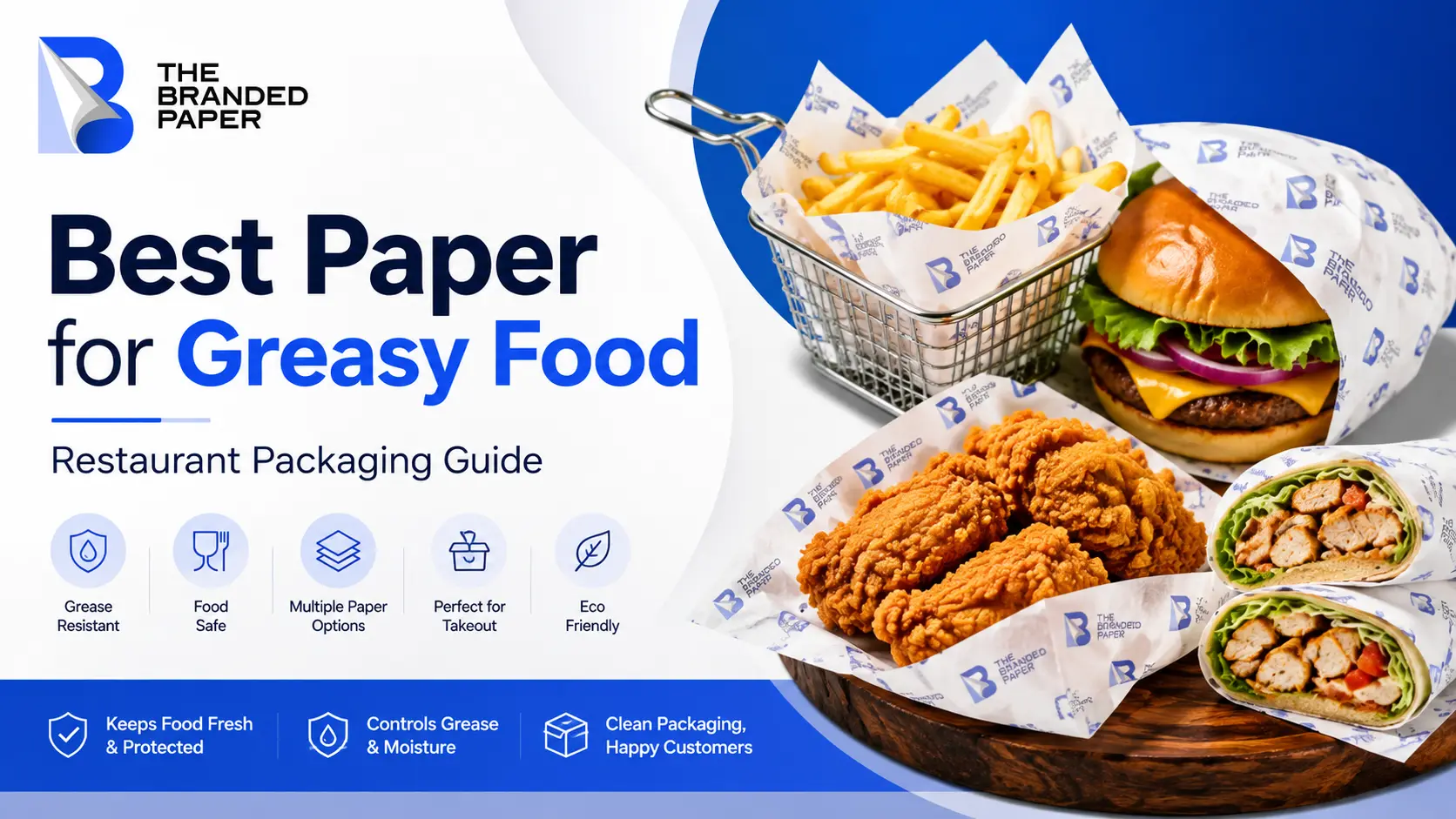
A burger wrapper, fry liner, and fried chicken sheet may all look like simple paper. Once hot oil, steam, sauces, and delivery time enter the picture, they behave very differently.
The best paper for greasy food is usually greaseproof or another food-grade paper designed with a strong oil-and-grease barrier. But no single paper works best for every menu item. A burger needs different moisture control than fried chicken. Fresh fries have different heat and steam challenges than a cold deli sandwich.
For restaurants, the better question is not simply, “Which paper absorbs grease?” It is: Which paper controls grease without tearing, leaking, trapping too much steam, or affecting the food?
Quick Answer: Which Paper Is Best for Greasy Food?
For most restaurant applications, greaseproof paper offers the best balance of grease resistance, flexibility, appearance, and everyday handling.
Different papers become better choices when heat, moisture, holding time, or cooking use changes.
| Paper Type | Best For | Grease Resistance | Heat Handling | Main Consideration |
| Greaseproof paper | Burgers, fried foods, sandwiches, basket liners | High | Varies by grade | Strong all-around restaurant option |
| Parchment paper | Hot foods, baking, oven-related applications | High | High when designed for baking | Often more than needed for basic wrapping |
| Wax paper | Sandwiches, pastries, deli foods, short holding times | Moderate to high | Limited | Not intended for high-heat cooking |
| Deli paper | Sandwiches, counters, baskets, light-grease foods | Moderate | Limited | Performance depends on coating and grade |
| Coated kraft paper | Burgers, sandwiches, takeaway presentation | Moderate to high | Varies | Confirm the grease barrier before ordering |
| Plain kraft or butcher paper | Drier foods and general wrapping | Low to moderate | Varies | Standard paper may show oil quickly |
Actual performance depends on the paper grade, coating or treatment, food temperature, grease level, and contact time.
Why Greasy Foods Are Hard on Food Wrapping Paper
Oil is only part of the problem.
Hot restaurant food can expose a wrapper to grease, water, steam, pressure, sauces, and movement at the same time. These factors become even more important when food sits for 20 or 30 minutes in a takeout bag.
A cheeseburger, for example, may release:
- Fat from the meat
- Oil from cheese or sauces
- Moisture from vegetables
- Steam from the hot patty
- Additional pressure when stacked inside a bag
Fried chicken creates another challenge. Hot cooking oil can remain on the crust while steam escapes from inside the meat.
A paper that blocks oil well but traps too much moisture may keep the package clean while making crisp food softer. A highly breathable paper may protect texture but allow grease spots to become visible.
That trade-off is why restaurants should choose paper around the actual food and service process, not appearance alone.
1. Greaseproof Paper: The Best All-Around Choice
For burgers, sandwiches, fries, wings, fried chicken, and similar foods, greaseproof paper for food wrapping is often the most practical starting point.
It is made to slow the movement of oils and fats through the sheet. That helps reduce visible grease stains, messy baskets, oily hands, and leakage into outer packaging.
Common uses include:
- Burger wraps
- Sandwich wraps
- Fry and onion ring liners
- Taco and wrap liners
- Fried chicken sheets
- Food basket liners
- Takeout box liners
- Bakery and pastry wrapping
Good grease-resistant paper for food should remain easy to fold while holding up against the expected grease level.
The important word is “expected.” A lightly buttered pastry and a freshly fried chicken sandwich do not put the same stress on paper.
When greaseproof paper makes the most sense
Choose it when you need:
- Strong oil resistance
- Fast wrapping during service
- A clean customer experience
- Custom printing or branding
- A liner that works across several menu items
- Better protection for takeaway orders
For many quick-service restaurants, cafés, food trucks, burger shops, and delis, it is the most versatile option.
2. Parchment Paper: Better When Heat Matters
Restaurants sometimes assume parchment and greaseproof paper are interchangeable. They overlap, but they solve different problems.
Parchment is commonly selected when heat resistance is a major requirement, especially for baking and cooking applications. It also offers useful grease resistance.
That makes parchment a good fit for:
- Baked products
- Hot pastries
- Roasted foods
- Kitchen preparation
- Foods that move from cooking to serving
For simple burger wrapping, parchment may provide more heat performance than the operation actually needs.
Is parchment paper greaseproof?
Parchment paper is generally resistant to grease, but that does not automatically make every parchment sheet the ideal restaurant wrapper.
A restaurant should still consider:
- Folding behavior
- Paper stiffness
- Printing requirements
- Cost per sheet
- Holding time
- How much steam the food releases
If the main problem is oil leakage rather than cooking heat, purpose-selected greaseproof wrapping paper may be the more practical choice.
3. Wax Paper: Useful, but Not for Every Hot Food
Wax paper has long been used for sandwiches, bakery items, deli service, and food presentation.
The waxed surface helps create a barrier against grease and moisture. It can work well for foods served cold, at room temperature, or under suitable warm-service conditions.
Ordinary restaurant uses include:
- Sandwich wrapping
- Pastry wrapping
- Deli counter service
- Basket liners
- Grab-and-go products
- Bakery box liners
The main limitation is heat.
Wax paper should not be treated as a replacement for baking parchment or another paper specifically designed for high-temperature cooking.
For restaurants asking greaseproof paper vs wax paper, the decision often comes down to temperature and service conditions. Greaseproof paper is usually more versatile for hot, oily restaurant foods, while wax paper can be a useful option for deli, bakery, and short-contact applications.
Greaseproof Paper vs Parchment Paper vs Wax Paper
Choosing becomes easier when the three materials are compared by use rather than by name.
| Need | Greaseproof Paper | Parchment Paper | Wax Paper |
| Wrapping burgers | Excellent | Good | Good for suitable temperatures |
| Fried food liners | Excellent | Good | Depends on temperature |
| Baking | Grade dependent | Excellent | Not a baking substitute |
| Sandwich wrapping | Excellent | Good | Excellent |
| Grease barrier | Strong | Strong | Strong in appropriate applications |
| High-heat cooking | Verify grade | Strong | Generally unsuitable |
| Custom restaurant wrapping | Excellent | Available | Excellent |
| Everyday takeaway | Excellent | Good | Application dependent |
The biggest mistake is selecting a material because another restaurant uses it. Menu composition, cooking method, portion size, and delivery time can completely change the result.
Best Paper for Fried Food
The best paper for fried food should manage oil while allowing the food to remain presentable during service.
Greaseproof sheets and greaseproof food basket liners are common choices because they help stop oil from reaching trays, baskets, boxes, and customers’ hands.
But more barrier is not always better.
Fresh fried food releases steam. If the complete package is too closed or moisture-resistant, that steam has fewer places to escape. Crisp coatings can soften faster.
For fries, chicken tenders, wings, mozzarella sticks, and similar foods, look at the whole package:
- Paper controls grease.
- The container provides structure.
- Ventilation helps manage steam.
- Holding time determines how demanding the package must be.
A paper cannot correct a takeout box that traps excessive steam.
Paper for wrapping fried chicken
Fried chicken places heavy demands on wrapping materials because it combines hot oil with internal moisture.
A suitable paper for wrapping fried chicken should:
- Resist visible oil penetration
- Stay strong when warm
- Avoid tearing easily around bones and crust
- Fit the holding time
- Work with the ventilation of the outer container
For dine-in baskets, a greaseproof liner may be enough. For delivery, paper should be tested inside the exact box, bag, or clamshell used during service.
What Is the Best Paper for Wrapping Burgers?
Greaseproof food paper is usually one of the strongest choices for burgers.
A Burger wrapper has to deal with more than beef fat. Sauces, melted cheese, pickles, tomatoes, steam, and toasted buns can all add moisture or oil.
The best paper for wrapping burgers should:
- Fold tightly without cracking
- Resist grease around the bottom of the burger
- Stay comfortable in the customer’s hands
- Avoid sticking badly to sauces or cheese
- Keep printed branding readable
- Remain strong during takeaway
Waxed or coated food papers may also work well depending on burger temperature and service conditions.
The Branded Paper offers custom food wrapping options for burgers, sandwiches, takeout, and similar restaurant uses, including grease-resistant options for branded food service applications.
Deli Paper Works Better for Lighter Grease Loads
Deli paper for greasy foods can be useful when the grease level is moderate rather than extreme.
Think about:
- Cold sandwiches
- Subs
- Cookies
- Pastries
- Cheese
- Bakery items
- Counter-service foods
For a heavily sauced double cheeseburger or freshly fried chicken, basic deli paper may not provide enough protection unless the specific grade includes a suitable grease-resistant treatment.
Product names alone can be misleading. Ask how the paper performs with fatty foods, moisture, temperature, and your expected contact time.
Oil Resistance and Moisture Resistance Are Different
Restaurant buyers sometimes treat these two properties as the same thing.
They are not.
Oil- and grease-resistant paper, sometimes described in packaging discussions as OGR paper, is designed to limit the movement of fats and oils.
Moisture-resistant food wrapping paper focuses on water, condensation, sauces, and other liquids.
A burger may need both.
A dry cookie with butter content may mainly need grease resistance. A sandwich with tomato, dressing, and hot meat may create both oil and water challenges.
Before ordering, identify what is actually causing packaging failure:
- Grease soaking through?
- Sauce leaking?
- Condensation weakening the sheet?
- Steam making food soggy?
- Paper tearing at folds?
- Ink or branding becoming hard to read?
The answer determines which barrier matters most.
Paper Thickness Does Not Tell the Whole Story
A heavier paper can feel stronger, but GSM alone does not tell you how greaseproof a sheet will be.
GSM measures paper weight per square meter. It is useful for comparing paper weight and feel, but grease resistance also depends on the material structure and any barrier treatment or coating.
A lighter grease-resistant paper may outperform a heavier untreated kraft sheet when wrapping an oily burger.
When discussing greaseproof paper GSM with a supplier, ask about performance as well as thickness.
Useful questions include:
- What foods is the paper designed to contact?
- Is it suitable for fatty foods?
- Does it have a grease-resistant coating or treatment?
- What temperatures can it handle?
- How long can oily food remain wrapped?
- Is the sheet suitable for direct food contact?
- Can samples be tested before a large order?
These questions are far more useful than simply asking for the thickest paper available.
Food-Contact Safety Should Be Part of the Decision
Paper that touches food should be suitable for its intended food-contact use.
In the United States, FDA regulations under 21 CFR Part 176 address components of paper and paperboard used in contact with food, including provisions covering contact with aqueous and fatty foods.
Restaurants should request appropriate food-contact documentation from packaging suppliers rather than assuming that any grease-resistant sheet is automatically suitable for direct food contact.
What about PFAS-free greaseproof paper?
PFAS became widely discussed because certain PFAS-containing substances were historically used to provide grease resistance in paper food packaging.
In February 2024, the FDA announced that grease-proofing substances containing PFAS were no longer being sold by manufacturers for food-contact use in the U.S. market. The FDA later stated that the relevant PFAS grease-proofing authorizations were no longer effective.
That does not mean restaurant buyers should ignore material documentation.
When sourcing PFAS-free greaseproof paper, ask the supplier what creates the grease barrier and what documentation is available for the intended food-contact application.
Sustainability claims deserve the same care. Terms such as compostable greaseproof paper, biodegradable greaseproof paper, and unbleached greaseproof paper describe different characteristics. One does not automatically guarantee the others.
How to Choose Grease Resistant Food Paper
The easiest way to choose paper is to start with the food instead of the paper catalog.
1. Measure the grease load
A cookie and a bacon cheeseburger need different barriers.
Separate menu items into light, medium, and heavy grease applications.
2. Consider serving temperature
Ask whether the food touches the paper:
- Cold
- Warm
- Hot
- Directly after frying
- During baking or reheating
Heat can change how both the food and wrapping material behave.
3. Check the real holding time
A burger eaten five minutes after service creates a different packaging challenge from one delivered across town.
Test for the longest realistic customer journey.
4. Account for steam
Fried foods, hot sandwiches, and burgers release moisture.
A strong grease barrier may still produce poor results if the entire package traps condensation.
5. Think about handling
Paper has to work for employees as well as customers.
A good restaurant wrapper should be easy to:
- Pick up quickly
- Fold
- Wrap
- Stack
- Place inside baskets or boxes
- Handle during peak service
A material that performs perfectly in a laboratory but slows down the lunch rush is not an ideal operational choice.
6. Consider branding
Custom printed wrapping turns an item the restaurant already needs into a repeated brand touchpoint.
The paper still needs to perform first.
Logo size, ink coverage, folds, grease spots, and food placement can affect how the finished wrapper looks. The logo should remain recognizable after the food is wrapped, not only when the sheet is lying flat.
Test Paper With Your Actual Menu Before Ordering
One of the most useful packaging tests requires no complicated equipment.
Take a sample sheet and use it exactly as a customer would receive it.
For a burger or fried item:
- Wrap the food immediately after normal preparation.
- Place it inside the actual takeaway container or bag.
- Check the paper after 10 minutes.
- Check it again after 20 to 30 minutes.
- Look for oil transfer, weak spots, tearing, condensation, and sticking.
- Open the package and inspect the food texture.
- Repeat the test with a second paper option.
For delivery-heavy restaurants, run the same test during an actual car trip.
This simple process often reveals problems that cannot be seen from a specification sheet.
Common Mistakes When Choosing Food Wrapping Paper
Choosing by GSM alone
Heavier does not automatically mean more grease-resistant.
Assuming Kraft paper is naturally greaseproof
Natural kraft appearance may look strong, but untreated paper can still absorb oil quickly.
Using the same paper for every menu item
A Deli sandwich and fried chicken do not create the same packaging conditions.
Focusing only on leakage
Preventing grease stains is important, but food texture matters too. A poorly designed package can keep the outside clean while trapping enough steam to soften fried food.
Ignoring delivery time
Takeout performance should be tested over realistic holding periods, not just at the service counter.
Treating all greaseproof papers as identical
Coatings, treatments, paper weights, temperature limits, and intended food uses can vary. Always review specifications for the exact product being purchased.
Which Paper Should Your Restaurant Choose?
A simple decision process works well.
Choose greaseproof paper when:
- Burgers, fried foods, sandwiches, or oily foods are the main application.
- Strong everyday grease control is the priority.
- The paper will also be used for baskets, trays, or takeaway.
Choose parchment when:
- High heat or baking is part of the process.
- The sheet needs to work during food preparation as well as serving.
Choose wax paper when:
- The application is suitable for its temperature limits.
- Sandwiches, deli foods, bakery products, or short-service wrapping are the main uses.
Choose Deli paper when:
- Grease levels are lighter.
- Fast counter service and presentation matter.
Choose coated or grease-resistant kraft when:
- A natural kraft appearance is important.
- The specified grade provides the oil barrier your food requires.
For restaurants with several greasy menu items, a quality greaseproof, or oil-resistant food wrapping paper is usually the best place to begin testing.
Better Paper Protects More Than the Table
The right wrapping paper makes service cleaner, but the benefit goes further.
It can reduce messy handling, keep outer packaging presentable, support a better takeaway experience, and give branded packaging a cleaner surface to do its job.
The smartest choice comes from matching grease level, temperature, moisture, holding time, food-contact requirements, and branding needs.
Restaurants considering custom printed food wrapping can compare paper options with The Branded Paper based on the foods they actually serve. Its U.S. packaging range includes custom wax paper, parchment, kraft, and other food wrapping options for restaurant and takeaway applications.
Before committing to a larger custom order, Request a suitable paper option or sample and test it with your greasiest menu item under real service conditions.
Frequently Asked Questions
1. What is the best paper for greasy food?
Greaseproof paper is usually the best all-around option for greasy restaurant foods such as burgers, fries, sandwiches, and fried items. The ideal grade still depends on temperature, grease level, moisture, and holding time.
2. What paper do restaurants use for burgers?
Restaurants commonly use greaseproof wrapping paper, waxed food paper, coated food paper, or other food-contact papers designed for oily foods. The best choice depends on how hot and greasy the burger is and whether it is served immediately or delivered.
3. Is parchment paper greaseproof?
Parchment provides good resistance to grease and is especially useful when heat resistance matters. For basic restaurant wrapping, however, dedicated greaseproof paper may provide a more practical balance of wrapping performance and cost.
4. What is greaseproof paper used for?
Greaseproof paper is commonly used for burgers, sandwiches, fries, fried chicken, pastries, basket liners, tray liners, and takeaway foods where oil could otherwise soak through ordinary paper.
5. What is the best paper for fried chicken?
A food-grade grease-resistant paper that can handle warm, oily food is a strong choice for fried chicken. The complete package should also allow enough moisture management to help protect the crust during holding and delivery.
6. Is wax paper better than greaseproof paper?
Neither is universally better. Wax paper can work well for sandwiches, bakery items, deli foods, and suitable short-contact applications. Greaseproof paper is often more versatile when hot and oily foods are the main concern.
7. What GSM should greaseproof paper be?
There is no single best GSM for every food. GSM describes the paper’s weight, not its grease resistance by itself. Choose the paper based on oil barrier, strength, folding performance, food temperature, contact time, and intended application.
8. What is the best food wrapping paper for takeout?
For greasy takeaway foods, greaseproof paper or another suitable oil-resistant food-wrapping paper is often the best starting point. The paper should then be tested in the actual takeaway box or bag to ensure grease, steam, and condensation are properly controlled.