Food wrappers have a simple job: hold food, control grease, and keep service clean. The chemistry behind that paper, however, has become a bigger concern for restaurants, food brands, and packaging buyers.
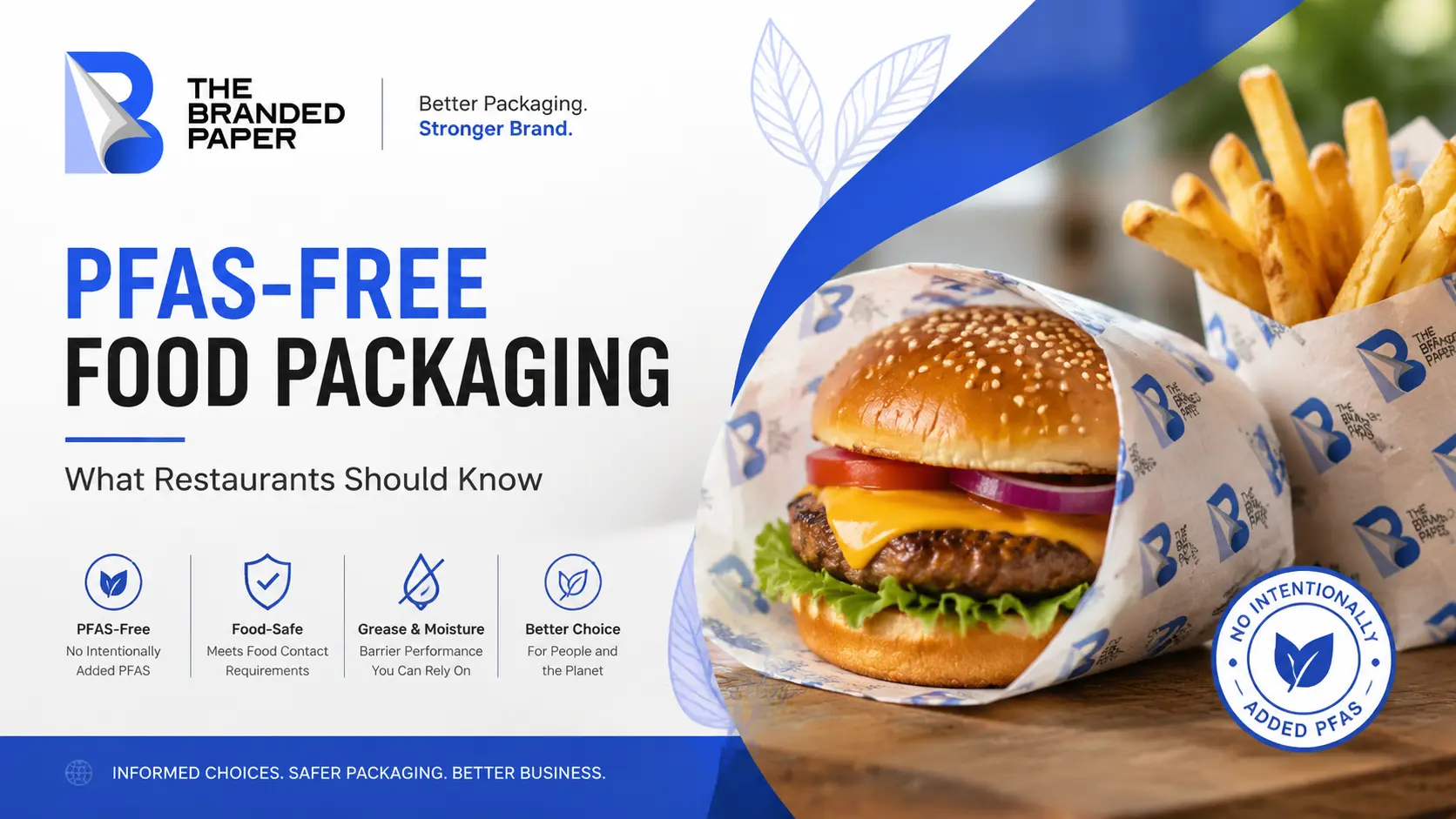
PFAS-free food packaging refers to food-contact packaging made without PFAS chemicals being intentionally added to provide properties such as oil, grease, or moisture resistance. PFAS were historically used in some paper and paperboard packaging because they created strong grease barriers. U.S. regulatory action and changes in manufacturing have now pushed food packaging toward PFAS-free alternatives.
For restaurants, the practical question is no longer just whether a wrapper looks grease-resistant. It is whether the material performs properly for the food, meets applicable food-contact requirements, and comes with clear information about its coatings and chemical treatments.
What Is PFAS-Free Food Packaging?
PFAS-free food packaging is packaging produced without intentionally using per- and polyfluoroalkyl substances to achieve functional properties such as grease, oil, water, or stain resistance. These materials can include food wrapping paper, burger wraps, sandwich paper, bags, liners, trays, and other food-contact paper products.
PFAS are a large family of synthetic chemicals. They are sometimes called chemicals forever because many are highly persistent and break down very slowly in the environment. The U.S. Environmental Protection Agency notes that PFAS have been widely used and can persist in water, soil, air, food, people, and animals.
In food packaging, their historical appeal was practical. Greasy foods can quickly soak through untreated paper. Certain PFAS treatments gave food contact paper and paperboard resistance to oil and moisture without making the material excessively thick.
That performance advantage came with growing concerns about persistence, exposure, and migration from food-contact materials.
Why Were PFAS Used in Food Packaging?
PFAS were mainly used in some paper-based food packaging because they provided effective resistance against grease, oil, and moisture. This made them useful for applications such as fast-food wrappers, takeout containers, microwave popcorn bags, and other packaging exposed to fatty foods.
Food-service packaging often faces difficult conditions.
A burger can release hot grease. Fried food creates both oil and steam. Sandwich sauces add moisture. A bakery item may contain butter or shortening that stays in direct contact with the paper for hours.
Packaging therefore needs a barrier between the food and the outer surface.
Historically, PFAS-based treatments could help provide:
- Oil resistance
- Grease resistance
- Moisture resistance
- Reduced soak-through
- Better structural performance around fatty foods
The FDA identified grease-proofing applications on paper and paperboard as the food-contact PFAS uses most relevant to potential dietary exposure.
Modern grease-resistant food packaging can achieve similar functional goals using other material systems, depending on the food, paper construction, coating, and intended contact conditions.
Are PFAS Still Used in U.S. Food Packaging?
The FDA says grease-proofing substances containing PFAS are no longer being sold by manufacturers for food-contact use in the U.S. market. This followed a voluntary industry phase-out. In January 2025, the FDA also determined that 35 related Food Contact Notifications were no longer effective because those uses had been abandoned.
That distinction matters when people search for a PFAS food packaging ban.
At the federal level, the current situation is better described as a completed market phase-out of these authorized grease-proofing uses combined with FDA action ending the effectiveness of the related notifications. It should not be simplified into a claim that every possible PFAS occurrence in every type of packaging is covered by one nationwide blanket ban.
Restaurants also need to consider state requirements.
For example, New York prohibits intentionally added PFAS in covered food packaging. Washington restricts intentionally added PFAS in specified paper and plant-fiber food packaging categories, including wraps, plates, food boats, pizza boxes, bags, sleeves, bowls, and certain containers.
For businesses operating across several states, supplier verification is therefore a practical purchasing step rather than an optional detail.
Does “PFAS-Free” Always Mean Zero PFAS?
Not necessarily. A PFAS-free claim should be understood in the context of how the supplier defines and verifies it. “No intentionally added PFAS” means PFAS were not deliberately included to perform a function, but it does not automatically prove that laboratory testing would detect absolutely zero PFAS.
New York’s Department of Environmental Conservation makes this distinction clearly. Its food-packaging guidance explains that PFAS can sometimes enter packaging unintentionally through manufacturing processes, processing aids, or recycled materials even when PFAS were not intentionally added.
This is why restaurants should avoid relying only on a marketing phrase.
Ask what the supplier means by:
- PFAS-free
- No intentionally added PFAS
- Fluorine-free
- Tested for PFAS
- Compliant with applicable food-packaging requirements
These statements can describe different levels of verification.
How Can Restaurants Tell if Food Packaging Has PFAS?
You generally cannot tell whether food packaging contains PFAS by looking at it, touching it, or testing how quickly grease soaks through. Restaurants should verify chemical information through their packaging supplier, manufacturer documentation, declarations, certificates, or appropriate testing where needed.
Grease resistance alone is not proof of PFAS treatment. Modern papers may use alternative barrier technologies.
New York regulators specifically advise businesses that are unsure about intentionally added PFAS to consult the manufacturer or packaging supplier.
A useful supplier checklist includes:
- Are PFAS intentionally added to this material?
- What creates the grease or moisture barrier?
- Is the paper intended for direct food contact?
- Is documentation available for the PFAS claim?
- Does the product meet requirements for the states where it will be used?
- Has PFAS testing been performed, and what exactly was tested?
- Does the claim apply to the paper, coating, ink, and finished packaging?
Documentation becomes especially useful for restaurant groups with multiple locations because purchasing teams can keep one consistent record rather than relying on verbal claims from different distributors.
What Are the Main PFAS Alternatives for Food Packaging?
PFAS alternatives for food packaging use different materials or barrier systems to control oil, grease, and moisture without intentionally relying on PFAS chemistry. The right alternative depends on the food itself, contact time, temperature, grease level, and whether the paper must also support printing or branding.
There is no single coating that is automatically ideal for every food application.
Possible solutions can include engineered paper structures, non-PFAS coatings, wax-based barriers, and certain water-based barrier coating systems. Performance must still match the intended use.
| Packaging Approach | Main Purpose | Typical Consideration |
| Uncoated food paper | Light food contact and handling | Limited resistance to heavy grease |
| Wax-treated paper | Moisture and grease management | Suitability depends on wax and food application |
| PFAS-free greaseproof paper | Oil and grease resistance | Verify barrier system and food-contact suitability |
| Water-based barrier coated paper | Grease or moisture control | Performance varies by coating formulation |
| Heavier paper or paperboard | Strength and structure | Barrier may still be required for oily foods |
Restaurants should choose based on actual service conditions instead of assuming that the strongest possible barrier is always necessary.
A sandwich served immediately has different packaging demands from fried chicken sitting inside a delivery bag for 30 minutes.
What Is PFAS-Free Greaseproof Paper?
PFAS-free greaseproof paper is paper designed to resist oil and grease without intentionally added PFAS treatments. Its performance may come from the paper structure itself, an alternative barrier coating, or another formulation chosen for food-contact use.
For restaurants, performance matters as much as the chemical claim.
Good oil and grease resistant paper should help:
- Reduce visible grease stains
- Limit oil transfer to hands or serving trays
- Keep wrappers more presentable
- Support clean takeaway service
- Protect printed branding from excessive grease exposure
The level of resistance needed depends on the menu.
For example, lightly toasted sandwiches may need less barrier performance than burgers, fried chicken, loaded fries, or other oily foods.
Restaurants evaluating wrappers for high-grease menus can also compare materials in this resource on the Best paper for greasy food.
Does Wax Paper Contain PFAS?
Wax paper does not automatically contain PFAS simply because it is grease-resistant. Whether a particular wax paper contains intentionally added PFAS depends on its specific formulation, coatings, manufacturing process, and supplier specifications.
Wax creates its own barrier properties, which is why food businesses have long used wax-coated papers for certain wrapping and food-service applications.
Still, buyers should not make a chemical-composition assumption based only on a product name.
If PFAS status matters to your purchasing requirements, request documentation for the exact stock and coating being supplied.
Restaurants comparing common food papers can also review the differences between Wax paper and parchment paper before selecting a material.
Does Parchment Paper Contain PFAS?
Parchment paper cannot be classified as PFAS-containing or PFAS-free based on the word “parchment” alone. Different manufacturers can use different treatments, release systems, coatings, and manufacturing specifications.
Food businesses should evaluate the exact product rather than the general paper category.
Ask whether the parchment:
- Contains intentionally added PFAS
- Is suitable for direct food contact
- Is designed for the intended temperature
- Has a grease or release treatment
- Has supporting supplier documentation
This is particularly important when parchment is used for baking or high-temperature applications, where material performance requirements differ from a room-temperature sandwich wrapper.
Does Butcher Paper Contain PFAS?
Butcher paper does not inherently require PFAS. Its composition and treatment depend on the manufacturer and intended application. Some butcher papers are relatively simple paper products, while others may be treated or engineered for moisture or grease performance.
That means color or thickness cannot confirm PFAS status.
Pink, white, or brown butcher paper may each have different specifications.
Restaurants, barbecue businesses, and meat retailers should confirm the finished material rather than assuming all butcher paper is chemically identical.
The same principle applies when comparing Kraft paper and butcher paper: material choice should follow food type, moisture, grease, strength, and service conditions.
PFAS-Free Burger Wrappers and Sandwich Paper: What Should Restaurants Look For?
PFAS-free burger wrappers and sandwich papers should combine the required grease resistance with safe food-contact use, practical folding, reliable printing, and enough strength for the intended serving or delivery period. PFAS status matters, but it is only one part of choosing a wrapper that works in real restaurant operations.
For burgers, consider hot grease and sauce.
For sandwiches, moisture from fillings may be the bigger problem.
For both, evaluate:
- Grease resistance
- Moisture resistance
- Food-contact suitability
- Wrap and fold behavior
- Tear resistance
- Print compatibility
- Heat exposure
- Holding time
- Delivery conditions
- Supplier documentation
A wrapper that performs well for a cold deli sandwich may fail around a double cheeseburger.
Likewise, an unnecessarily heavy barrier can add cost without improving the customer’s experience.
Restaurants developing branded wraps can use a Custom burger wrapping paper guide to match material choices with presentation and service requirements.
Why PFAS-Free Food Wrappers Matter Beyond Compliance
Moving toward PFAS-free food wrappers helps restaurants reduce reliance on a chemical class associated with persistent environmental contamination while keeping attention on the practical requirements of food service. It can also simplify purchasing as federal market changes and state restrictions continue to shape packaging specifications.
PFAS persistence is one reason the chemicals are commonly called forever chemicals in food packaging discussions. EPA explains that many PFAS break down very slowly and can remain in the environment for long periods.
For a restaurant, however, sustainability claims should never replace performance checks.
A wrapper still has to work during:
- Preparation
- Counter service
- Takeout
- Delivery
- Storage
- Customer handling
The best packaging decision balances chemical requirements, food protection, operational performance, printing needs, waste considerations, and cost.
What Should Restaurants Ask Before Buying PFAS-Free Paper Packaging?
Restaurants should ask suppliers for specific material and chemical information instead of selecting packaging from a PFAS-free label alone. A short purchasing checklist can prevent problems with grease performance, food-contact suitability, state requirements, and inconsistent product specifications later.
Before approving a food paper, confirm:
1. What Does the PFAS Claim Mean?
Determine whether it means no intentionally added PFAS, fluorine-free, tested below a stated detection level, or something else.
2. Is It Designed for Direct Food Contact?
Food packaging should be appropriate for its intended contact conditions. The FDA regulates substances that come into contact with food, including packaging components that may migrate or reasonably be expected to migrate into food.
3. What Provides the Grease Barrier?
Ask whether resistance comes from the paper construction, wax, a PFAS-free barrier coating, a water-based system, or another technology.
4. Will It Handle the Menu?
Test actual food.
A restaurant serving fried food has different needs from a bakery, deli, coffee shop, or sandwich counter.
5. Can the Supplier Provide Documentation?
Keep specification sheets, declarations, certificates, and other supporting records with purchasing files.
6. Is Custom Printing Compatible With the Material?
Barrier treatment, paper surface, ink system, coverage, and design can affect finished print quality.
The Branded Paper supplies custom branded food packaging for U.S. food businesses, so restaurants comparing materials can evaluate both functional requirements and branded presentation before choosing a wrapping paper format.
PFAS-Free Paper Packaging Is a Material Decision, Not Just a Label
Safe food packaging materials should be chosen by combining food-contact suitability, chemical information, barrier performance, and real operating conditions. PFAS-free packaging addresses one important part of that decision, but restaurants still need the paper to protect food, control grease, print properly, and perform consistently through service and delivery.
The U.S. packaging market has already changed significantly. FDA states that PFAS-containing grease-proofing agents for paper and paperboard food-contact applications are no longer being sold into the U.S. market, and the related 35 Food Contact Notifications are no longer effective.
State requirements can go further, particularly around intentionally added PFAS.
For restaurant buyers, the practical approach is straightforward: know what the packaging is made from, understand what provides its barrier performance, request supplier documentation, and test it with the food you actually serve.
Choosing PFAS-free paper does not mean accepting poor grease resistance. It means selecting the right modern material for the job.
Frequently Asked Questions
1. What does PFAS-free mean on food packaging?
PFAS-free generally indicates that PFAS chemicals are not used in the packaging according to the supplier’s stated standard. Buyers should check whether the claim specifically means no intentionally added PFAS, because that is not necessarily the same as proving zero detectable PFAS under every testing method.
2. Why were PFAS added to food wrappers?
PFAS were used in certain food-contact papers because they provided strong resistance to grease, oil, and moisture. This made them useful for products such as fast-food wrappers and other packaging used with fatty foods.
3. Is there a federal PFAS food packaging ban in the United States?
The federal situation is more specific than a simple blanket-ban description. FDA says PFAS-containing grease-proofing substances are no longer sold for food-contact use in the U.S., and in January 2025 it determined that 35 related Food Contact Notifications were no longer effective because those uses had been abandoned.
Individual states may also impose their own restrictions.
4. How can I tell if a food wrapper contains PFAS?
You usually cannot determine PFAS content from appearance or grease resistance alone. Ask the manufacturer or supplier whether PFAS are intentionally added and request supporting material specifications, declarations, certificates, or relevant testing information.
5. Are PFAS-free wrappers still grease-resistant?
Yes, food paper can be designed for grease resistance without intentionally added PFAS. Performance depends on the paper construction and alternative barrier technology, so restaurants should test the packaging with their actual menu items.
6. Are PFAS-free food wrappers suitable for burgers?
They can be. Burger wrappers should be selected according to grease level, heat, sauces, holding time, delivery conditions, paper strength, and barrier performance rather than PFAS status alone.
7. Is fluorine-free packaging the same as PFAS-free packaging?
The terms can be related, but they should not automatically be treated as interchangeable. Suppliers may use different definitions and testing standards. Ask for the exact meaning behind the claim and what documentation supports it.
8. What is intentionally added PFAS?
Intentionally added PFAS refers to PFAS deliberately added to a product or component to perform a particular function, such as providing oil, grease, water, or stain resistance. New York’s food-packaging rules use this functional distinction and also explain that unintended PFAS presence can occur through other sources.